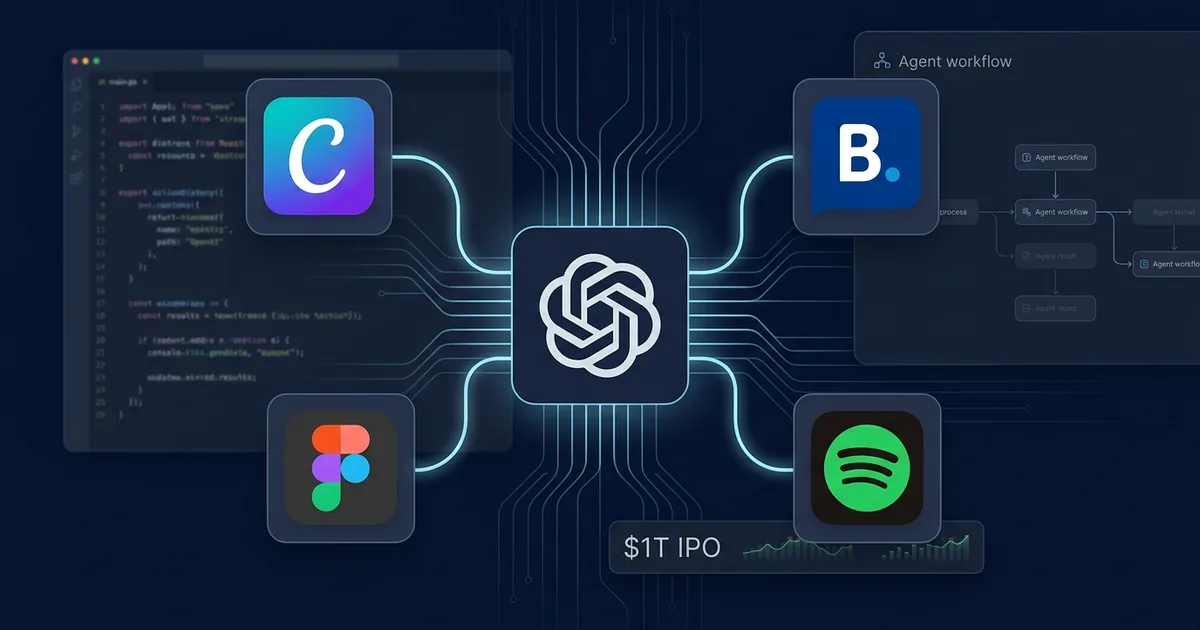
OpenAI is rebuilding ChatGPT from a chatbot into a platform. A June 2026 redesign codenamed “Aria” folds AI agents, a coding tool called Codex, image generation, and third-party app integrations into a single unified interface, with launch partners including Canva and Booking.com. The timing is not accidental: the company is preparing for a Q4 public listing at a valuation that could top $1 trillion.
From Chatbot to Super App
The scope of the overhaul is significant. ChatGPT will no longer be a conversation-first product. The new interface integrates autonomous agents that can complete multi-step tasks (booking travel, organizing schedules, summarizing complex datasets), a dedicated coding environment, image generation, and a growing catalog of third-party services. OpenAI’s internal framing, according to a detailed breakdown from Gagadget, positions this as “chat is dead,” a deliberate shift from the conversation paradigm that made ChatGPT a household name in 2023.
The third-party app layer is where the platform economics get interesting. Confirmed launch partners include Canva, Booking.com, Expedia, Figma, Spotify, Coursera, and Zillow. Each integration lets ChatGPT’s 900-million-plus weekly active users interact with these services without leaving the app. For OpenAI, every integration deepens user lock-in. For partners, the calculus is simpler: go where the users are.
The IPO Math Behind the Redesign
The superapp pivot is inseparable from OpenAI’s listing timeline. The company is targeting a Q4 2026 IPO with Goldman Sachs and Morgan Stanley advising, at a valuation goal of up to $1 trillion. Its last funding round in March 2026 closed at $122 billion in committed capital and an $852 billion post-money valuation. Monthly revenue has crossed $2 billion.
The problem is the gap between revenue and profitability. OpenAI projects $14 billion in losses for 2026 and does not expect to turn profitable until around 2030. At a $1 trillion listing, investors would be paying roughly 40x annual revenue for a company that burns cash faster than almost any enterprise in history. The superapp strategy is the answer to the obvious question public-market investors will ask: where does the revenue growth come from after the initial chatbot novelty wears off?
Platform revenue is the bet. If ChatGPT becomes the interface through which hundreds of millions of users access third-party services, OpenAI can extract transaction fees, subscription upsells, and enterprise licensing on top of its existing $200/month Pro tier. The WeChat comparison has been circulating in Silicon Valley for months, and OpenAI appears to be embracing it.
What It Means for the AI Platform War
The competitive implications are immediate. Microsoft, which has invested $13 billion in OpenAI, now faces the awkward reality that ChatGPT’s superapp ambitions overlap directly with Copilot’s enterprise positioning. BTN previously covered how OpenAI’s “Dreaming” v3 architecture enables persistent memory and synthesis across sessions, a technical foundation the superapp needs but that also makes ChatGPT a more direct competitor to Microsoft’s own products.
Google faces a different challenge. The Gemini-powered Siri deal announced today at WWDC gives Google massive distribution through Apple, but the ChatGPT superapp creates an alternative AI platform that bypasses both Apple and Google’s app-store ecosystems entirely. If users start booking flights and editing designs inside ChatGPT, the traditional app store takes a revenue hit.
For Anthropic, which filed its S-1 in early June at a near-trillion-dollar valuation, the pressure is different. Claude’s positioning as the “responsible AI” alternative works for enterprise buyers, but it lacks the consumer-facing platform play that OpenAI is building. The superapp race rewards breadth, not just model quality.
Regional Gaps and the EU Question
One notable limitation: the new app integrations are currently unavailable in the UK, the European Economic Area, and Switzerland. The OpenAI Apps SDK lists these regions as “coming soon” with no committed rollout date. Whether this reflects GDPR compliance work, EU AI Act preparation, or commercial negotiation with European regulators is unclear, but it means the superapp launches with a geographic hole that covers 450 million potential users.
The CryptoBriefing analysis noted that this regional gap could give European competitors and regulators time to shape the terms of OpenAI’s expansion, a dynamic that played out with Google’s ad-tech business and could repeat with AI platforms.
The Stakes for Public Markets
OpenAI’s superapp gamble is a bet that the next phase of AI monetization is not better models but better distribution. The $1 trillion IPO target assumes ChatGPT can transition from a tool people use to a platform people live inside. If the Canva and Booking.com integrations gain traction and the agent layer delivers on autonomous task completion, the revenue path becomes clearer. If users treat ChatGPT as a utility rather than a platform, the valuation math collapses under the weight of $14 billion in annual losses.
The answer will arrive before the IPO roadshow does.