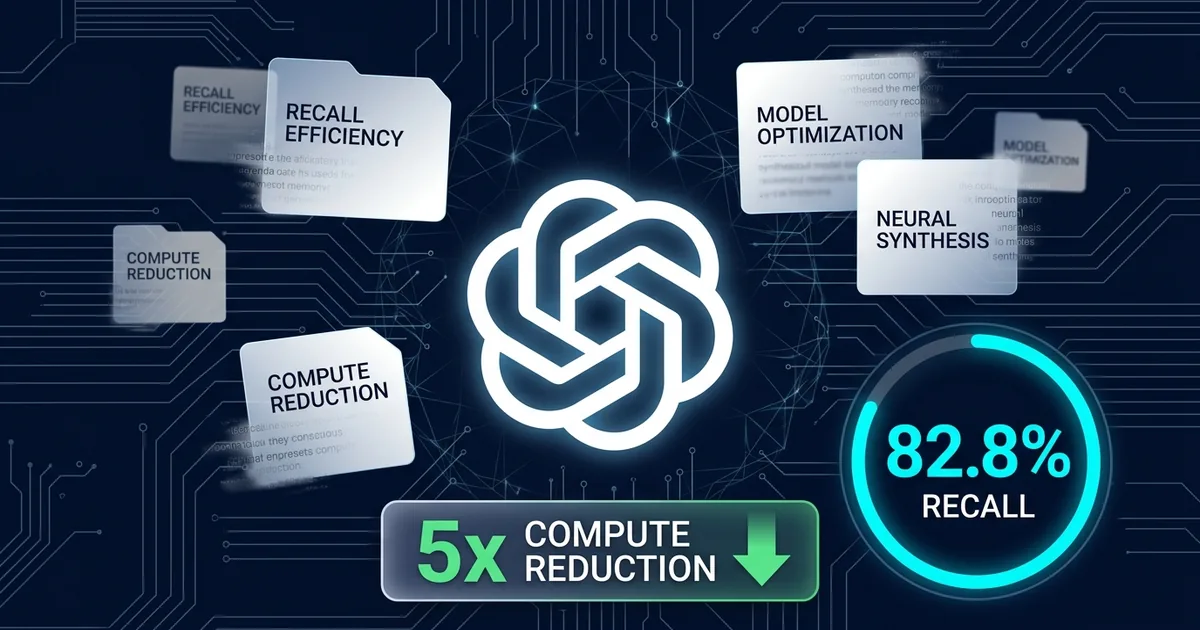
OpenAI rolled out the most significant upgrade to ChatGPT’s memory system since the feature launched, and the business implications extend well beyond the product itself. The new architecture, called Dreaming V3, automatically synthesizes information across conversations without users explicitly asking the system to remember anything. It began reaching Plus and Pro subscribers in the United States on June 4, and OpenAI says it will expand to free-tier users for the first time.
How Dreaming V3 Works
The previous memory system was largely manual. Users told ChatGPT to remember facts, and the system stored them as discrete entries. Dreaming V3 replaces that model with a background process that continuously reviews conversation history and builds a synthesized understanding of each user. The system updates its own memory over time, revising entries as circumstances change. OpenAI gave the example of automatically converting “you are going to Singapore in July” to “you went to Singapore in July 2026” after the trip has ended.
Three user-facing changes accompany the architectural shift: a readable memory summary page showing what ChatGPT has synthesized, controls to add, update, or delete remembered details, and settings for which topics the system should proactively surface and when.
The performance improvement is concrete. OpenAI reported that factual recall accuracy jumped from 41.5% in 2024 to 82.8% with Dreaming V3, a near-doubling that makes the system meaningfully more useful for returning users who rely on continuity across sessions.
The Compute Economics Matter More Than the Feature
The headline number for the business side is the 5x reduction in compute required to serve memory features. That is not a marginal optimization. It is the kind of efficiency gain that changes the economics of who gets access to a feature.
Under the old architecture, persistent memory was expensive enough that OpenAI restricted it to paying subscribers. The compute savings from Dreaming V3 make free-tier memory viable for the first time, which means OpenAI can extend a sticky retention feature to its largest user cohort without proportionally increasing infrastructure costs. In a market where Microsoft is building its own models specifically to reduce dependence on OpenAI, anything that deepens user lock-in is strategic.
The Privacy Trade-Off
There is a catch that enterprise buyers and privacy-conscious users will notice. TechTimes noted that the new system “limits the audit trail” compared to the old approach. Previously, each remembered fact was a discrete, visible entry that users could inspect and delete. With Dreaming V3, the synthesis process blends information across conversations into broader characterizations. Users can see and edit the result, but the intermediate steps, which conversations contributed to which synthesis, are less transparent.
For consumer use cases, this is a reasonable trade-off. For enterprise deployments, especially in regulated industries where data provenance matters, the opacity could be a compliance issue. OpenAI has not yet detailed how Dreaming V3 will interact with its enterprise data retention policies or whether organizations can disable the synthesis process while keeping manual memory.
Where This Fits in the AI Race
Memory is becoming the new moat. Google’s Gemini has its own persistent context features, Anthropic’s Claude maintains conversation history through its Projects feature, and Microsoft’s Copilot integrates with Microsoft Graph to surface organizational context. But none of these systems currently offers the kind of autonomous synthesis that Dreaming V3 promises, where the AI actively builds and maintains an evolving model of each user without being asked.
The strategic value is straightforward: the more an AI system knows about you, the harder it is to switch. OpenAI is betting that personalization, not model capability alone, will be the durable competitive advantage. With Anthropic heading toward its IPO and Microsoft’s MAI models offering cheaper alternatives, that bet is about to be tested at scale.
What to Watch
The free-tier rollout timeline is the number to watch. OpenAI has confirmed the plan but has not given a date. If Dreaming V3 reaches free users before the end of Q3, it will represent the most aggressive feature expansion OpenAI has undertaken since making GPT-4 available to non-paying users. The compute savings make it economically feasible. The question is whether OpenAI moves fast enough to capitalize before competitors close the gap.