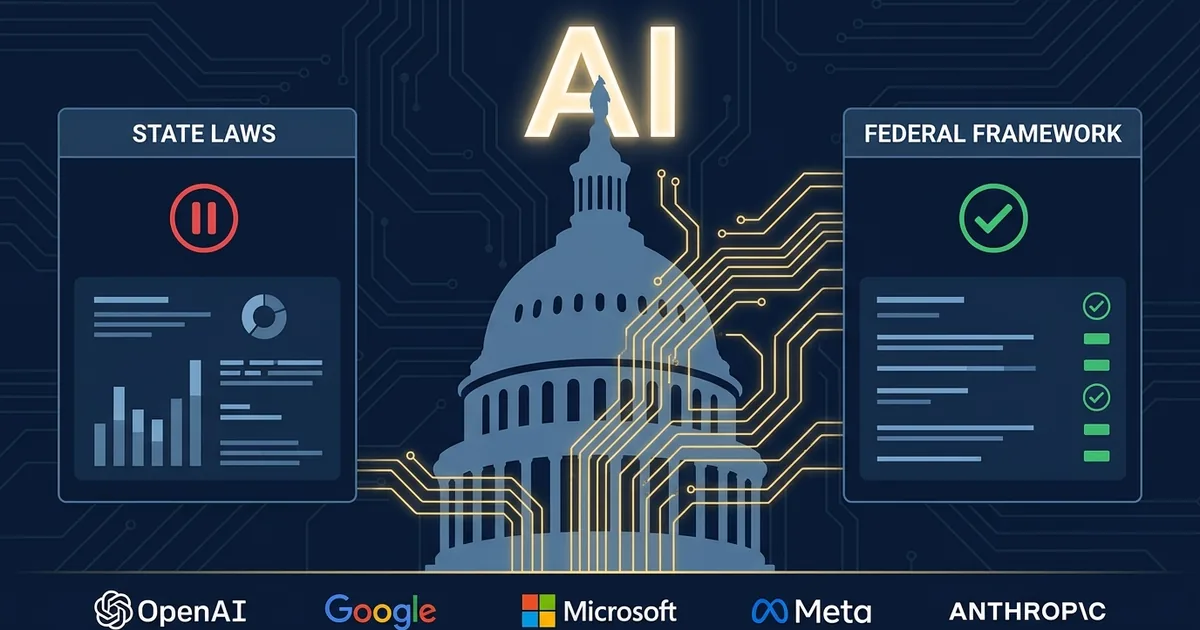
A bipartisan pair of House lawmakers dropped a 269-page discussion draft this week that would, for the first time, establish a comprehensive federal framework for governing artificial intelligence in the United States. Representatives Jay Obernolte of California and Lori Trahan of Massachusetts are calling it the Great American Artificial Intelligence Act, and the most consequential provision is a three-year preemption of state laws that regulate the development of frontier AI models.
What the Bill Actually Does
The draft targets companies with more than $500 million in annual gross revenue that develop frontier AI models. Those companies would be required to publish “frontier AI frameworks” detailing how they manage risk, and they would face mandatory reporting requirements for critical safety incidents. The bill would authorize $100 million per fiscal year for a new Center for AI Standards and Innovation and would direct the Census Bureau and Bureau of Labor Statistics to begin incorporating AI adoption metrics into federal surveys.
On the criminal side, the bill creates new penalties for using AI to impersonate government officials. On the oversight side, it would require transparency in how the federal government itself deploys AI systems, with agencies directed to disclose their use cases and risk assessments.
Axios reported that the bill also establishes a framework for AI model evaluation, with third-party testing requirements for the most capable systems before deployment.
The State Preemption Fight
This is where the real battle begins. The three-year preemption provision would effectively freeze state-level AI development regulation. California, Colorado, and Illinois have all passed or advanced AI governance laws in the past two years. California’s SB 1047, which Governor Newsom vetoed in 2024 but which returned in modified form, specifically targeted frontier model safety requirements, an area the federal bill now claims for itself.
The industry reaction has been predictably supportive. The Information Technology Industry Council, whose members include Google, Microsoft, Meta, and Amazon, praised the bill’s “innovation-first approach” and its effort to create a unified national standard. That is the polite way of saying the largest AI companies would rather negotiate with one regulator in Washington than 50 state legislatures.
Public Citizen took the opposite view, arguing that the bill “strips states’ authority to protect consumers, workers, and children” during a critical period when federal oversight capacity is still being built.
Why This Matters for Business
The $500 million revenue threshold is carefully calibrated. It captures OpenAI (approximately $47 billion annualized run rate), Anthropic (roughly $47 billion), Google DeepMind, and Meta’s FAIR lab, while exempting the thousands of smaller companies building applications on top of those models. That distinction matters because the bill regulates development, not deployment. Companies using AI for hiring, lending, medical diagnostics, or content moderation would still face whatever state-level rules exist for those specific use cases.
For investors, the preemption clause is the headline. A single federal framework reduces compliance costs and regulatory uncertainty for the companies that can afford to comply. It also raises the barrier for state attorneys general who have been using existing consumer protection statutes to police AI harms. If the preemption holds, enforcement shifts to federal agencies that have historically been slower, less aggressive, and more susceptible to industry lobbying.
The bill joins a crowded field. The Senate has been circulating its own AI proposals, and the White House has issued executive orders. But as FedScoop noted, this is the first House effort to consolidate everything into a single comprehensive statute. Its bipartisan sponsorship, with additional support from Representatives Scott Franklin, Suhas Subramanyam, Erin Houchin, and Scott Peters, gives it a stronger starting position than most tech regulation efforts manage.
The Clock Is Ticking
The discussion draft is exactly that: a draft. Obernolte and Trahan are soliciting feedback from stakeholders, experts, and the public before formal introduction. But the three-year preemption sunset creates its own urgency. If the bill passes in 2026 or 2027, the preemption window closes around 2029 or 2030, by which point the frontier AI landscape will look nothing like it does today.
The deeper question is whether federal regulation can keep pace with an industry where the competitive landscape shifts every quarter. The bill’s answer is to bet on frameworks and reporting rather than prescriptive rules, giving companies room to innovate while requiring them to document what they are doing. Whether that amounts to meaningful governance or an expensive paperwork exercise will depend entirely on how aggressively the new Center for AI Standards chooses to use its authority.