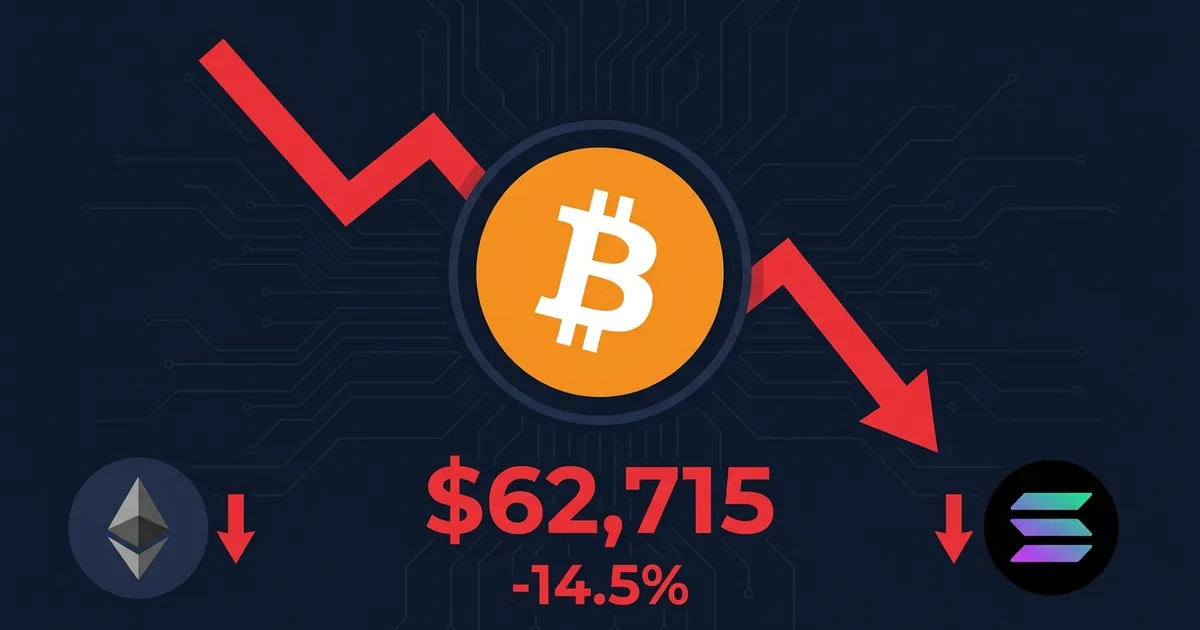
Bitcoin crashed to $62,715 on Thursday, down 14.5% on the week, as the AI-fueled risk rally that powered crypto and equities through the first half of 2026 finally hit a wall. Roughly $3 billion in margin positions were liquidated in just two days, with $1.7 billion wiped in the last 24 hours alone, according to CoinDesk’s market data.
The AI Trade Breaks Down
The proximate trigger was Broadcom’s disappointing AI chip forecast, which paused a months-long advance in semiconductor stocks and sent shockwaves through every asset class that had ridden the AI narrative higher. Crypto, which spent much of 2026 trading as a high-beta proxy for tech optimism, took the hardest hit.
Bitcoin had been holding above $73,000 as recently as late May, buoyed by institutional inflows and the persistent belief that AI-driven productivity gains would keep risk appetite elevated indefinitely. That thesis cracked when Broadcom signaled that hyperscaler capital expenditure was decelerating faster than Wall Street expected. The semiconductor index dropped sharply, and crypto followed within hours.
The correlation between AI semiconductor stocks and Bitcoin has been one of the defining features of this market cycle. When Nvidia rallied, Bitcoin rallied. When chip demand forecasts tightened, the entire risk stack unwound in sequence. Thursday’s move was the most violent expression of that linkage yet.
Altcoins Bleed Harder
Ethereum dropped 4.8% to $1,696, extending its weekly decline to 15%. Solana fell 5.4% to $66.51, down 18.5% on the week. Both tokens have given back virtually all of their Q2 gains in a single week of selling.
The liquidation cascade was brutal. Margin-funded long positions built up during the AI rally were force-closed as prices broke through key support levels, triggering a chain reaction across major exchanges. Funding rates on perpetual futures flipped deeply negative for the first time since early 2025, suggesting that traders are now paying to hold short positions.
MicroStrategy Sells Bitcoin for the First Time
Perhaps the most symbolic moment of the selloff came from MicroStrategy, which executed its first-ever coin sale. The company, which had built its entire corporate identity around accumulating Bitcoin, crossed a line that Michael Saylor had repeatedly insisted was unthinkable. MicroStrategy had been selling shares to buy Bitcoin for years. Selling the Bitcoin itself is a fundamentally different signal.
The sale happened at approximately $68,000 earlier this week, before the worst of Thursday’s decline. Whether this was prudent treasury management or a sign that even the most committed institutional holders are losing conviction, the market read it as the latter. MicroStrategy’s stock dropped in tandem with BTC on the news.
Arthur Hayes Dumps Zcash After Vulnerability Discovery
BitMEX co-founder Arthur Hayes liquidated his entire Zcash position after researchers disclosed a critical vulnerability in the ZEC protocol. The specifics of the vulnerability have not been fully detailed publicly, but Hayes apparently decided the risk was not worth holding through.
The move is notable because Hayes has historically been one of the louder voices in favor of privacy coins and decentralized alternatives. His exit from ZEC, combined with the broader market rout, adds another layer of negative sentiment to a crypto ecosystem that is already dealing with a crisis of confidence.
Follow the Money: Who Gets Hurt
The $3 billion in liquidations landed disproportionately on retail traders and smaller funds that had built margin positions during the May rally. The largest centralized exchanges saw record liquidation volumes, with Binance and OKX accounting for roughly 60% of the total, as CNBC reported.
Institutional holders with unhedged spot positions are weathering the storm better, but they are not unscathed. Galaxy Digital, Coinbase, and several Bitcoin ETF issuers saw their equities drop 8-12% on Thursday. The Grayscale Bitcoin Trust traded at its widest discount to NAV in months.
The broader question is whether this represents a temporary unwinding or the start of a more sustained drawdown. The AI trade was the single largest macro tailwind for crypto in 2026. Without it, Bitcoin needs a new narrative, and the market has not found one yet.
What Comes Next
The bull case is that this is a healthy flush of speculative excess, similar to the May 2021 and November 2022 washouts that preceded multi-month recoveries. The bear case is that the AI trade was the last pillar holding up an overextended risk complex, and without a new catalyst, crypto grinds lower through the summer.
Traders will be watching two things closely: whether semiconductor stocks stabilize (which would remove the proximate trigger for further crypto selling) and whether the Bitcoin ETF complex sees net outflows or net inflows at these levels. If institutional money treats $62,000 as a buying opportunity, the floor could hold. If ETF redemptions accelerate, the next support level is somewhere around $55,000.
For now, the market is pricing in the possibility that the AI boom, which lifted all boats for 18 months, may have peaked. And crypto, which made itself the highest-beta expression of that trade, is paying the price.