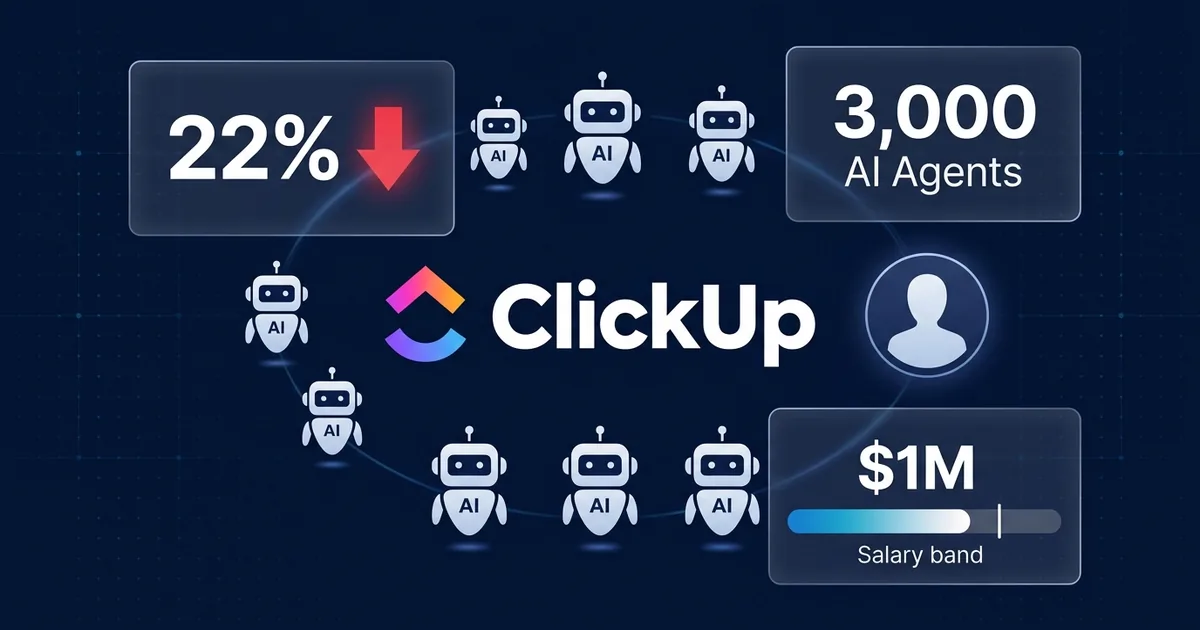
ClickUp laid off roughly 290 employees last week, about 22% of its 1,300-person workforce, and CEO Zeb Evans did not frame it as a cost cut. He framed it as the opening move in what he calls the “100x org,” a company where AI agents outnumber human employees three to one and the remaining staff spend their days directing machines rather than doing the work themselves. The productivity software company has already deployed approximately 3,000 internal AI agents to handle tasks that humans performed a month ago.
The $1 Million Salary Bet
The most provocative detail in ClickUp’s restructuring is not the headcount reduction. It is the compensation model Evans introduced alongside it. ClickUp is rolling out salary bands that reach $1 million per year in cash, available to nearly anyone in the company who demonstrates what Evans calls “100x impact” by building, managing, or optimizing AI systems that generate outsized output.
The logic is explicit: if one person directing a fleet of AI agents can produce the output of 100 people, that person is worth a seven-figure salary. TechCrunch’s analysis of the restructuring noted that this inverts the traditional SaaS staffing model, where companies scale headcount roughly linearly with revenue. Evans is betting that the curve bends sharply when agents handle the marginal work.
The Broader Layoff Wave
ClickUp is not operating in isolation. The tech industry has shed more than 100,000 jobs across roughly 250 layoff events in 2026 so far. Meta cut 8,000 roles the same week despite posting record revenue. Oracle eliminated up to 30,000 positions to fund AI infrastructure buildout. Intuit, Salesforce, Workday, and dozens of smaller SaaS companies have made similar moves, each citing some variation of “AI-driven efficiency” as the rationale.
What makes ClickUp’s case distinct is the transparency. Most companies announce layoffs with vague references to “restructuring for the future” and avoid naming AI as the direct cause. Evans named it explicitly: the agents are doing the work, the humans who were doing it are gone, and the remaining humans are being paid to manage the agents. That honesty, or provocation, depending on your read, is why the story went viral across technology and business communities within hours.
Does the Math Actually Work?
The productivity gains ClickUp claims are enormous and largely unverified. A Gartner survey published in May 2026 found that about 80% of companies deploying autonomous technology had cut jobs, but those reductions did not reliably produce better financial returns. The gap between “we deployed AI agents” and “the AI agents made us more profitable” is where most of these experiments die.
ClickUp is a private company, so we cannot see the revenue-per-employee metrics that would validate or debunk the thesis. What we can see is the structural bet: fewer people, higher individual compensation, and a production model where the agents handle volume while humans handle judgment. If it works, it is a template that every SaaS company with 500 to 5,000 employees will study. If it does not, it is the most expensive reorg in ClickUp’s history, executed in public.
What This Signals for the Labor Market
The ClickUp story matters beyond one company because it names the mechanism that most employers have been careful to obscure. When Meta lays off 8,000 people, the press release talks about “efficiency.” When Oracle cuts 30,000, it talks about “strategic realignment.” ClickUp said: we replaced those jobs with AI agents, and we are paying the remaining people more to run them.
That framing has policy implications. If the pattern scales, the workforce impact is not a gradual displacement over a decade. It is a rapid compression where companies shed 20 to 30 percent of headcount in a single quarter while simultaneously creating a small number of very high-paying roles for the people who manage the technology. The winners win big. Everyone else is looking for work in a market where the same tools that eliminated their job are being deployed at the next company on their interview list.