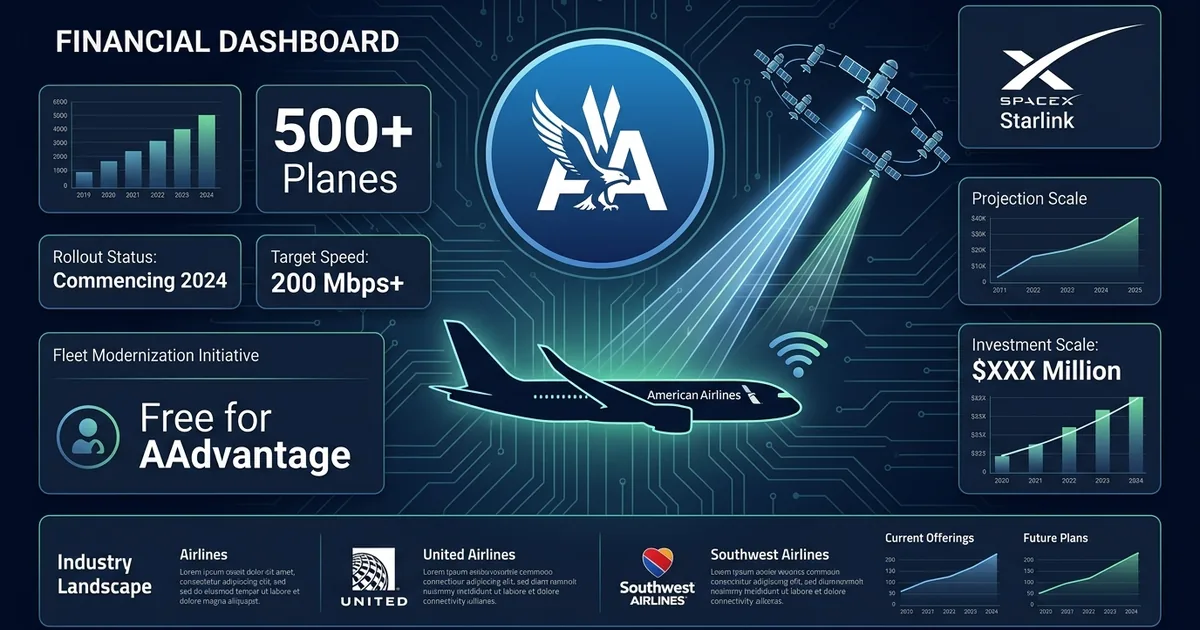
American Airlines is installing SpaceX’s Starlink satellite internet on more than 500 of its narrowbody aircraft, making it the latest major U.S. carrier to abandon legacy inflight WiFi providers in favor of Musk’s low-earth orbit network. The deal hands SpaceX a high-profile commercial win just weeks before its potentially record-breaking Nasdaq IPO.
The Deal
American announced on May 26 that it will equip its Airbus A321XLR, A320neo, and other narrowbody fleet types with Starlink’s Aero Terminal, as TechCrunch reported. Installation begins in Q1 2027. The service will be free for AAdvantage loyalty program members, a significant perk that positions inflight connectivity as a retention tool rather than an ancillary revenue line.
The 500-plus plane commitment covers American’s narrowbody Airbus fleet. Notably, Boeing aircraft are not included in this agreement, which suggests either a separate negotiation timeline or a fleet-specific technical consideration.
A Starlink Sweep of Commercial Aviation
American joins United Airlines and Southwest Airlines in choosing Starlink over competing providers, giving SpaceX’s satellite internet division a near-sweep of the major U.S. domestic carriers. The pattern is decisive and fast. Skift reported that American’s decision effectively closes the door on Amazon’s Project Kuiper for its narrowbody fleet, after earlier reports suggested both providers were in contention.
Starlink’s competitive advantage in aviation comes down to physics and scale. With thousands of satellites in low Earth orbit, the network delivers multigigabit connectivity per aircraft through its Aero Terminal, which supports up to 1 Gbps per antenna. Legacy geostationary satellite providers cannot match this throughput, and passengers know it. Every traveler who has endured $8 per hour for connections that cannot stream video understands why the airlines are switching.
The IPO Angle
The timing is not accidental. SpaceX is targeting a Nasdaq debut as early as June 12 at a valuation of at least $1.8 trillion. Every major commercial contract signed between now and the roadshow strengthens the Starlink revenue narrative that underpins that valuation.
Starlink already serves more than 4 million subscribers globally and has achieved profitability ahead of internal projections. The aviation contracts add a layer that pure consumer satellite internet does not provide: multi-year enterprise agreements with guaranteed recurring revenue, high switching costs, and fleet-wide deployment timelines that lock in demand for years.
For SpaceX’s IPO roadshow, American’s deal is a clean talking point. It demonstrates that Starlink is not just a rural broadband play or a consumer curiosity. It is becoming critical infrastructure for industries that depend on reliable, high-bandwidth connectivity in environments where terrestrial networks cannot reach.
What It Means for Passengers
American is making Starlink free for AAdvantage members, following United’s approach of bundling connectivity into the loyalty ecosystem rather than charging per session. The economics make sense: inflight WiFi as a loyalty perk drives membership engagement, increases time spent in the airline’s digital ecosystem during flights, and differentiates the carrier in a market where Spirit Airlines collapsed and the remaining majors are competing on experience rather than price.
For the broader aviation industry, the Starlink sweep signals the end of an era where inflight WiFi was a premium upcharge that barely worked. The next competitive frontier is what airlines do with the connectivity: real-time entertainment streaming, seat-back commerce, personalized offers, and operational data that improves everything from maintenance scheduling to crew management.
The Competitive Landscape Shifts
Amazon’s Project Kuiper, which had been considered a serious contender for several airline contracts, has lost ground rapidly as Starlink locked up the major domestic carriers. Kuiper has yet to launch its full commercial constellation, and the timing gap gives Starlink a first-mover advantage that will be difficult to close. Airlines need connectivity solutions that work today, not promises about networks that will be operational in 2028.
Delta Air Lines remains the most notable holdout among the Big Four U.S. carriers, currently relying on Viasat for its premium connectivity offering. The pressure to evaluate Starlink will intensify as passengers begin comparing inflight WiFi quality across carriers in real time. JetBlue, Alaska Airlines, and the international flag carriers face similar decisions.
The broader implication is that inflight connectivity is transitioning from a differentiated amenity to table stakes, much the way seatback screens did a decade ago. The airlines that move early will set passenger expectations. The ones that wait will spend more to catch up.
American Airlines just bought a seat on the fastest network in the sky. The question for Delta and the remaining holdouts is how long they can wait before the gap becomes a competitive liability that shows up in booking data.