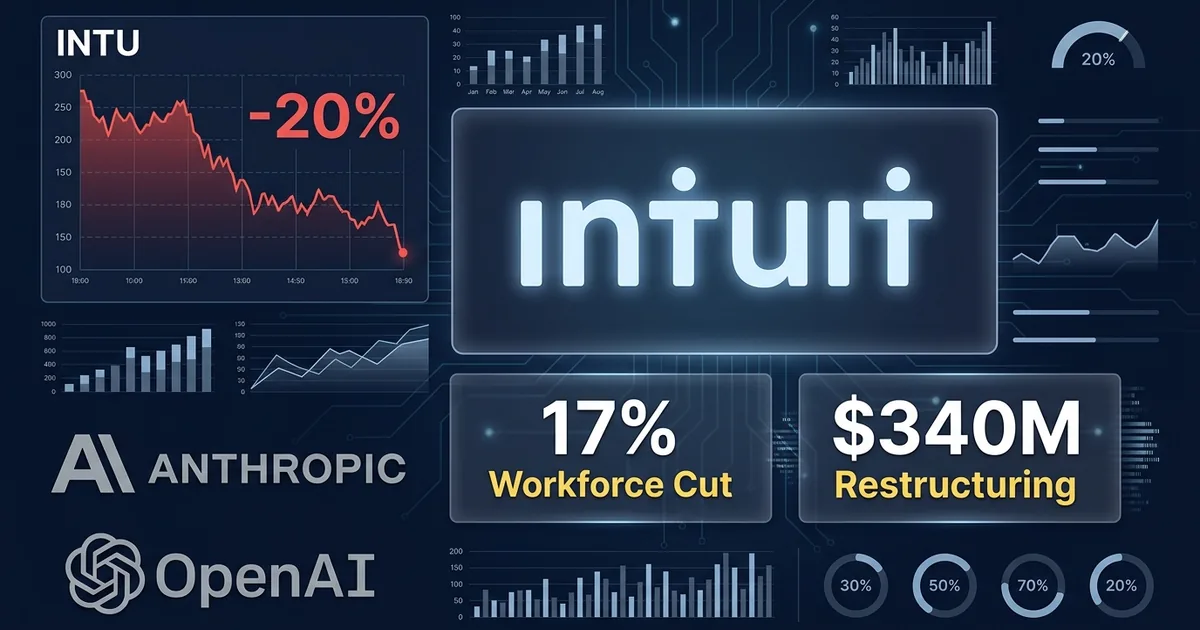
Intuit just axed more than 3,000 jobs, roughly 17% of its entire workforce, and the market responded by shaving a fifth off the company’s valuation in a single session. The TurboTax and QuickBooks parent is betting that fewer humans and more AI will make the math work, but investors are not convinced the trade-off pencils out.
The Numbers Behind the Cut
CEO Sasan Goodarzi framed the restructuring as a simplification play, not an AI replacement story, telling employees the company needed to “move with greater velocity.” The restructuring will trigger between $300 million and $340 million in charges, mostly concentrated in the current quarter. U.S. employees affected will have a final day of July 31, with severance packages starting at 16 weeks of base pay plus two additional weeks per year of tenure.
But the framing only goes so far. Intuit is simultaneously eliminating management layers, cutting what it calls “coordination-heavy roles,” and canceling duplicative functions created during the integration of Credit Karma and TurboTax, as TechCrunch reported on May 20. The company also disclosed multi-year AI partnerships with both Anthropic and OpenAI to embed their models directly into its tax and finance platforms. When a company signs deals with two competing foundation model providers in the same quarter it announces a 17% headcount reduction, the “nothing to do with AI” line reads more like legal positioning than operational reality.
Strong Earnings, Weak Conviction
The financial results themselves were solid. Intuit posted adjusted earnings of $12.80 per share on $8.56 billion in revenue for its fiscal third quarter, beating consensus estimates of $12.57 per share. Revenue grew 10% year over year. The company also completed a multi-year share repurchase program totaling roughly $12.57 billion and raised its full-year outlook.
None of that mattered. INTU shares cratered 15% during after-hours trading on May 20 and continued sliding, losing roughly 20% of their value within days. The disconnect tells a clear story: Wall Street is pricing in execution risk on a restructuring of this scale, not rewarding the cost savings.
A Pattern, Not an Outlier
Intuit’s cuts land in the middle of the largest AI-driven workforce reshuffling the tech sector has seen. More than 80,000 tech jobs were eliminated in Q1 2026 alone, with nearly half attributed directly to AI restructuring. Meta cut 8,000 roles the same week. Cloudflare shed 1,100 positions in May. Oracle, Fidelity, and Wix have all executed significant reductions this quarter, each citing AI-driven efficiency as the rationale.
What makes Intuit’s case notable is the combination of a strong balance sheet and aggressive headcount reduction. This is not a struggling company making survival cuts. Intuit is profitable, growing, and buying back billions in stock while simultaneously telling 3,000 employees their roles no longer fit the strategy. The message to the rest of the industry is unmistakable: AI restructuring is not reserved for companies in distress. It is now standard operating procedure for companies in growth mode.
The AI Pivot Is the Strategy
Intuit is not just trimming fat. The company is reorganizing around what Goodarzi calls an “AI-first” operating model, transferring roughly 7,000 employees into new AI-focused groups including Applied AI Engineering, an Agent Transformation Accelerator, and a Central Analytics division, according to PYMNTS. Another 6,000 open requisitions have been canceled outright, bringing the effective headcount reduction to 14,000 positions when you count the roles that will never be filled.
The dual partnerships with Anthropic and OpenAI are telling. Rather than building foundation models in-house, Intuit is outsourcing the core AI infrastructure to two competing providers and focusing its internal teams on application-layer integration. It is a pragmatic choice that accelerates time to market, but it also raises a strategic question that should concern long-term shareholders: if every fintech company can plug into the same foundation models, where does Intuit’s moat come from? The answer has to be data. Intuit sits on tax returns, small-business financials, and personal finance records for more than 100 million customers. That proprietary data advantage is the only durable differentiator in a world where the AI layer itself is commoditized.
What This Means for the Broader Tech Workforce
JPMorgan downgraded Intuit from Overweight to Neutral following the announcement, slashing its price target. The analyst note pointed to execution risk: restructurings of this magnitude historically take 12 to 18 months to deliver promised efficiencies, and the transition period is littered with productivity loss, institutional knowledge drain, and customer-facing disruptions.
For the 73,000-plus tech workers who have already lost their jobs in 2026, Intuit’s cuts reinforce an uncomfortable reality. The companies doing the layoffs are not struggling. They are posting record revenues, buying back stock, and raising guidance. The restructuring is not about survival. It is about margin optimization in an era where AI makes certain categories of human work redundant faster than new categories can be created.
The 20% stock decline says investors want to see receipts before they believe it. For the workers caught in the middle, the receipts are already in.