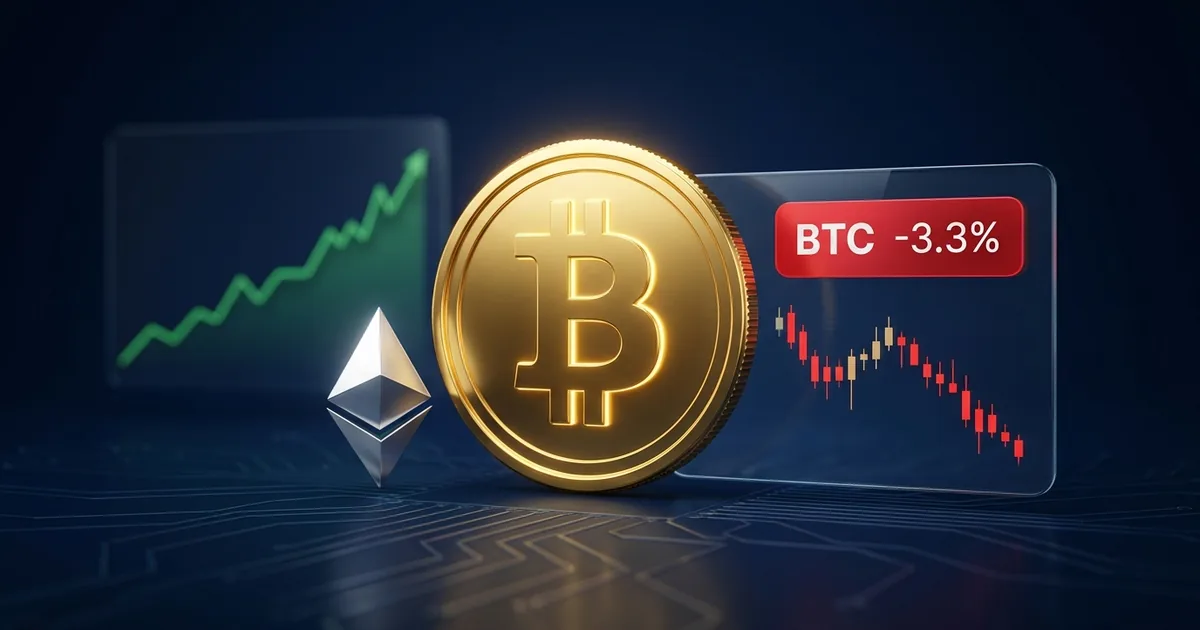
Something is off in the relationship between crypto and stocks. As US equities pushed to record highs on Thursday, Bitcoin slid to roughly $72,700, down about 3.3%, and Ethereum fell near $1,986, off close to 4%. On a day when risk appetite was supposedly back, the market’s most famous risk asset went the other way. That divergence is the most interesting thing happening in markets right now, because it scrambles the story investors have been telling themselves about what Bitcoin actually is.
The Numbers and the Disconnect
Bitcoin has been under steady pressure into the end of May. It opened Thursday around $74,300, down roughly 2% on the day, and kept sliding from there toward the low $73,000s before settling near $72,700, a move tracked in Yahoo Finance’s daily Bitcoin price report. Ethereum followed it down. The same softness shows up in Fortune’s price snapshot, which pegged Bitcoin in the low $70,000s as the selling continued.
Now hold that against the equity tape. Stocks hit records, oil cooled, and bonds caught a bid, all driven by optimism around an extended US-Iran ceasefire. Every traditional risk asset celebrated the good geopolitical news. Crypto sat it out. When the macro mood improves and the one asset that is supposed to be pure risk-on appetite falls anyway, the textbook correlation has broken.
The Identity Crisis at the Center of This
Here is the deal-room read on why this matters. Bitcoin has spent years being sold as two contradictory things at once, and both pitches just got tested in the same session. To one set of buyers it is digital gold, an uncorrelated hedge that protects you when traditional markets wobble. To another it is high-beta risk-on, a high-octane bet on liquidity and animal spirits that rips when stocks rip.
It cannot be both, and Thursday exposed the contradiction. If Bitcoin were digital gold, easing geopolitical tension would let it drift while safe havens unwound, which roughly fits. But if it were a risk-on asset, a record day in equities should have pulled it higher, and it did the opposite. The price action is telling you the market has not actually decided what Bitcoin is, and that ambiguity is itself a risk.
Follow the Flows
When crypto moves against the macro narrative, the explanation usually lives in flows rather than headlines. Earlier in May, when US-Iran and Strait of Hormuz tensions spiked, investors pulled back from the riskiest, most liquid corners of their books, and crypto trades 24/7, which makes it the easiest thing to sell when someone needs to de-risk fast. We covered the sharper version of that dynamic when Bitcoin cracked below $77,000 amid surging bond yields and a wave of liquidations.
The residue of that de-risking can linger even after the macro fear fades. Margined positions get unwound, liquidations cascade, and the selling develops its own momentum independent of whatever the stock market is doing on any given day. That is the likeliest read here: equities are trading the improving geopolitical story, while crypto is still digesting a positioning hangover.
What It Means for the Thesis
For anyone holding Bitcoin as a portfolio diversifier, this is the uncomfortable part. The pitch was that crypto would zig when stocks zag. Lately it has mostly zagged when stocks zagged and then kept zagging when stocks zigged, which is the worst of both worlds: downside correlation when markets fall, and no participation when they rise. A hedge that drops with everything and rises with nothing is not a hedge.
None of this is a verdict on Bitcoin’s long-term case. Adoption, institutional custody, and the structural supply story have not changed in a week. But the near-term behavior is a useful corrective to the cleaner narratives. Bitcoin is not reliably digital gold and it is not reliably risk-on. It is its own thing, driven by its own credit and margin cycles, and it will keep confounding anyone who insists on forcing it into a traditional box.
The Bigger Read
The crypto-stock divergence is worth watching precisely because it is unusual. Correlations that break tend to reset, and the direction they reset in tells you which narrative won. If Bitcoin reconnects to the upside as equities hold their records, the risk-on story reasserts itself. If it keeps sliding while stocks climb, the market is quietly repricing crypto as something other than a high-beta bet on good times.
For now, the signal is humility. The asset that was supposed to be the clearest expression of risk appetite just refused to play its assigned role on the one day it mattered most. That is the kind of behavior that should make anyone with a tidy theory about Bitcoin pause.