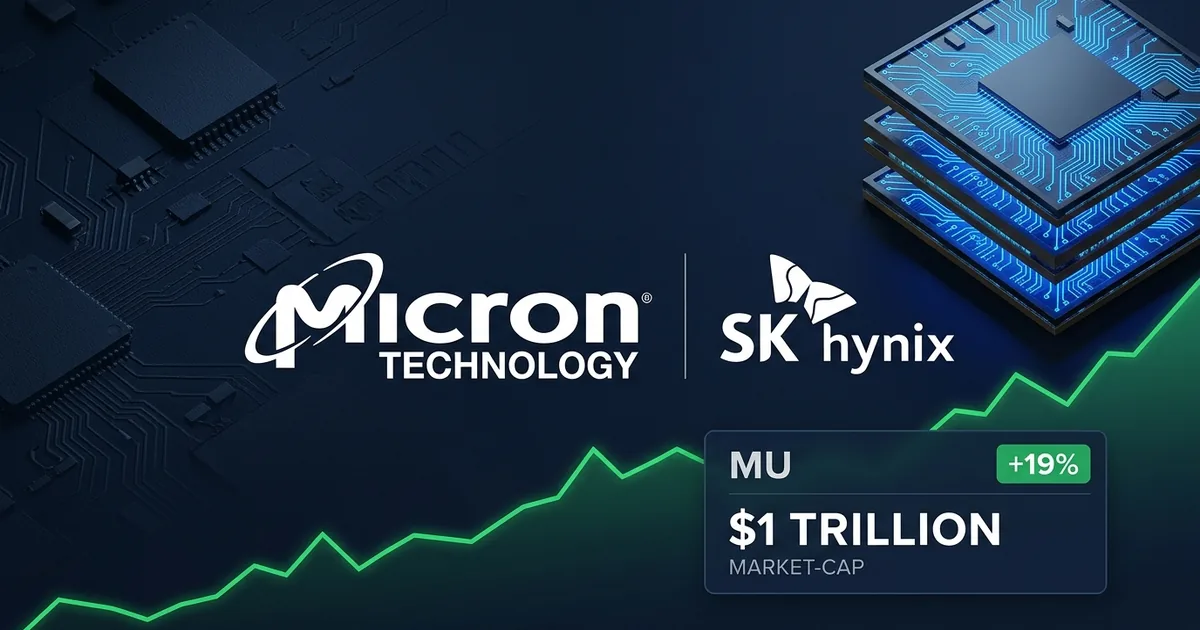
Micron Technology just did something that would have sounded absurd eighteen months ago: it became a trillion-dollar memory company. Shares jumped 19% to push the chipmaker past a $1 trillion market capitalization, with UBS arguing in a note that Micron is no longer a boom-bust commodity supplier but a full-blown AI infrastructure giant. The move helped drag the S&P 500 to a record close of 7,519 and the Nasdaq to 26,656, and it put Micron’s valuation in the same neighborhood as Eli Lilly and Berkshire Hathaway.
For anyone who has covered semiconductors for more than a cycle or two, that last sentence is the story. Memory was always the unglamorous, margin-thin corner of the chip business, the part that flooded into oversupply every couple of years and torched everyone’s earnings. The AI build-out has rewired that logic, and the market is now repricing the whole category in real time.
Why High-Bandwidth Memory Rewrote Micron’s Math
The piece of Micron that Wall Street is paying for is high-bandwidth memory, the stacked DRAM that sits next to Nvidia and AMD accelerators inside every serious AI server. You cannot run a frontier model on logic chips alone. The GPU does the math, but it starves without enough fast memory feeding it, and HBM is the only thing that keeps the most expensive silicon in the data center busy.
That has handed Micron something memory makers almost never get: pricing power. Yahoo Finance reported that UBS sees Micron becoming an AI giant as HBM demand runs well ahead of what the industry can physically produce. When supply is sold out and customers are signing multi-quarter agreements to lock in allocation, the boom-bust pattern that defined memory for thirty years starts to look, at least temporarily, broken. Micron’s HBM capacity is reportedly committed deep into next year, which is why the stock is trading less like a cyclical and more like a toll road on AI compute.
Follow the money and the logic holds up. Every dollar of the roughly $78 billion in annual AI capital spending that hyperscalers have guided toward needs memory attached to it. Micron has gone from price-taker to one of three companies that can supply the most important version of it.
The $1 Trillion Club Adds a Memory Wing
Micron did not make the trip alone. SK Hynix joined Micron in the $1 trillion club as the AI memory rally accelerated, a remarkable moment for two companies investors treated as deep cyclicals as recently as 2023. Together with Samsung, they form a tight oligopoly, and oligopolies with sold-out capacity tend to behave with discipline rather than start a price war.
That discipline is the part of the bull case that matters most. The last memory glut, in 2023, was so severe that Micron posted billions in losses and idled capacity. What is different now is not that memory stopped being cyclical, but that the three players have learned to manage supply growth instead of racing each other into the ground. If that holds, the re-rating from commodity multiple to AI multiple is defensible. If it cracks, a trillion-dollar memory company becomes a very expensive reminder of how the sector usually ends.
The Cyclical Ghost Investors Are Choosing to Ignore
Here is the uncomfortable question underneath the record highs. A $1 trillion valuation does not price in a healthy up-cycle. It prices in a permanent one. Micron is being valued as if HBM demand never normalizes, competitors never catch up, and AI capex never pauses, and all three of those assumptions have a shaky track record in this industry.
Samsung is pouring money into closing its HBM gap. AI capital spending, the engine under all of this, is increasingly scrutinized by a bond market that has started asking whether the returns justify the borrowing, a tension visible in the broader chip-stock rally that has powered record after record this spring. None of that means the trade is wrong today. It means the margin for error at these prices is thin, and memory investors have been burned for ignoring exactly that before.
What to Watch Next
The near-term tells are concrete. Watch the timing of HBM4, the next generation Micron and SK Hynix are racing to qualify with Nvidia, because whoever wins design-in there locks in the next leg of pricing power. Watch Samsung’s qualification progress, the single biggest threat to the current pricing discipline. And watch this week’s earnings from Dell and Marvell, both of which sell into the same AI server demand and will give a cleaner read on whether the order book is still accelerating or quietly flattening.
For now, the tape is unambiguous. The least loved corner of the chip industry has produced two trillion-dollar companies in a matter of days, and the memory chip has become the purest way left to bet that the AI build-out keeps running. The only thing the market has not priced is what happens when it slows.