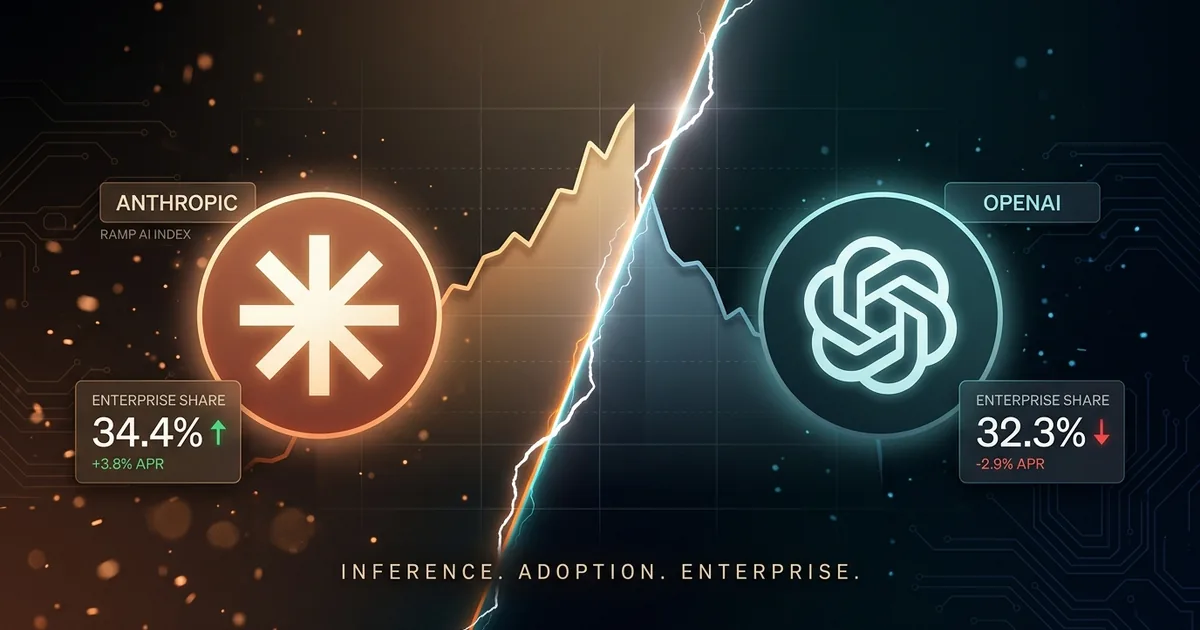
For two years, every enterprise AI conversation started with OpenAI. ChatGPT was the consumer breakthrough. GPT-4 was the enterprise default. The Microsoft tie-in gave OpenAI a distribution advantage no rival could match. As of April 2026, that story is over. Ramp dropped its monthly AI Index this week and the numbers are unambiguous. Anthropic now sits at 34.4% of businesses on Ramp’s spend data, up 3.8% in April. OpenAI is at 32.3%, down 2.9%. For the first time, Anthropic has more business customers than OpenAI.
This is not noise. Over the last twelve months, Anthropic quadrupled its enterprise footprint while OpenAI grew adoption by 0.3%. Anthropic went from 7.94% of businesses in April 2025 to 34.44% in April 2026. That is the kind of curve that does not show up in mature markets unless something structural is happening underneath. Something structural is happening underneath. It is called Claude Code.
The Coding Tool That Ate The Enterprise
Anthropic’s agentic coding product is, by the company’s own accounting, the fastest-growing product in its history. It is what salespeople call a wedge: a low-friction entry point that bypasses procurement, lands in engineering, and pulls the rest of the org through the door. By February, Anthropic was winning roughly 70% of head-to-head matchups against OpenAI among businesses buying AI services for the first time. That number is brutal if you sit on OpenAI’s enterprise sales team.
The bigger insight is what Claude Code says about how AI adoption actually works inside large companies. Enterprise AI was supposed to be a top-down sale: CIO meets vendor, vendor signs MSA, deployment cascades down. What is happening instead is bottom-up. Engineering teams pick Claude Code because the agent works better on their codebase. Once Claude is doing the actual work, the rest of the model purchasing decision tilts the same direction. By the time the CIO weighs in, the answer is already on the table.
OpenAI Has A Compute Problem And A Pricing Problem
The Ramp report also contains the asterisk that should worry Anthropic bulls. Anthropic charges by tokens. So does OpenAI. Both companies have a structural cost problem because inference is expensive and their gross margins live and die by compute pricing. The same Ramp data shows AI inference platforms offering cheap open-source models among the fastest-growing line items in April. Translation: companies are happy to use Claude for the hard stuff and a cheaper open-source model for the easy stuff.
That is the long-term threat. The short-term threat is OpenAI’s own balance sheet. Sarah Friar walked back the IPO timeline this month, citing compute constraints and a $14 billion loss against $25 billion in revenue, which is what happens when you build a business on the most expensive infrastructure in tech and charge customers per token. Friar’s warning, set against the new Ramp data that flipped the enterprise leaderboard, paints a picture of an OpenAI that has lost narrative momentum at the exact moment its main competitor is taking market share.
Sam Altman will still take OpenAI public eventually. The question is at what valuation, against what comps, and with what enterprise growth story to sell. The current setup makes those answers harder than they were six months ago.
Anthropic Is Now A $950 Billion Conversation
Anthropic is reportedly fielding interest at a valuation north of $950 billion. That is not a typo. The company has gone from interesting startup to potential trillion-dollar private name inside three years. Some of that is the Claude Code traction. Some of it is the cleaner enterprise narrative. And some of it is that investors have run out of credible AI bets that are not OpenAI, and the runway gap matters.
The interesting tension is whether $950 billion is sustainable. Anthropic’s revenue, while growing fast, is still smaller than OpenAI’s. The margin profile is similar, which means the same compute economics that constrain OpenAI also constrain Anthropic. The bull case is that Claude Code’s stickiness justifies a premium multiple because coding agents have unusually high switching costs once a team is deployed. The bear case is that token-based pricing eventually hits a ceiling as customers route work to whichever model wins on cost-per-task for each specific job.
Microsoft’s Position Is The Wild Card
Here is where the story gets messy. Microsoft owns roughly 49% of OpenAI’s commercial entity. Microsoft also signed a $4 billion deal earlier this month renting Elon Musk’s Colossus supercomputer for Anthropic inference workloads. That tells you Microsoft is not betting on a single horse. Bill Ackman’s $2.1 billion Microsoft position, disclosed Friday, implicitly bets that Microsoft’s optionality across both Anthropic and OpenAI is worth more than any single AI vendor outcome.
Said another way: Microsoft wins if either Anthropic or OpenAI dominates the enterprise. That is a hedged position the entire rest of the AI market cannot match. Google is locked into Gemini. Meta is locked into Llama. Anthropic and OpenAI are locked into their respective compute deals. Microsoft is the only Big Tech name with a genuine spread.
What Wall Street Should Watch
Three signals matter in the next 90 days. First, OpenAI’s next enterprise sales numbers. If the share decline continues into May and June, the Friar IPO walk-back stops looking like a one-quarter blip and starts looking like a trend. Second, Anthropic’s revenue disclosures. The company has been quiet on the run rate. A clean number above $8 billion annualized validates the $950 billion conversation. Below that, the multiple gets harder to defend. Third, the pricing wars. If either company cuts token pricing meaningfully, the margin story for the entire AI vendor space resets. TechCrunch’s read of the Ramp report framed it correctly: the inflection has happened, and the next question is whether Anthropic can hold it.
For now, the Ramp numbers are the cleanest evidence yet that the enterprise AI race is not a one-horse story. OpenAI’s lead just got smaller. Anthropic’s lead just got bigger. And the buyers, finally, have leverage.