Jensen Huang got a phone call from the White House on Monday night. By Wednesday morning he was on Air Force One. By Thursday he was sitting in the corporate delegation in Beijing watching the United States approve the export licenses he had been fighting for since 2024.
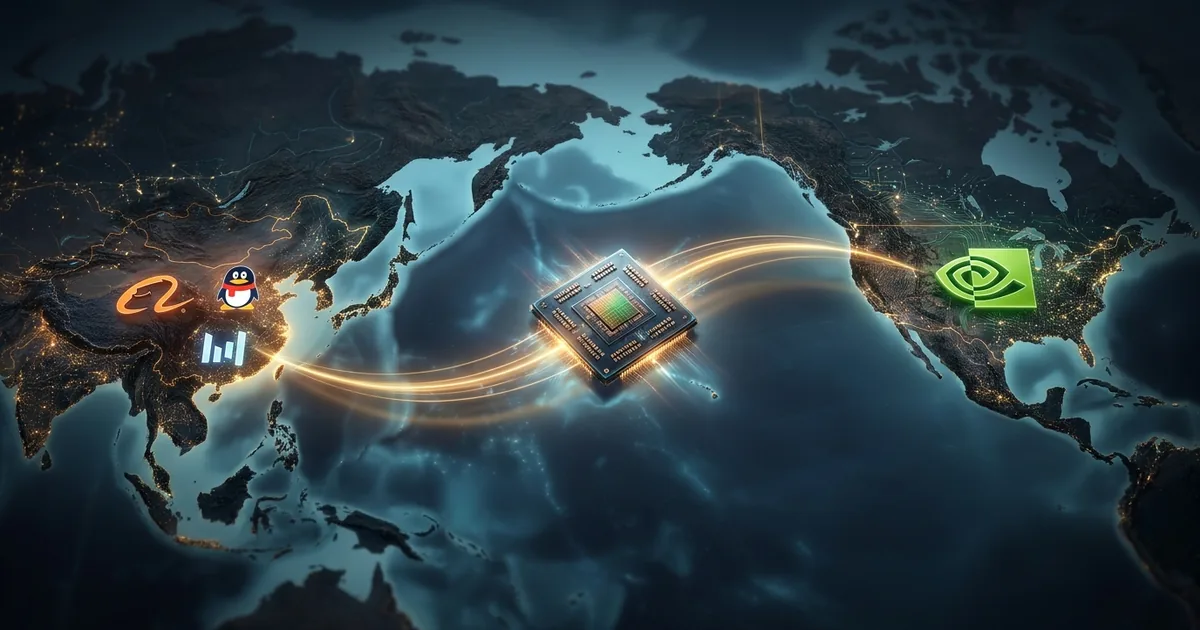
That is the short version of how the Nvidia CEO ended up at the center of the biggest US-China AI trade development of the year. The long version, reported by Reuters and confirmed across multiple wires Thursday morning, is that the US Commerce Department has cleared sales of Nvidia’s H200 AI accelerators to roughly ten major Chinese technology firms. The approved list reads like the entire Chinese cloud and consumer internet stack: Alibaba, Tencent, ByteDance, JD.com, and several more buyers under license conditions that cap each at 75,000 chips.
Nvidia traded up 4.6 percent in pre-market Thursday. The Philadelphia Semiconductor Index futures jumped 1.8 percent. China tech ADRs ripped, with KWEB futures up 3.9 percent before the New York open.
This is what a policy deliverable looks like when the negotiators want a market reaction.
What The License Actually Permits
The H200 is Nvidia’s flagship Hopper-architecture accelerator, the chip that sits one generation below Blackwell and roughly two generations above anything the US has previously allowed into China. The Biden-era export framework banned it. The Trump-era framework opened a narrow window for a handful of approved buyers under tight conditions. Wednesday’s approval blows that window open.
At 75,000 chips per buyer and a street price somewhere north of $30,000 per H200, each license is worth roughly $2.25 billion in potential bookings to Nvidia. Multiply by 10 buyers and you get a $22 billion ceiling on H200 China demand if every license is exercised in full. According to Reuters reporting carried by CNBC, the licenses include conditions on end-use monitoring and a prohibition on resale to entities on the US Commerce Department restricted list.
That ceiling does not get hit. The real number depends on whether Beijing lets the chips actually clear customs, which is the part the headline misses. In early 2026, Chinese customs began quietly blocking H200 shipments even from buyers holding valid US export licenses. The Cyberspace Administration of China issued informal guidance restricting H200 purchases to “special circumstances,” which translated in practice to “university research labs and nowhere else.” That guidance has not been formally rescinded. Whether Thursday’s US approval unlocks Chinese customs is the next shoe to drop.
Why Huang Was On The Plane
The Nvidia CEO was not on the original delegation list. We covered the Trump-Xi summit pre-arrival roster on Tuesday, and Huang’s absence at that point was a tell. The interpretation in the market was that the H200 license framework had been negotiated to the point of approval but the political optics of putting Huang in Beijing alongside Trump were still being managed.
Then the call happened. According to multiple wires, Trump personally phoned Huang and asked him to join the trip, and Air Force One detoured to Alaska to collect him before the long-haul leg to Beijing. The detour was the signal. Nvidia is no longer a private-sector company that the US government interacts with at arm’s length. It is, for all practical purposes, an instrument of American AI industrial policy, and the policy makers want it visible at the negotiating table.
For Huang, the calculation is straightforward. China was 25 percent of Nvidia data center revenue in 2023. By the end of 2025 it was effectively zero. Even a partial reopening adds $5 to $10 billion in incremental revenue to a company that is already running at $190 billion in annual run-rate. It also undercuts the domestic Chinese chip ecosystem, which has been racing to close the gap. Huawei’s Ascend 910C, the most credible domestic alternative, performs at roughly 65 percent of H200 throughput on the training workloads Chinese hyperscalers run. The H200 license framework, if executed, kneecaps Huawei’s last 18 months of work.
What The Chinese Buyers Get
For Alibaba, Tencent, ByteDance, and the other approved firms, the H200 is the chip they have been engineering around for two years. ByteDance alone reportedly stockpiled inventory of older Nvidia parts ahead of the 2024 restrictions and has been running training runs at degraded efficiency since. Alibaba Cloud and Tencent Cloud have lost AI infrastructure customers to AWS and Azure because they could not match US chip availability for the largest training workloads.
The H200 license narrows that gap. It does not close it. Blackwell, the architecture Nvidia is shipping to Western customers, remains export-restricted. And the 75,000-chip cap, while generous, is one to two orders of magnitude below what the largest US hyperscalers buy in a single quarter. A reasonable framing is that the deal lets Chinese firms compete in the second tier of global AI infrastructure but not the first.
The market read it as net positive anyway. Alibaba ADRs jumped 6.2 percent in pre-market trading. Tencent’s Hong Kong listing closed up 4.4 percent ahead of the US session. ByteDance is private but the secondary market valuation has reportedly firmed by 8 to 10 percent in the last 48 hours according to private market tracking from Forge Global and EquityZen.
The Wider Trade Package
The H200 deal is the marquee item but it is not the only one. According to CNBC’s coverage of the summit dynamics, the broader negotiating package includes a potential 500-jet Boeing order, a multi-year LNG purchase commitment, soybean and beef quotas, and a framework for rare earth processing cooperation. Analyst Stephen Roach told reporters Thursday that Trump may use the joint statement to claim China is committing to $1 trillion in cumulative American goods purchases over the next three years.
That number is, to put it gently, aspirational. Beijing has agreed to similar headline figures in past trade deals and delivered a fraction. The mechanism by which a $1 trillion commitment is enforced is unclear. The point of the headline is the headline.
For the trade, the names to watch beyond Nvidia are Boeing, ADM, Chevron, and the rare earth processors. Boeing is up 22 percent off its March lows on the deal expectation. Soybean futures jumped 4 percent on the early summit headlines. The cleanest pure-play is still Nvidia, because the H200 license is the only deliverable that comes with a hard number attached.
The Real Test
The question that determines whether Thursday’s headlines become Q3 revenue is whether China’s customs and cyberspace authorities allow the chips to actually arrive. Beijing has every reason to slow-walk approvals as negotiating leverage on the rare earth and Taiwan files. The US export license is a permission slip from one side of the deal. The import permission slip from the other side has not been issued.
The market priced Thursday as if it had been. That is probably premature, but it is also the right direction. The Trump-Xi summit moved the US-China AI trade from “blocked” to “negotiated,” which is itself a regime change. The chips might take six months to ship. The repricing happened in six hours.