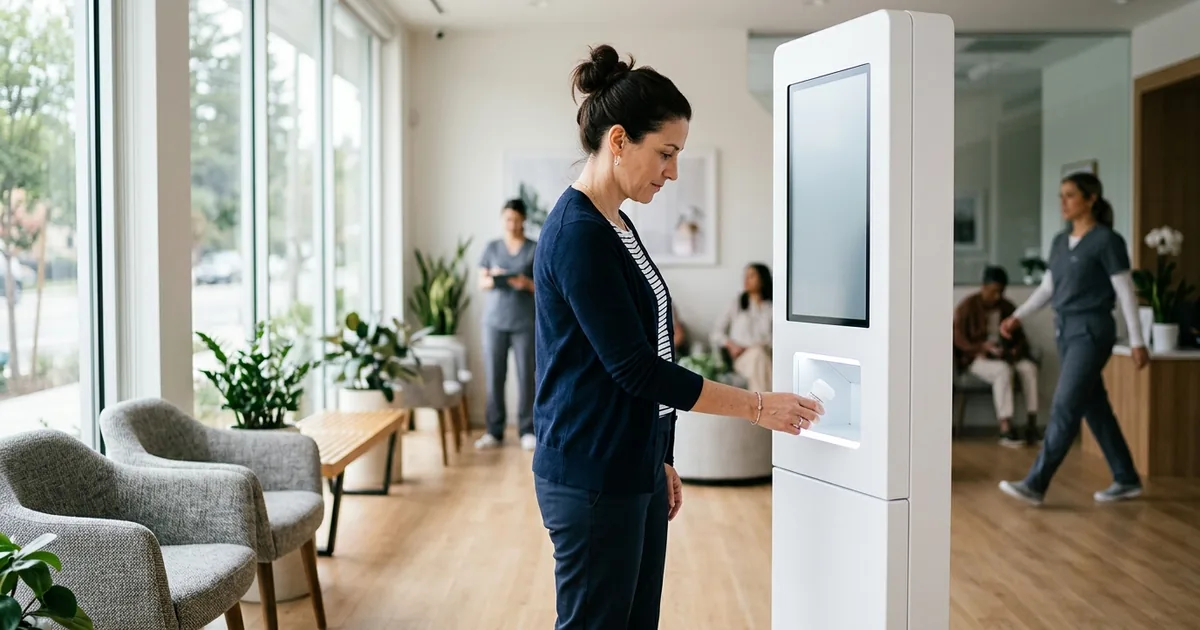
Amazon Pharmacy is selling Novo Nordisk’s new Ozempic pill at kiosks inside One Medical clinics, with same-day delivery to more than three thousand zip codes and a cash price of $149 a month. That last number is the story. A drug that ran $1,000 a month at retail two years ago, and that landed in shortage status with the FDA when demand outran supply, is now stocking next to printer ink in Amazon Prime’s same-day catalog. Insurance copays start at $25.
This is what the weight-loss-drug market looks like once it stops being scarce. The medical category that consumed pharma earnings calls and patient waiting lists for two years is now competing on convenience.
What Amazon Actually Announced
The deal puts the Wegovy-class oral semaglutide pill, recently approved by the FDA for weight management, on three retail surfaces. Amazon Pharmacy customers can order it for same-day delivery to roughly three thousand zip codes today, expanding to forty-five hundred zip codes by year-end. One Medical clinics, which Amazon owns, now have on-site kiosks that dispense the prescription within minutes after an in-person appointment with a clinician. And Amazon already stocks the injectable Wegovy and Eli Lilly’s oral Foundayo pill, meaning the pharmacy now competes head-to-head across the GLP-1 weight-loss category.
The on-site kiosk piece is the operationally interesting bit. According to CNBC’s coverage of the launch, the kiosks are vending-style hardware that fulfills a prescription faster than a patient can walk back to the parking lot, eliminating the standard pharmacy queue entirely. For a refill-driven medication, that workflow is closer to a Diet Coke at a stadium than a controlled substance.
The Pricing Tells You the Strategy
The cash price of $149 a month for a drug that ran four to seven times that retail two years ago is not a one-off promotion. It is Amazon negotiating volume against Novo Nordisk’s stated target of expanding the user base for branded GLP-1 products beyond the prior-authorization customer.
The $25 insurance copay is more telling. Amazon has the negotiating power to push payer integration faster than CVS Caremark or Express Scripts on a single product, because the pharmacy is part of a flywheel that includes Prime, One Medical, and the Whole Foods footprint. None of CVS or Walgreens has that combination of consumer reach and primary-care touchpoints.
The delivery footprint matters too. Reuters reporting on the rollout put the same-day window at three thousand zip codes today and forty-five hundred by December, which corresponds to roughly seventy percent of the U.S. population by the end of 2026. For a drug class where adherence collapses if the next prescription is more than a few days away, that distribution is a moat in its own right.
This Is a Direct Hit on CVS and Walgreens
CVS and Walgreens have spent two years selling investors on the in-store-clinic flywheel. The pitch was that physical retail pharmacies, paired with primary-care minute-clinics, would capture the GLP-1 prescription channel because the drugs require ongoing patient management. Amazon’s pitch is that same-day delivery from a Prime-backed pharmacy, paired with One Medical’s actual primary-care network, captures the channel without needing the storefront.
CVS shares finished red Tuesday on the announcement. Walgreens finished worse. That is investors voting on which model holds up. The retail-pharmacy model has been bleeding share for half a decade. Adding GLP-1 prescription velocity to Amazon’s existing parcel velocity is not a marginal threat. It is the moment retail pharmacy stops being the default channel for a high-value chronic medication.
It is also the moment the pharmacy benefit manager industry has to take a position. PBMs make money on rebates from manufacturers and on steering prescriptions toward preferred channels. Amazon Pharmacy is not a traditional PBM client, and the contracts that bind a CVS Caremark or an OptumRx do not constrain Amazon in the same way. Watch what happens to the weighted-average GLP-1 rebate over the next two earnings cycles.
Why Novo and Lilly Stocks Both Climbed
Novo Nordisk shares closed up on the news. Eli Lilly closed up too. That is unusual for a competitive product launch. The market read is that any signal showing the pill format can compete on convenience expands the addressable market for the entire category, not just for a specific brand.
The category has been throttled by patient resistance to weekly self-injection. A pill that arrives on Prime in two hours bypasses that friction entirely. If pill-format adherence is even ten percentage points higher than injection adherence, the lifetime revenue per patient goes up by enough to justify a re-rating across both companies’ GLP-1 franchises.
The compounding-pharmacy fight is the other part of the read. Novo has spent the last six months suing telehealth providers and pressing the FDA to crack down on knockoff semaglutide. The Amazon channel does not solve that problem on its own, but it puts the FDA-approved branded pill on a delivery network as fast and as cheap as the compounded versions from Hims and Ro. Cost and convenience were the only real moats the compounders had. Both moved.
What It Means for the Weight-Loss-Drug Market
The most underrated number in the announcement is forty-five hundred zip codes. A medication that reaches three-quarters of the U.S. population by same-day delivery is no longer a specialty product. It is a household-staple SKU with a prescription gate. That is not a category. That is an aisle.
For Amazon, the strategic value runs through the data, not the margin. Every GLP-1 prescription generates refill cadence, payer integration, and patient-history information that Amazon can layer into the Prime-and-One-Medical bundle in ways no pure pharmacy can. Pharmacy gross margins on branded drugs are thin by design. The product is a wedge, not a profit center.
For Novo and Lilly, the read is that distribution risk is now contained. The compounders are still a problem, the regulatory fight is ongoing, but the Amazon channel ensures that branded GLP-1 reaches the patient as fast as any unregulated alternative. That is the part of the moat that mattered.
For CVS and Walgreens, the read is harder. The retail-pharmacy footprint that absorbed roughly half a century of capital is now competing on a feature it cannot match. The next earnings call from either name will not be a category recovery story. It will be a defensive posture and a search for a different moat.
The Ozempic kiosk is a small piece of hardware. The strategic move it represents is not.