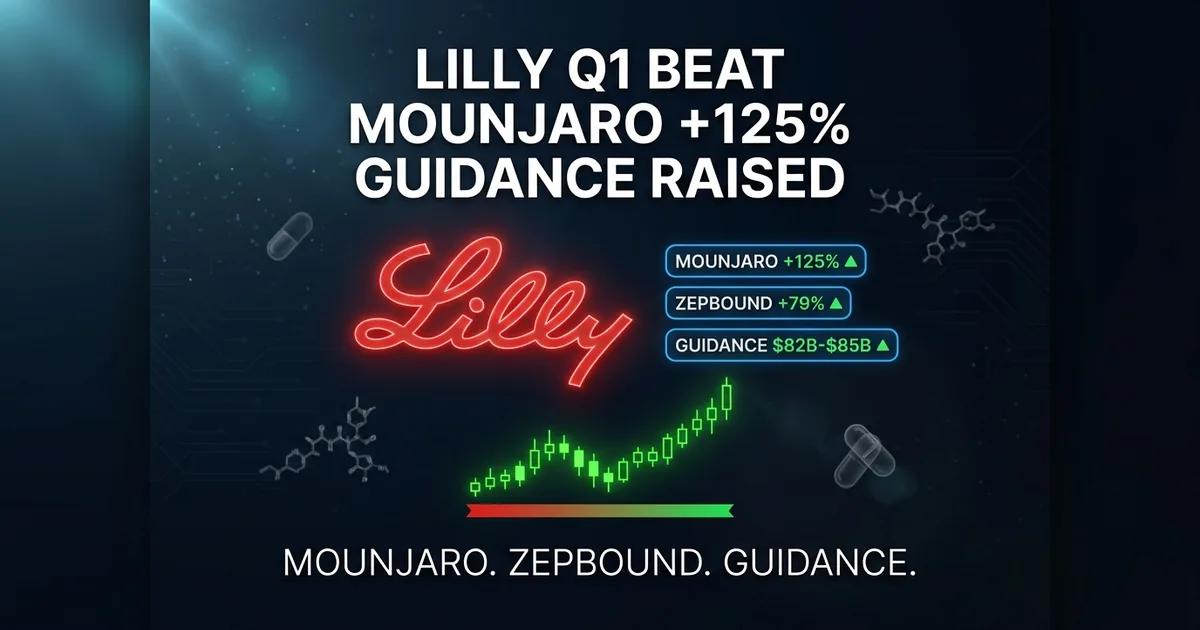
The GLP-1 trade was supposed to be cooling off. Pricing pressure was supposed to be biting. Compounders were supposed to be eating share. Then Eli Lilly walked onto the earnings stage Thursday morning and threw a Q1 print so loud it reset the entire weight loss and diabetes drug conversation. Revenue of $19.8 billion came in 12% ahead of consensus, up 56% year over year. Adjusted EPS of $8.55 ran 21% past the $7.06 estimate, with earnings up 156% from a year ago. Then management raised full-year 2026 revenue guidance by $2 billion to a $82 billion to $85 billion range. The stock popped roughly 7% in pre-market and held into the open.
This was not an in-line beat. This was the kind of quarter that forces analysts to rebuild their models, and forces competitors to explain why their growth curves do not look like this.
The Mounjaro And Zepbound Numbers Are Doing Most Of The Talking
Mounjaro, the diabetes drug that quietly became one of the best-selling pharmaceutical products in history, posted Q1 revenue of $8.7 billion, up 125% year over year. U.S. Mounjaro revenue alone hit $4.2 billion, with international growth doing the heavier lift as Lilly continued to expand into European and Asian markets where supply has finally caught demand. Zepbound, the obesity-indication twin to Mounjaro, brought in another large slug of revenue with U.S. sales up 79% to $4.1 billion.
The mix matters. Volume is doing the work. Lilly noted that strong demand was partially offset by lower realized prices, which is what every healthcare investor was watching for. The 2026 thesis on GLP-1 manufacturers has hinged on whether volume could continue to outrun price pressure from PBMs, employer plans, Medicare expansion, and the Wegovy class of competitors. This quarter, the answer is yes, and not by a small margin. Even with discounts widening, the underlying patient adoption curve is still steep enough to drive triple-digit growth.
That is the line in the analyst notes that will be quoted for the next 90 days: when volume is this strong, pricing pressure becomes a math problem, not a business problem.
The Guidance Raise Is The Real Story
Pharma companies do not raise full-year revenue guidance by $2 billion in April unless they are confident the back half can carry it. Lilly now expects 2026 revenue between $82 billion and $85 billion, up from the prior $80 billion to $83 billion range. EPS guidance moved to $35.50 to $37 from $33.50 to $35. Even at the new range, several Street models view the bar as conservative, given the volume trends now showing up in the script data.
The implications run beyond Lilly. The buyside has been waiting to see whether the broader GLP-1 category was approaching saturation, plateauing, or still in early innings. The answer in this print is unambiguous: still early. Lilly’s manufacturing capacity additions, including the Indiana and North Carolina plants that came online in 2025, are now fully ramped, and the supply pipeline is supporting a step-change in availability. The patients are showing up. The prescriptions are getting written. The reimbursement fights are getting won, slowly and unevenly, but won.
What This Means For Novo Nordisk And The Compounder Trade
For Novo Nordisk, this print is the kind of competitive update that hurts. The Danish drugmaker has spent the past 18 months trying to stabilize Wegovy’s market share narrative, fight back compounder inroads, and convince investors that its next-generation pipeline including the oral GLP-1 candidate amycretin can recapture momentum. Lilly just turned in a 56% top-line growth quarter while Novo’s most recent disclosures continue to show share erosion in the U.S. obesity category. The relative growth gap is widening, not closing, and U.S. payer dynamics continue to favor Lilly’s pricing flexibility.
For the compounding pharmacies that have built businesses around supplying compounded semaglutide and tirzepatide alternatives, the FDA’s stance and the supply normalization at Lilly have already begun to squeeze margins. With Lilly’s volume now this strong, the compounder thesis is harder to defend. Several state-level regulatory cases are still working through the system, and the political optics of cheap GLP-1 access have made a clean enforcement push politically delicate, but the supply argument that originally justified the compounding pathway is now getting demolished by Lilly’s manufacturing footprint.
For investors, the lesson is simpler. The GLP-1 category is no longer a hype trade. It is one of the largest unit-volume product categories in pharmaceutical history, and it is still ramping.
The Pipeline Is The Multi-Year Bull Case
The reason LLY can defend a near $700 billion market cap with a 56% growth quarter is not just current sales. It is the pipeline. Lilly’s oral GLP-1 candidate orforglipron, which posted strong Phase 3 readouts last year for both Type 2 diabetes and chronic weight management, is on track for regulatory submissions through 2026 and a potential launch into 2027. An oral version of the GLP-1 class would change the distribution and adherence math entirely, opening primary care prescribing patterns and dramatically broadening the eligible patient pool.
Beyond the obesity franchise, Lilly’s neurology pipeline includes Kisunla, the Alzheimer’s therapy launched in 2024 with a slowly building uptake curve. Its oncology portfolio, anchored by Verzenio, continues to deliver double-digit growth. Mirikizumab in IBD has begun to break through. Zepbound for sleep apnea is gaining real-world traction. The story is no longer single product. The story is a top-five global pharma running multiple billion-dollar franchises through a manufacturing engine that is now fully operational.
The Risks That Did Not Show Up In Q1
The bear case has not disappeared. The Trump administration has signaled openness to pharmaceutical tariffs that could reach as high as 200% on imports, and while Lilly’s domestic manufacturing footprint insulates more of its production than peers, the global supply chain still has exposure. Most-favored-nation pricing rhetoric out of Washington has not gone anywhere. Insurer pushback on coverage criteria for obesity indications continues. And the long-tail safety database on GLP-1 drugs continues to grow as the patient population scales.
For now, none of those risks shows up in the financials. Q1 was clean, gross margin expansion was real, operating leverage was visible, and management’s confidence in the back half is the loudest signal. As CNBC reported on the print, the Street’s reaction has been to lift price targets and tighten conviction on Lilly as the cleanest large-cap pharma growth story in 2026.
Cook gets to leave Apple with a $111 billion record quarter. Lilly CEO David Ricks gets to spend 2026 watching every diabetes and obesity script in America move through his manufacturing plants. Both are quarters worth studying. Only one is still in the early innings.