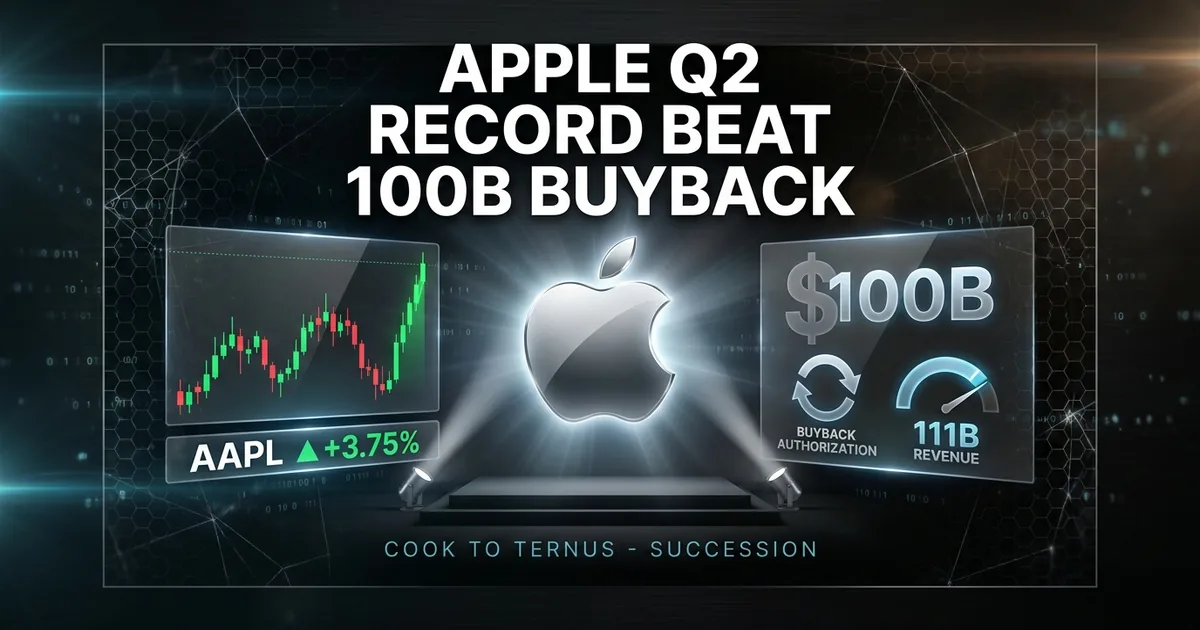
Tim Cook walked into Apple’s Q2 2026 earnings call carrying the kind of farewell present that makes a board look smart. The company posted a March quarter revenue record of $111.2 billion, up 17% year over year, beat consensus on every line that mattered, raised guidance into the June quarter, and then dropped a fresh $100 billion buyback authorization on top of the existing program. The stock rose roughly 3% in the after-hours tape. If you wanted a clean handoff narrative for the most valuable franchise in modern capitalism, this was it.
The succession piece is what separates this print from any other Apple beat. As Apple announced on April 20, Cook becomes Executive Chairman on September 1, and senior vice president of Hardware Engineering John Ternus takes the CEO seat. That made Wednesday’s call less a quarterly check-in than a closing argument. Cook’s argument: services are humming, hardware is recovering, the cash machine is intact, and the next guy is inheriting a balance sheet built for whatever comes after the smartphone.
A Quarter That Looked Like A Mic Drop
The headline numbers are the kind that make the back row of an analyst call quiet down. Revenue of $111.2 billion against a Street consensus of $108.92 billion. Adjusted EPS of $2.01 versus the $1.93 estimate. Gross margin clocked in at 49.3%, ahead of the 48.4% forecast and the highest March quarter print in Apple’s modern history. Earnings rose 22% year over year, the strongest growth pace this fiscal cycle.
Underneath the top line, the segment mix told a more interesting story. Mac revenue came in at $8.4 billion against expectations for $8.02 billion. iPad delivered $6.91 billion, ahead of the $6.66 billion estimate. Wearables, Home and Accessories printed $7.9 billion versus $7.7 billion projected. Services, the segment that has quietly become Apple’s most important growth engine, hit $30.98 billion, up sharply year over year and ahead of the $30.39 billion the Street had penciled in.
The one bruise: iPhone. Apple’s flagship product missed estimates for the second time in three quarters. That is the line item Wall Street will be watching most closely as Ternus inherits a portfolio where the device that built the company is no longer the one driving growth. China revenue, the other historical worry, came in roughly in line with expectations, helped by carrier subsidy promotions and a softer comparison base.
The $100 Billion Buyback Is A Vote Of Confidence, Not A Hail Mary
Apple boards do not authorize $100 billion in fresh repurchases when management is uncertain. The new authorization, paired with a 4% bump in the quarterly dividend to 27 cents per share, signals two things. First, the cash flow story is not breaking: Apple expects to keep printing free cash flow at a level that lets it pay shareholders and still fund whatever AI capex Ternus decides to deploy. Second, the board is telling investors it does not see a transformational acquisition or step-change capex bill on the horizon that would require hoarding the balance sheet.
That is its own kind of statement. While Microsoft talks about $190 billion in 2026 AI investments and Meta lifts its capex range to $145 billion, Apple is signaling that the AI race, at least for the first stretch of the Ternus era, will be run on a tighter budget. That is either disciplined or dangerous, depending on whether you think the company can buy or partner its way to a credible foundation model story before the iPhone refresh cycle catches up to it.
Cook’s Last Quarter And The Question Ternus Now Owns
For Cook, this is the kind of quarter you put in the highlight reel: gross margin record, services record, cash returns expanding, June quarter guidance for revenue growth between 14% and 17% versus a Street looking for 9.5%. He spent his 15 years running Apple turning a hit-driven gadget company into a global services and platforms business, and the segment mix today is the proof. In 2011, the iPhone was 47% of revenue. This quarter it was just under 50%, even with services, wearables, and Mac all hitting fresh highs. The company is bigger and broader than it has ever been.
What Ternus inherits is more complicated than the print suggests. Apple is a hardware company that has not produced a true AI breakthrough product. Apple Intelligence, the on-device AI suite rolled out in 2024 and expanded through 2025, has been received politely rather than enthusiastically. The Vision Pro is a learning vehicle, not a market mover. The car project is gone. The wearables business is mature. The next leg of growth has to come from somewhere, and the obvious candidate is whatever Apple decides to do about its missing foundation-model layer.
Ternus is the right operator for that conversation. The 50-year-old mechanical engineer joined Apple in 2001 and has overseen hardware engineering for nearly every major product in the current lineup, from the latest iPhones to AirPods to the Mac transition to Apple silicon. If the next era is about marrying custom chips with proprietary AI software and tightly integrated devices, his fingerprints are already on every link in that chain. As Bloomberg reported when the succession was announced, Ternus has spent two decades inside the product and silicon engine that makes Apple’s hardware advantage hard to copy. Cook is leaving him a war chest. The question is what war he chooses to fight.
What Wall Street Wants To Hear Next
The June quarter guidance is the more interesting tell than the March print. Apple is calling for 14% to 17% revenue growth, well above the Street’s 9.5% expectation. That implies management sees the iPhone 17 cycle continuing to ramp and services momentum holding. It also implies the company believes its supply chain can absorb the latest round of tariff and Hormuz related cost pressure without margin damage.
The next read for AAPL holders comes at WWDC in June, where Ternus is expected to begin sketching the AI roadmap he wants to own. The earnings beat buys him room. The buyback buys him patience. The succession buys him a clean slate. The hardest part of taking over the most valuable consumer technology company in history is that Cook left almost nothing to fix. The bar is now whether the next decade can be as profitable as the last one.
For now, Apple has done what Apple does. It put up a record quarter, returned more cash than most companies generate in a year, and handed John Ternus the keys with the engine running.