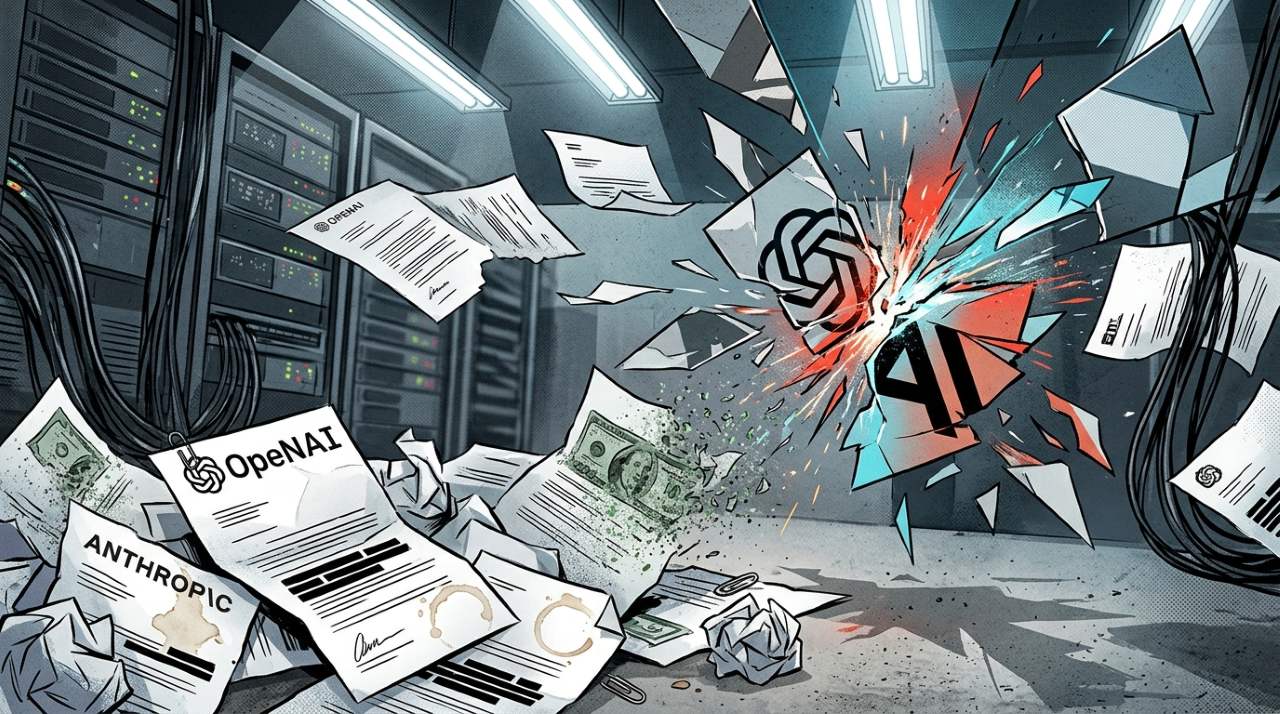
The most consequential rivalry in artificial intelligence is no longer playing out in research papers or benchmark scores. It’s playing out in investor memos, and the gloves have come off. Over the past week, OpenAI’s top revenue executive Denise Dresser circulated a series of internal memos to investors and senior leadership that directly attack chief rival Anthropic, accusing the Claude maker of overstating its revenue by $8 billion, operating on a “meaningfully smaller” compute curve, and building its entire narrative on “fear, restriction, and the idea that a small group of elites should control AI.”
These are not subtle jabs from a press release. This is a corporate knife fight conducted through investor communications, and it tells you everything you need to know about where the AI industry stands in April 2026: two companies collectively valued at over $1 trillion, both circling IPOs, both desperate to convince the market that their version of AI, and their business model, is the one that wins.
The Revenue Accusation
The most incendiary claim in the memos is the revenue one. OpenAI’s Dresser told investors that Anthropic is using “accounting treatment that makes revenue look bigger than it is,” and that the company’s widely reported $30 billion annual run rate is inflated by approximately $8 billion. If true, that would drop Anthropic’s actual run rate to roughly $22 billion, a number that is still enormous but that changes the competitive narrative significantly.
The accusation centers on how Anthropic counts revenue from its cloud provider partnerships, particularly its deals with Amazon Web Services and Google Cloud. When a cloud provider resells Claude API access to its enterprise customers, there’s a legitimate question about whether the gross transaction value or Anthropic’s net revenue share is the right number to report. OpenAI is essentially accusing Anthropic of reporting gross numbers while implying they represent net revenue. Anthropic has not publicly responded to the specific accounting claims.
This matters because both companies are in active conversations about going public. Revenue growth rate and absolute revenue figures are the two metrics that will most directly determine their IPO valuations. If OpenAI can plant doubt about Anthropic’s numbers before either company files an S-1, it gains a meaningful advantage in the investor roadshow.
The Compute Arms Race
The second front in the memo war is about computing infrastructure. OpenAI claims it is planning to reach 30 gigawatts of compute capacity by 2030, while estimating that Anthropic will have roughly 7 to 8 gigawatts by the end of 2027. The implication is that OpenAI will have a structural advantage in training and serving the next generation of AI models simply because it will have access to more raw computing power.
There’s a real argument embedded in this posturing. The scaling hypothesis, the idea that making models bigger and training them on more data consistently produces better results, has been the central bet of the AI industry for four years. If scaling continues to work, then the company with more compute wins. OpenAI is telling investors: we will have more compute, therefore we will have better models, therefore we will win.
Anthropic would counter, and has countered in its own investor materials, that raw compute is not the only path to better models. The company’s research on constitutional AI, interpretability, and efficient training methods suggests that how you use compute matters as much as how much you have. Anthropic also recently announced an expanded chip agreement with Google and Broadcom for 3.5 gigawatts of next-generation TPUs, plus a major infrastructure deal with CoreWeave. The company is not compute-starved. It is making different bets about where compute comes from.
The Microsoft Problem
Perhaps the most revealing detail in the memos is what OpenAI said about its own partner. In a separate communication, OpenAI told investors that Microsoft has “limited our ability” to reach enterprise clients, a stunning admission from a company that has received more than $13 billion in investment from Microsoft and whose products are deeply integrated into Microsoft’s Azure cloud platform.
This is the first time OpenAI has openly acknowledged tension in the Microsoft relationship in investor-facing materials. The complaint appears to center on enterprise sales: OpenAI wants to sell directly to large companies, but Microsoft’s Azure sales team often controls those customer relationships and steers them toward Microsoft’s own Copilot products rather than OpenAI’s API. OpenAI is simultaneously touting a new alliance with Amazon, signaling that it views AWS as an alternative distribution channel that Microsoft cannot control.
The irony is thick. OpenAI is attacking Anthropic for being too dependent on cloud partners while simultaneously complaining that its own cloud partner is holding it back. Both companies are learning the same lesson: in enterprise AI, distribution is as important as technology, and the cloud providers who control distribution have their own interests.
The Philosophical Split
The most personal attack in the memos goes beyond business metrics. Dresser accused Anthropic of constructing its brand narrative “on fear, restriction, and the idea that a small group of elites should control AI.” This is a direct shot at Anthropic’s positioning as the safety-focused AI company, and it frames the competitive dynamic as an ideological battle, not just a market share fight.
OpenAI is betting that the market will reward speed, scale, and openness. Anthropic is betting that the market will reward trust, safety, and reliability. Both companies have multi-billion-dollar revenue streams that validate their approach. The question is which narrative investors find more compelling when the IPO roadshows begin.
What Happens Next
The memo war is a prelude to what will likely be the two most closely watched tech IPOs since the dot-com era. Both companies need to go public to satisfy investors who have poured tens of billions into AI development with the expectation of eventual liquidity. The timing, likely later this year or early 2027, means that every public statement, every investor memo, and every competitive claim is now part of the pre-IPO positioning game.
For enterprise AI buyers, the rivalry has immediate practical implications. Companies choosing between OpenAI and Anthropic for their AI infrastructure are now watching a vendor war that could affect pricing, product roadmaps, and long-term viability. The smart move for CIOs is to avoid betting everything on one provider, but the reality of enterprise procurement is that switching AI vendors is expensive and disruptive once you’re integrated.
For the broader AI industry, the memo war represents a maturation moment. The era of friendly competition and “we’re all working toward AGI together” rhetoric is over. This is now a market share fight between two companies that need to justify trillion-dollar valuations, and they’re willing to attack each other’s financials, strategy, and philosophy to do it. The AI industry just got its Coke vs. Pepsi moment. Except both companies are worth more than Coca-Cola, and neither one has figured out how to be consistently profitable yet.