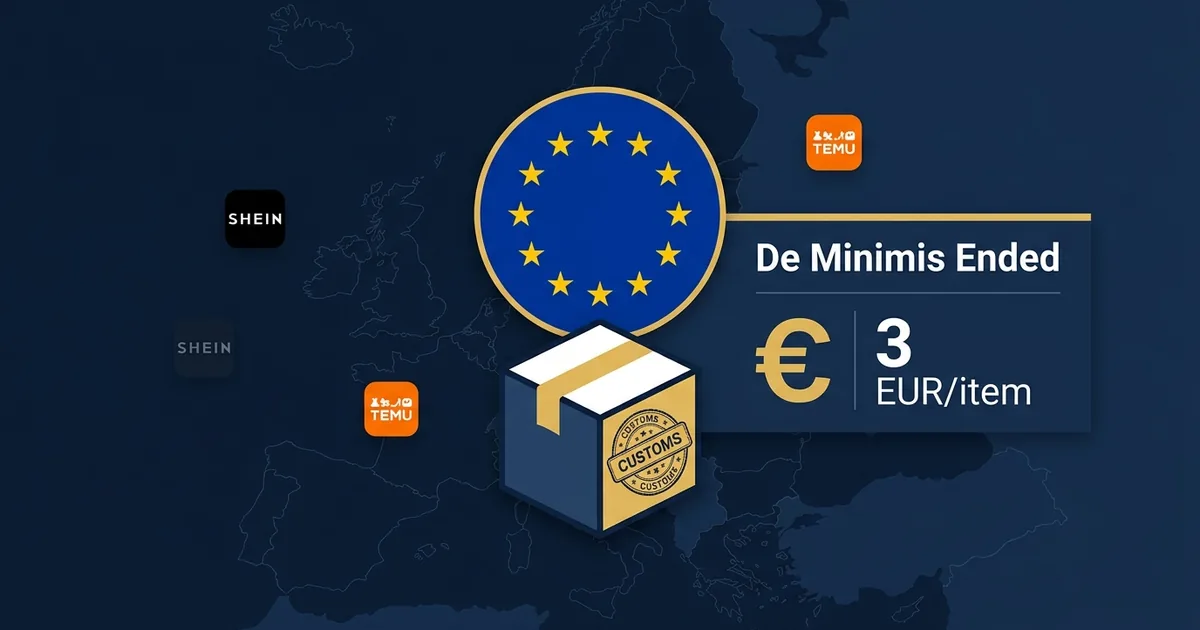
The era of duty-free cheap imports into Europe ended Tuesday. As of July 1, 2026, the European Union abolished the de minimis customs exemption that allowed goods valued under 150 euros to enter the bloc without paying import duties. In its place, a flat 3-euro customs fee now applies per item on qualifying low-value consignments, a change that will ripple through cross-border ecommerce from Shein and Temu to every small merchant shipping to European customers.
What Changed on July 1
The old rule was simple: parcels with an intrinsic value of 150 euros or less entered the EU duty-free. That exemption had been in place for decades and was originally designed for an era of occasional cross-border mail orders, not a world where Chinese ecommerce platforms ship millions of low-value packages to European consumers every week.
The European Council agreed in December 2025 to scrap the exemption and replace it with a temporary flat fee: 3 euros per item, charged per tariff heading within each consignment. That means a package containing three items in different product categories incurs three separate 3-euro charges, not one. The fee is levied on the seller, importer, or their customs representative, not collected from the consumer at the door.
Who Gets Hit
The primary targets are ultra-fast-fashion and discount ecommerce platforms that built their business models on high-volume, low-value shipments. Shein, Temu, AliExpress, and similar platforms have flooded Europe with sub-150-euro packages, exploiting the de minimis threshold to avoid the customs duties that their brick-and-mortar competitors have always paid. That competitive advantage is now gone.
But the impact extends well beyond the Chinese platforms. Any non-EU seller registered in the EU’s Import One-Stop Shop (IOSS) for value-added tax purposes falls under the new regime. The European Commission estimates that covers 93% of all ecommerce flows into the EU, which means small U.S. and U.K. merchants selling directly to European consumers will also face the new charges.
The Bigger Trade Policy Picture
The EU is not acting in isolation. Japan, Thailand, and Mexico have all moved to eliminate or restrict duty-free treatment for small parcels in 2026, and the United States effectively ended its own de minimis exemption for Chinese goods when it imposed tariffs on all imports from China regardless of value. The global consensus has shifted: the de minimis threshold, once a sensible administrative convenience, became a massive trade loophole that subsidized foreign ecommerce platforms at the expense of domestic retailers.
The policy shift also reflects growing concern about product safety and consumer protection. Duty-free parcels often bypassed the safety checks, chemical testing, and labeling requirements that apply to commercially imported goods. European manufacturers and retail associations had been lobbying for the exemption’s removal for years, arguing that it created an uneven playing field where imported goods faced lower regulatory scrutiny than domestically produced alternatives.
What Comes Next
The 3-euro flat duty is explicitly a transitional measure. It runs until July 1, 2028, when the EU Customs Data Hub for ecommerce is expected to go online. At that point, normal customs duties based on each product’s tariff classification will apply to all low-value imports, replacing the flat fee with a more granular system that could mean higher charges on some categories and lower ones on others.
Starting November 1, 2026, sellers will also need to provide product identifier data for all low-value shipments, a requirement that will enable better customs enforcement and product safety screening. That data mandate is technically voluntary from July 1 but will become mandatory in November, adding another compliance burden for cross-border sellers.
The Business Impact
For ecommerce platforms, the 3-euro charge is modest on a per-item basis but adds up at scale. A platform shipping 100 million items per year to the EU faces 300 million euros in new costs before the transitional period even ends. Whether those costs get absorbed by the platform, passed to the seller, or reflected in consumer prices will vary by platform and product category, but the margin compression is real.
For European brick-and-mortar retailers and domestic ecommerce operators, the change is an overdue leveling of the competitive landscape. For years, they have argued that duty-free imports from Asia gave foreign platforms a structural cost advantage that no amount of operational efficiency could offset. That argument just won.
The question now is whether the flat fee is enough to meaningfully change consumer behavior, or whether the convenience and price advantages of cross-border ecommerce will absorb a 3-euro hit without blinking. If history is any guide, the behavioral impact will be modest until the full tariff classification system kicks in at the 2028 deadline. That is when the real cost reckoning begins.