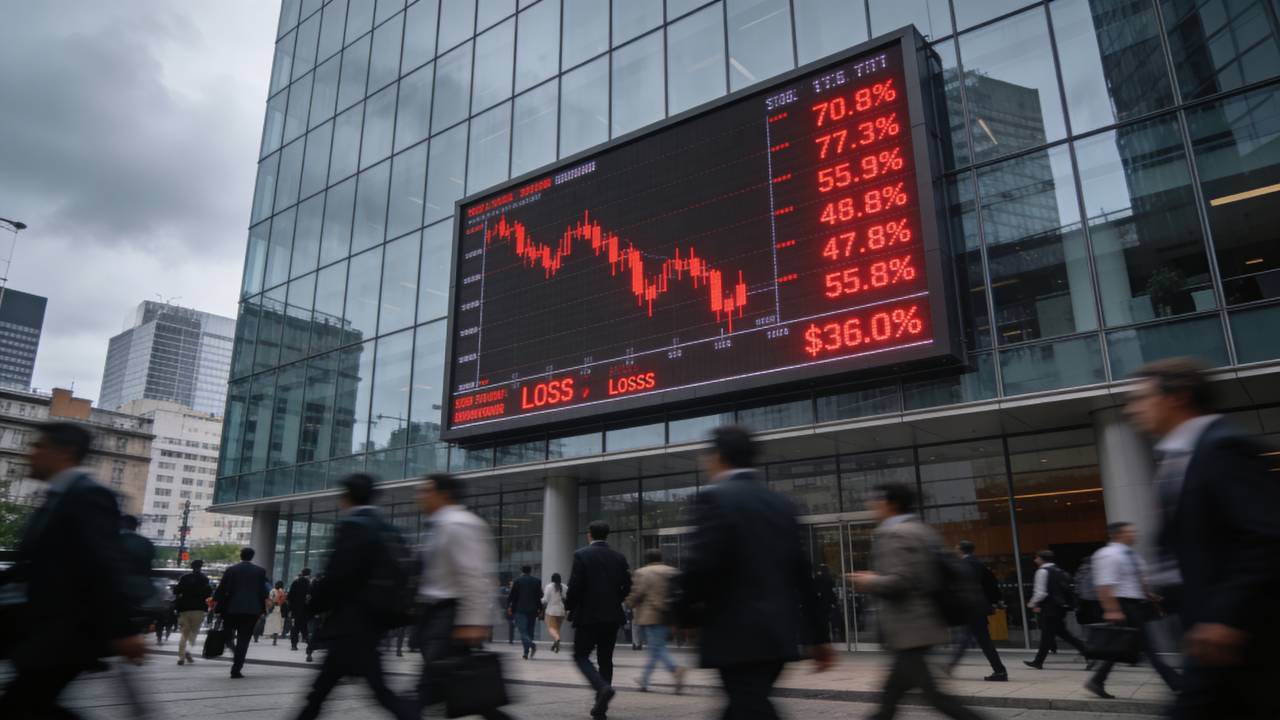
There are weeks when the economic data arrives as a single bad number and you file it away as noise. This is not one of those weeks. In the span of seven days, the American economy has been hit by a catastrophic jobs report, an oil price surge triggered by a shooting war in the Middle East, persistent inflation driven by its own tariff policy, a government shutdown that has now entered its second month, and a Federal Reserve with no good options in any direction. This is not noise. This is a convergence, and it deserves to be reported as one.
The Jobs Report: Worse Than It Looks on the Surface
Friday’s Bureau of Labor Statistics report delivered a February payroll loss of 92,000 jobs, against economist forecasts of a gain of roughly 59,000. The unemployment rate rose to 4.4%. Those are the headline numbers, and they are bad. But the revisions buried underneath are arguably more alarming. December, initially reported as a gain of 48,000 jobs, was revised to a loss of 17,000. January was trimmed from 130,000 to 126,000. The economy has now lost jobs in five of the past nine months. The picture of the labor market that Americans and policymakers were working from was materially wrong, and the corrected version is considerably darker.
The sectoral breakdown tells a structural story, not just a weather story. Yes, the Kaiser Permanente labor strike sidelined more than 30,000 workers in California and Hawaii, accounting for a 28,000-position loss in healthcare that is at least partially recoverable. Yes, severe winter weather dragged on construction and retail hiring. But manufacturing shed 12,000 jobs despite tariffs specifically designed to reshore that employment. Information services lost another 11,000, continuing a 12-month trend of AI-driven structural contraction averaging 5,000 positions per month. Federal government employment fell 10,000, part of a larger contraction that has now eliminated approximately 330,000 federal jobs since October 2024. Transportation and warehousing dropped 11,000. These losses do not melt away when the snow does.
Then the Strait of Hormuz Closed
The jobs report would be the dominant economic story of the week under normal circumstances. These are not normal circumstances. On February 28, the United States and Israel launched military strikes against Iran. Iran’s response included closing the Strait of Hormuz, the narrow waterway through which approximately one-fifth of the world’s seaborne oil and a significant share of global liquefied natural gas supply transits daily. Tanker traffic through the strait has ground to a near standstill. Iran’s Revolutionary Guard declared any vessel attempting passage would be set ablaze. At least five tankers have been damaged.
The energy market reaction was immediate. Brent crude surged 10 to 13% to around $80 to $82 per barrel within days of the conflict beginning. Brent has since extended its gains, rising to $82.76 per barrel as of Wednesday, near its highest level since January 2025, while WTI futures climbed to $75.48. Brent crude has risen 36% year to date. At the pump, the national average price of unleaded gas hit $3.11 per gallon in a single overnight surge of 11 cents, the biggest single-day spike since March 2022, according to GasBuddy. Analysts are forecasting the national average could reach $3.25 to $3.50 in coming weeks, with higher spikes in western states.
The Hormuz disruption is not just an oil story. QatarEnergy halted activity at the world’s largest liquefied natural gas export facility after it was targeted in an Iranian drone attack, while tanker traffic through the Strait of Hormuz has come to a near standstill, threatening roughly a quarter of global seaborne oil trade and a fifth of LNG supply. European natural gas prices have nearly doubled. Analysts forecast prices could reach $100 per barrel if disruptions persist, potentially adding 0.8% to global inflation. For an American economy already dealing with tariff-driven cost increases, this is not a minor external shock. It is gasoline on a fire that was already burning.
Tariffs, Oil, and the Inflation Vise
The cruel mathematics of the current moment is that inflation is being driven from multiple directions simultaneously, and none of them are easy to turn off. Tariffs on imported goods are a permanent, policy-driven cost increase baked into every supply chain that touches foreign inputs, which is to say most of them. The Iran war has now added an energy price shock on top of that structural inflation. Companies were already planning price increases for 2026 because of tariffs. The Iran conflict layered an additional set of cost pressures on top, with economists warning that higher shipping costs and elevated insurance premiums will filter through to consumers in the coming months.
The tariff argument was always that short-term cost increases would be offset by long-term job creation, particularly in manufacturing. February’s jobs report is the most direct empirical test of that thesis yet. Manufacturing lost 12,000 jobs in a month when the tariffs were fully operational. The jobs did not come. The cost increases did. That is the worst possible outcome of trade protectionism: inflation without the compensating employment gains. Add an oil shock to that equation and the inflationary pressure becomes genuinely difficult to contain regardless of what any central bank does.
The Federal Reserve Has No Good Move
Former Treasury Secretary Janet Yellen put the Fed’s dilemma plainly this week. The Iran conflict puts the Fed even more on hold, more reluctant to cut rates, she said, noting that US inflation already stood at 2.4% in January, above the Fed’s 2% target, and warning that tariffs alone could push annual inflation to at least 3%. Now add an oil shock to that inflation baseline.
This is the stagflation trap in its purest form. Cutting rates to address a softening labor market risks accelerating inflation that is already running above target and being fed by two independent structural forces, tariffs and an oil shock, that monetary policy cannot directly address. Holding rates steady while jobs continue to disappear risks allowing a labor market deterioration to compound into a genuine contraction. There is no interest rate that fixes both problems simultaneously. Nomura economists summarized the bind succinctly, noting that the Iran conflict solidifies the case for many central banks to hold rates steady, as policymakers juggle the delicate task of balancing inflationary risk against slowing growth. That is a polite way of saying the central bank is paralyzed.
The Consumer Is Starting to Crack
Consumer spending drives roughly 70% of the American economy. It is the variable that, when it turns, turns everything with it. The early data is not encouraging. The Commerce Department reported retail sales dipped 0.2% in January following a flat reading the prior month. Gas prices are now surging, which functions as an immediate, regressive tax on household budgets, consuming disposable income that would otherwise flow to discretionary spending. Federal workers who have lost jobs are pulling back on purchases and delaying major decisions. The self-reinforcing dynamic of a consumer-led contraction, less spending, less revenue, less hiring, less income, is at least beginning to show its shape in the data.
The timing is particularly punishing. Americans were already dealing with what economists were calling a broad affordability crisis heading into 2026, with housing costs, food prices, and borrowing costs all elevated. Gas at $3.50 per gallon does not exist in isolation. It lands on top of a household budget that is already stretched, and it reduces the margin for error in a way that shows up in consumer confidence surveys before it shows up in GDP figures.
What Businesses Should Be Watching
The immediate variables that will determine whether this week’s convergence resolves or compounds are largely outside the control of any business operating in the United States. The duration of the Iran conflict and the Hormuz disruption is the single biggest swing factor in the near-term economic outlook. Energy traders are currently pricing the conflict through a shorter-term lens, with markets well-positioned to weather a short disruption given recent global oil oversupply and strong stockpiles, particularly in China. But a sustained closure of the strait, or an escalation that draws in Gulf states, changes that calculus entirely and pushes oil toward the $100 threshold that analysts have identified as the trigger for broader global economic damage.
For businesses with energy-intensive operations, the immediate priority is locking in fuel cost exposure where possible. For businesses dependent on imported components, the combination of tariffs and Hormuz-driven shipping disruptions represents a double hit to input costs. For companies planning Q2 hiring, the labor market picture is murky enough that caution is warranted. And for anyone watching the federal contracting and procurement space, the ongoing government shutdown continues to disrupt payment flows and project timelines in ways that will take months to fully surface in reported data.
The word stagflation is uncomfortable to use because it implies a level of entrenchment that markets and policymakers instinctively resist acknowledging. But the definition of the condition is rising prices plus slowing growth plus rising unemployment, all occurring at the same time. Check the jobs report. Check the oil price. Check the tariff schedule. Check the retail sales number. Check all of them together. The definition fits.
Full February 2026 Employment Situation report, Bureau of Labor Statistics.