BlackRock opened trading of a new kind of Bitcoin product on Nasdaq on Tuesday, and the timing tells you everything about where the institutional crypto race is headed.
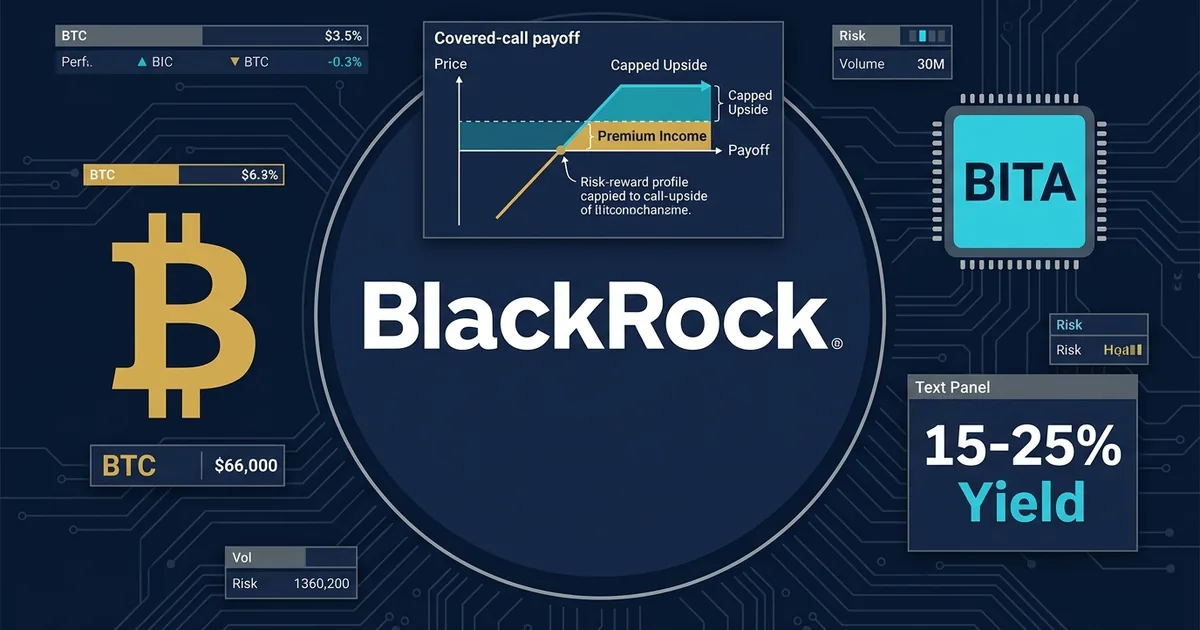
The iShares Bitcoin Premium Income ETF, trading under the ticker BITA, is the first exchange-traded fund designed to generate yield from Bitcoin without requiring investors to sell their holdings. Bitcoin News reported that BlackRock beat Goldman Sachs to market by several weeks, with Goldman’s competing product not expected until early July.
How BITA Actually Works
The mechanics are straightforward for anyone familiar with options strategies, though the application to Bitcoin is new. BITA holds shares of BlackRock’s existing iShares Bitcoin Trust (IBIT), the spot Bitcoin ETF that has already accumulated massive inflows since its January 2024 launch. On top of that position, the fund sells covered call options on IBIT to generate premium income.
KuCoin’s analysis of the launch noted that BITA targets 15% to 25% annual yield through this strategy, while capturing roughly 70% of Bitcoin’s upside. The trade-off is capped gains: when BTC rallies hard, BITA holders participate in most of the move but not all of it.
The expense ratio is 0.65%, which undercuts BlackRock’s likely competitors by roughly 30 basis points. For context, IBIT itself charges 0.25%.
Why This Matters Beyond Crypto
BITA is not just a crypto product. It is a signal that the world’s largest asset manager now views Bitcoin as a yield-generating asset class, not merely a speculative one. That is a meaningful philosophical shift. For the past decade, the knock on Bitcoin from traditional finance has been that it produces no income, no dividends, no cash flow. BITA does not change Bitcoin’s fundamental nature, but it does change how institutions can package it for income-seeking portfolios.
The timing also matters. Bitcoin is trading around $66,300 on Monday, consolidating after a volatile stretch that saw it dip to $59,130 during the recent AI trade unwind before recovering sharply on geopolitical relief from the U.S.-Iran peace deal. The market is watching today’s opening of the Fed’s June FOMC meeting, with the rate decision Wednesday likely to set the near-term direction for risk assets including crypto.
The Competitive Landscape
Goldman Sachs has a similar Bitcoin income product in the pipeline, expected in early July. JPMorgan has been building out its own crypto-structured products unit. The race to offer institutional-grade Bitcoin yield products mirrors what happened with spot Bitcoin ETFs in 2024, when BlackRock’s IBIT dominated the field within months of launch.
BlackRock’s first-mover advantage here is real but narrow. The covered-call ETF structure is well understood on the equity side, and any major asset manager can replicate it on IBIT. What BlackRock has that others do not is distribution: its relationship network across pension funds, endowments, and RIAs means BITA will land in front of allocators who would never buy Bitcoin directly but might allocate to a yield product managed by the most trusted name in asset management.
What to Watch
The key metric in BITA’s first weeks will be day-one inflows relative to its competitors’ equity-based covered call ETFs. If BITA attracts meaningful capital quickly, it validates the thesis that there is institutional demand for Bitcoin yield, not just Bitcoin exposure. If flows are tepid, it suggests the income-seeking buyer still is not ready for crypto volatility, even in a buffered wrapper.
Either way, the product exists now, and that alone changes the conversation about what Bitcoin is for.