The claim. The special committee “determined that this transaction provided the greatest value for the Company’s minority shareholders.”
The counter-fact. After 85 days of negotiating, the committee got $2 a share more than the opening bid, and $3 to $5 less than where the stock traded the week that bid landed.
Penske Automotive Group is going private at $212 a share in cash, and the coverage has settled on a tidy story: Roger Penske takes his dealership empire home. The merger announcement Penske Automotive filed Thursday supports a different emphasis. The bigger cash buyer is Mitsui & Co., the Japanese trading house that has held a stake for 25 years, and the price the minority is being asked to accept is barely above the number Penske Corporation and Mitsui opened with in July.
Shares jumped about 9% on Thursday to close near the deal price. That is the market saying the deal will happen. It is not the market saying the price is generous.
Who Is Writing the Check
Mitsui’s own release, filed with the SEC alongside the deal, is the document nobody quoted. It is written for Tokyo investors in yen, and it lays out the money.
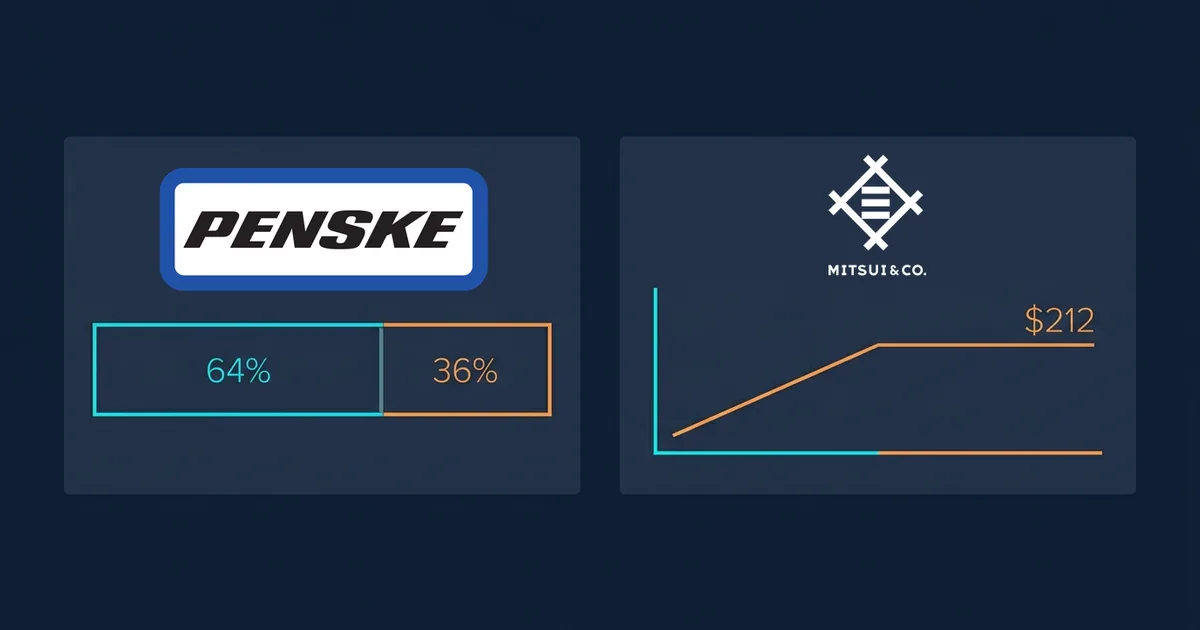
Before the deal, Penske Corporation and a subsidiary held about 52.1% of Penske Automotive, Mitsui about 20.3%, and public shareholders about 27.7%. After it closes, Penske Corporation will own about 64% and Mitsui about 36%.
Run that forward. Penske Corporation gains about 11.9 percentage points. Mitsui gains about 15.7. Of the roughly 27.6 points of public stock being bought out, Mitsui takes 57%.
The equity commitments match the split. Mitsui and Penske Corporation “have committed to provide equity financing to Buyer of up to US$1.6 billion (240 billion yen) and US$600 million (90 billion yen), respectively.” Mitsui supplies 73% of the $2.2 billion in committed equity. The rest of the bill is borrowed: the buyer “intends to finance the transaction through borrowings from one or more third-party lenders.”
How big is that bill? The July proposal priced the public stake at about $3.8 billion at $210 a share, which works out to roughly 18.1 million public shares. At $212, the cash going to public holders is about $3.84 billion. Take away the $2.2 billion of equity and something like $1.6 billion has to come from lenders, before fees.
So the man whose name is on the building is adding the smaller slice, with a lighter equity check, and leaning harder on debt. Mitsui is paying for most of the stock it gets in cash.
What 85 Days Bought the Minority
Penske Automotive confirmed the opening proposal on July 22: $210 a share, unsolicited, preliminary, non-binding. The board formed a special committee of independent directors, which hired Moelis & Company and Paul, Weiss to advise it.
The final number is $212. That is a 0.95% improvement.
Multiply it out. About 18.1 million public shares times $2 is roughly $36 million, total, to every outside holder combined. On a deal with an enterprise value of about $16.3 billion, the committee’s negotiation moved the price by about two-tenths of one percent of enterprise value.
That does not mean the committee did nothing. It means the committee had almost nothing to negotiate with.
The Stock Told You Where the Leverage Went
Here is the price path, reconstructed from the premiums in the company’s own release and the trading reports from July.
- July 21, the day before the bid: about $195.21. The release says $212 is an 8.6% premium to that close.
- July 23 and 24: the stock pushed through the offer and settled around $217. Morgan Stanley, downgrading the shares, said trading around $215 meant the market was “embedding a non-zero probability of a higher bid.”
- October 14, the day before the deal: about $194.78. The release calls $212 an 8.84% premium to that close.
- October 15: about $212, at the deal price.
In late July, buyers were willing to pay more than $210 because they expected the committee to win a raise. By mid-October that expectation was gone and the stock sat 7% below the standing offer. A stock trading below a controller’s bid tells the controller that walking away costs nothing. A special committee across the table from that chart is not negotiating. It is waiting.
Why No One Else Could Bid
The bidders already owned 72.6% of the stock. No rival could buy Penske Automotive without them, and the deal terms include no go-shop period to test for one. The committee’s only alternative to a deal was no deal.
That structure is the whole problem with “greatest value.” Greatest compared to what? There was no auction, no competing bid, and no way to run one. The phrase is a conclusion about a market that was never allowed to form.
The One Real Protection
The deal does carry a condition that matters. It requires “approval by holders of a majority of the votes cast by unaffiliated stockholders,” which means the roughly 27.7% outside the Penske and Mitsui camp decide. It is not subject to a financing condition and is expected to close in the first quarter of 2027.
Majority-of-the-minority votes are the reason courts give controller buyouts more deference, and they only work if holders treat the vote as a real choice instead of a formality.
Our Read
$212 is not a bad price. It is a price nobody was allowed to beat.
The special committee’s statement asks minority holders to accept its judgment on faith, and the record so far does not earn it. Two dollars over 85 days, with no market check, is a negotiation the controllers could not lose. The committee deserves some credit for extracting the majority-of-the-minority condition, which is the single lever outside holders have left.
What should happen next is specific. The proxy has to show the full range of values Moelis computed for its fairness opinion, every counteroffer the committee made, and whether it ever asked for a go-shop. If Moelis’s range sits meaningfully above $212, the committee settled below its own adviser’s math, and holders should vote no. If the range brackets $212, the price stands, and the story is simply that Mitsui wanted more of a luxury-heavy dealer group and paid for most of it in cash.
Questions Shareholders Are Asking
Can minority shareholders block the deal?
Yes, in principle. The merger needs approval from a majority of the votes cast by stockholders not affiliated with Penske Corporation or Mitsui. If outside holders vote it down, the deal fails even though the buyers own 72.6% of the company.
Will Penske Automotive keep paying dividends?
The company can keep paying quarterly cash dividends until closing, but any increase is capped at $0.02 a share above the current level, according to the merger announcement.
When does the deal close?
The companies expect to close in the first quarter of 2027. The deal has no financing condition, though part of the purchase is funded with borrowed money that the buyers say is already committed.
What Mitsui Gets
Penske Automotive runs dealerships in seven countries and employs more than 28,900 people, and Morgan Stanley’s note on the bid pointed to a brand portfolio with a luxury skew above 70%. Mitsui’s release promises to “support PAG’s business development” across its network, which is a long way of saying it wants a bigger share of a cash-generating business it already knows. After 25 years as the junior partner, it is still the junior partner, only now it is putting up most of the new equity to stay one.