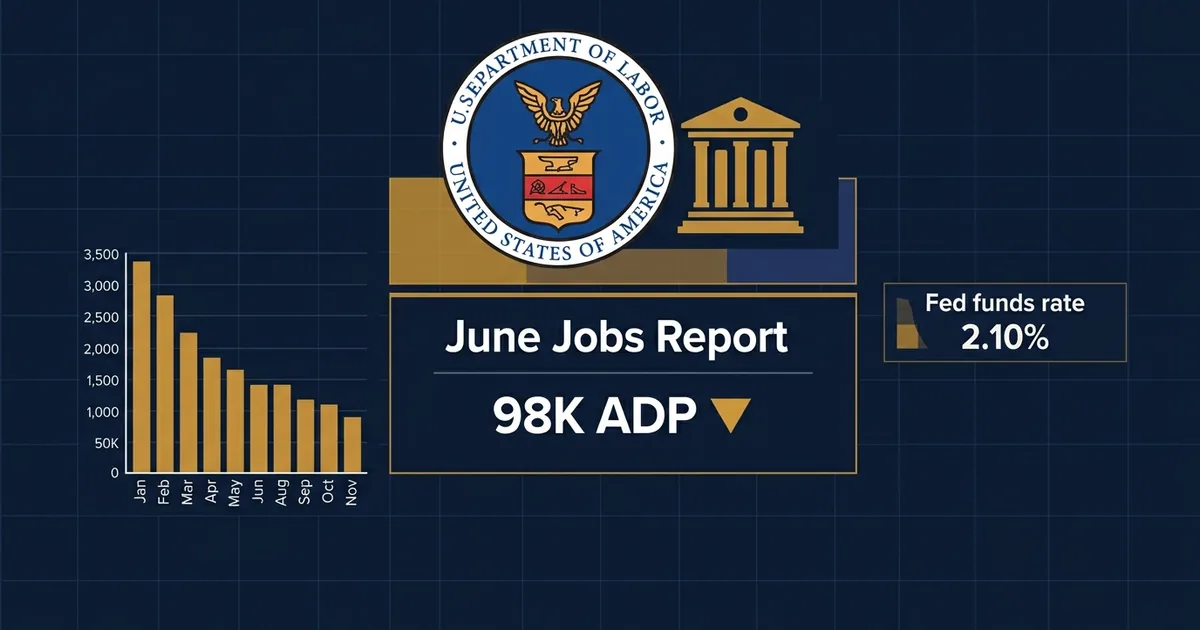
The June nonfarm payrolls report drops at 8:30 a.m. Eastern Thursday, and the preview data already suggests the labor market is losing momentum at exactly the wrong time for a Federal Reserve that still has its foot on the brake.
The ADP Preview Points Down
Private sector employers added just 98,000 jobs in June, according to ADP’s National Employment Report released Wednesday, a notable deceleration from the revised 122,000 in May and well below the consensus forecast of 120,000. The ADP number is not a perfect predictor of the Bureau of Labor Statistics’ nonfarm payrolls count, but the directional signal is clear: hiring is cooling.
Economists expect the official number to come in around 100,000 to 115,000 new jobs, down sharply from 172,000 in May. FactSet’s consensus sits at 100,000, which would mark the slowest month of job creation since early 2024. The unemployment rate is projected to hold steady at 4.3%, a level that looked comfortable six months ago but now sits uncomfortably close to the threshold where the Fed’s dual mandate starts pulling in opposite directions.
Why This Report Matters More Than Usual
The timing turns a routine monthly data release into a potential market catalyst. Fed Chair Kevin Warsh just spent Tuesday at the ECB Forum in Sintra telling global central bankers that inflation remains “too high” and that the Fed will not tolerate prices running above the 2% target. Markets interpreted the remarks as hawkish, with futures briefly pricing in a higher probability of a rate hike at the next FOMC meeting.
A weak jobs number would complicate that narrative. If hiring is genuinely slowing, the case for tightening further weakens regardless of where inflation prints. The Fed would face the uncomfortable choice between fighting residual inflation with higher rates and risking a labor market downturn that could tip the economy into recession. That tension is exactly why stock futures fell Thursday morning, with S&P 500 futures down 0.08% and Nasdaq-100 futures dropping 0.3%.
The Sector Story Behind the Numbers
The ADP data revealed divergent trends beneath the headline. Services-sector hiring continued to drive the bulk of job creation, while manufacturing payrolls remained flat or slightly negative. Construction showed modest gains, but the temporary staffing category, historically a leading indicator for broader labor market direction, posted its third consecutive monthly decline.
That pattern matters for how the Fed reads the report. A headline miss driven by temporary staffing weakness and manufacturing softness, with services holding steady, looks more like a structural shift than a cyclical downturn. It could give Warsh and his colleagues room to argue that the labor market is “normalizing” rather than deteriorating, which would keep the hawkish bias intact.
What Markets Are Pricing
Bond markets have already started moving. The 10-year Treasury yield dipped below 4.2% overnight as traders positioned for a soft print. If the actual payrolls number comes in below 100,000, expect a sharp rally in bonds and growth stocks as rate-hike expectations get repriced lower. A number above 130,000 would likely extend Wednesday’s equity selloff, particularly in rate-sensitive sectors like real estate and utilities.
The semiconductor selloff that swept from Wall Street to Asia Thursday morning adds another layer of volatility. With chip stocks already under pressure from profit-taking, a strong jobs print that reinforces the higher-for-longer rate thesis could accelerate the rotation out of growth and into value names.
The Bigger Picture
The June jobs report arrives at a genuine inflection point for the U.S. economy. Consumer spending has begun to moderate, credit card delinquencies are rising, and the tariff refund windfall that boosted corporate earnings in Q2, most notably Nike’s $986 million recovery, is a one-time event that will not repeat. If the labor market is indeed cooling alongside these trends, the second half of 2026 looks meaningfully different from the first.
For investors, the number to watch is not just the headline payrolls print. Wage growth, hours worked, and labor force participation will tell the Fed whether the tightness that drove inflation is easing or simply reshuffling. The answer determines whether the next Fed move is a hold, a hike, or something nobody is currently pricing in.