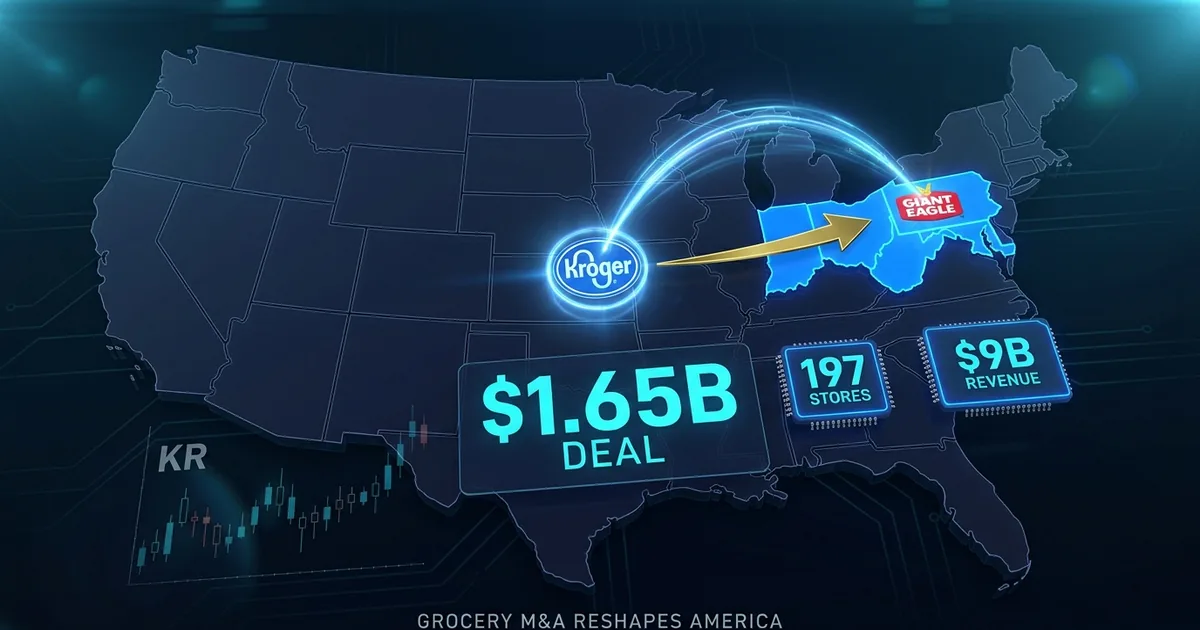
Kroger just made the deal that Albertsons was supposed to be. The Cincinnati-based grocery giant announced on Tuesday that it will acquire family-owned Giant Eagle for $1.65 billion, picking up 197 supermarkets and 11 pharmacies across five states in a move that rewrites its post-merger-collapse playbook.
The Deal Math: Cash, Debt, and a Leaner Target
The purchase price breaks down to $1.25 billion in cash plus roughly $400 million in assumed liabilities. Giant Eagle, which generated approximately $9 billion in annual sales, gives Kroger a concentrated foothold across northern Ohio, western Pennsylvania, West Virginia, Maryland, and Indiana, markets where Kroger’s existing store count is thin or nonexistent.
Kroger CEO Greg Foran called it a “strong strategic fit,” telling investors the two companies share an “unwavering focus on delivering for customers.” Translation: Giant Eagle’s regional density fills gaps that Kroger’s organic growth never closed. The Kroger investor relations page laid out the financial guardrails: net debt to adjusted EBITDA stays at 2.3 to 2.5 times, the dividend holds, and the $2 billion share buyback continues. The company expects the deal to be accretive to adjusted earnings per share in the second full year after close.
Notably, this is a far simpler target than Albertsons. Giant Eagle is a private, family-owned chain. There are no dueling shareholder lawsuits, no publicly traded stock to arbitrage, and far fewer overlapping stores to trigger regulatory alarm bells.
Why Now: The Albertsons Hangover and the FTC Lesson
The timing here is not accidental. Kroger spent two years and hundreds of millions in legal fees trying to close its $24.6 billion Albertsons merger, only to watch the FTC kill it in court in late 2024. That collapse left Kroger with the same strategic problem it had before: Walmart dominates the national grocery landscape, and Kroger needs regional density to compete on logistics, supply chain, and private-label economics.
Giant Eagle solves that problem surgically. Instead of a coast-to-coast mega-merger that regulators will reflexively challenge, Kroger is buying a concentrated regional chain in markets where antitrust overlap is minimal. The company acknowledged it anticipates “limited store divestitures” to clear Hart-Scott-Rodino review, a signal that both sides already know which handful of stores would need to go. The deal is expected to close in 2027.
This is also a structurally different kind of target. Giant Eagle sold its GetGo convenience store and fuel business to Alimentation Couche-Tard last year, stripping the chain down to its core supermarket and pharmacy operations. That makes integration cleaner and keeps Kroger out of the gas station business, which carries its own margin headaches and environmental liabilities.
What Giant Eagle’s Family Gets Out of It
Giant Eagle has been a Pittsburgh institution for decades, but the family-ownership model was showing strain. With GetGo already gone, what remains is a supermarket and pharmacy operation facing the same margin squeeze every regional grocer confronts: Walmart on price, Amazon on delivery, Costco on bulk, and dollar stores on the low end.
For the owning family, $1.65 billion is a clean exit from a business environment that rewards national scale and punishes regional independence. The grocery industry has consolidated relentlessly since the pandemic, with labor costs, supply chain disruptions, and inflation squeezing operators who lack the buying power to negotiate supplier terms at Walmart-level volumes.
The Regulatory Question: Will the FTC Let This One Through?
This is where Kroger’s Albertsons experience actually helps. The FTC’s objection to Albertsons was straightforward: too many overlapping stores in too many metro areas, creating local monopoly risk. Giant Eagle operates in a geographic corridor where Kroger’s existing presence is limited, reducing the overlap problem dramatically.
Kroger’s SEC filing signals confidence. The company structured the deal with built-in divestiture expectations, which suggests pre-deal conversations with antitrust advisors that went well enough to move forward. The contrast with Albertsons is stark: $1.65 billion versus $24.6 billion, 197 stores versus 2,200, and a geographic footprint that barely overlaps with Kroger’s existing network.
Still, no deal is guaranteed. If the FTC decides that grocery M&A in general is a problem category, even a clean geographic fit could face extended review. But recent precedent, including the DOJ’s clearance of the Paramount-WBD merger without concessions, suggests that regulators are distinguishing between deals that reduce competition and deals that build complementary scale.
What This Means for the Grocery Landscape
KR shares dipped roughly 1% in premarket trading on the announcement, a mild reaction that suggests Wall Street views this as a sensible bolt-on rather than a risky bet. The market is pricing in execution risk, not strategic doubt.
For consumers in Giant Eagle territory, the near-term impact is likely positive. Kroger’s supply chain muscle and private-label brands, Simple Truth and Private Selection, should bring lower prices on store-brand goods. The pharmacy integration could improve prescription pricing through Kroger’s existing PBM relationships.
The bigger picture is the one Kroger is quietly assembling. After Albertsons failed, the company signaled it would pursue smaller, more targeted acquisitions. Giant Eagle is the proof of concept. If this closes cleanly, expect Kroger to keep shopping for regional chains in markets where it lacks density. The grocery war is not being won by a single mega-merger. It is being won store cluster by store cluster, and Kroger just bought the next one.