The biggest media merger in a generation just cleared its last federal hurdle, and the Justice Department did not extract so much as a handshake promise in return.
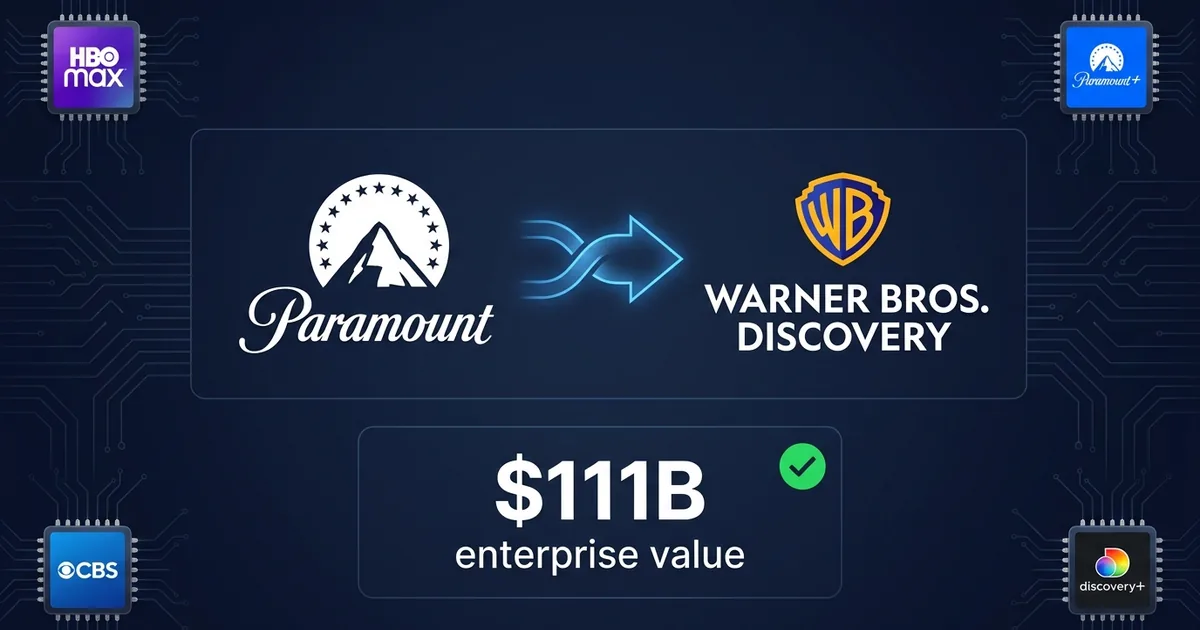
The DOJ’s Antitrust Division formally closed its investigation into Paramount Skydance’s proposed acquisition of Warner Bros. Discovery on Thursday, approving the $111 billion deal without requiring any divestitures, behavioral remedies, or concessions. The official DOJ statement confirmed that after reviewing more than two million documents over eight months, the division concluded the transaction posed no likely harm to competition or American consumers.
What the Combined Company Looks Like
Paramount is acquiring 100% of WBD at $31 per share in cash, representing an $81 billion equity value and roughly $110 billion in enterprise value. The combined entity will control HBO, Max, Paramount+, CNN, Warner Bros. Studios, Paramount Pictures, CBS, TNT, TBS, Discovery Channel, and a deep library catalog stretching from Harry Potter to Yellowstone.
The deal’s logic is consolidation arithmetic. Both companies face the same structural squeeze: legacy pay-TV revenue is eroding, streaming margins remain razor-thin, and the cost of premium content production keeps climbing. Together, they can rationalize overlapping content pipelines, merge two streaming platforms into one with genuine scale, and spread the fixed costs of sports rights across a larger subscriber base.
David Ellison, who engineered the Skydance takeover of Paramount that preceded this deal, is betting that a combined media giant can compete with Netflix, Disney, and Amazon in a market that has proven hostile to mid-tier players.
Why the DOJ Waved It Through
The Antitrust Division’s analysis focused on three markets: streaming video on demand, linear television, and studio development and distribution of films for theatrical release. In all three, the division found insufficient evidence that the merger would reduce competition.
That conclusion is less surprising than it sounds. The streaming landscape has fragmented so aggressively that even a Paramount+Max combination would trail Netflix, Amazon Prime Video, and arguably YouTube in total engagement hours. In linear TV, cord-cutting has already removed the pricing power that once made cable bundle economics a regulatory concern. And in theatrical distribution, the studio system now competes with direct-to-consumer releases, international co-productions, and a flood of independent content funded by private equity.
The DOJ’s reasoning, as Variety reported, essentially acknowledged that the competitive threat to consumers comes not from traditional media consolidation but from the tech platforms that have rewritten distribution economics entirely.
State Attorneys General Could Still Block the Path
Federal clearance does not mean the deal is done. The European Union’s competition authority began its own review and set a July 14 deadline for an initial ruling. More consequentially, a coalition of state attorneys general in California, New York, and roughly a dozen other states is actively weighing an antitrust challenge. Their concern centers on local broadcast markets and regional sports networks, where the combined company’s footprint could give it outsized bargaining power with advertisers and distributors.
WBD shareholders already approved the transaction at a special meeting on April 23. But if state-level litigation materializes, it could delay closing past the Q3 2026 target. The deal includes a $0.25 per share ticking fee for each quarter the transaction remains unclosed past September 30, a provision that creates financial pressure on both parties to resolve regulatory challenges quickly.
The Bigger Picture for Media
This deal crystallizes a reality the media industry has been circling for years: the era of standalone legacy media companies is ending. Warner Bros. Discovery, which was itself a merger product when AT&T spun off WarnerMedia and combined it with Discovery in 2022, never achieved the scale or streaming economics its architects promised. Paramount, even after the Skydance infusion, faced the same treadmill of rising content costs and shrinking linear revenue.
The combined company will carry significant debt, and its success depends on execution: merging streaming platforms without subscriber churn, cutting overlapping costs without gutting creative pipelines, and renegotiating sports rights deals that have historically been priced for a cable-era subscriber base that no longer exists. The advertising sales operation across CBS, CNN, TBS, TNT, and Discovery’s cable networks will need rapid consolidation to compete with the programmatic scale that Google and Meta offer buyers.
For investors, the immediate signal is that Washington under the current administration is not inclined to block horizontal media consolidation. That has implications well beyond this deal, potentially opening the door for further combinations among the remaining mid-tier players. The question is whether bigger actually means better in a market where Netflix has proven that technology, algorithm-driven content investment, and global scale matter more than library depth alone.