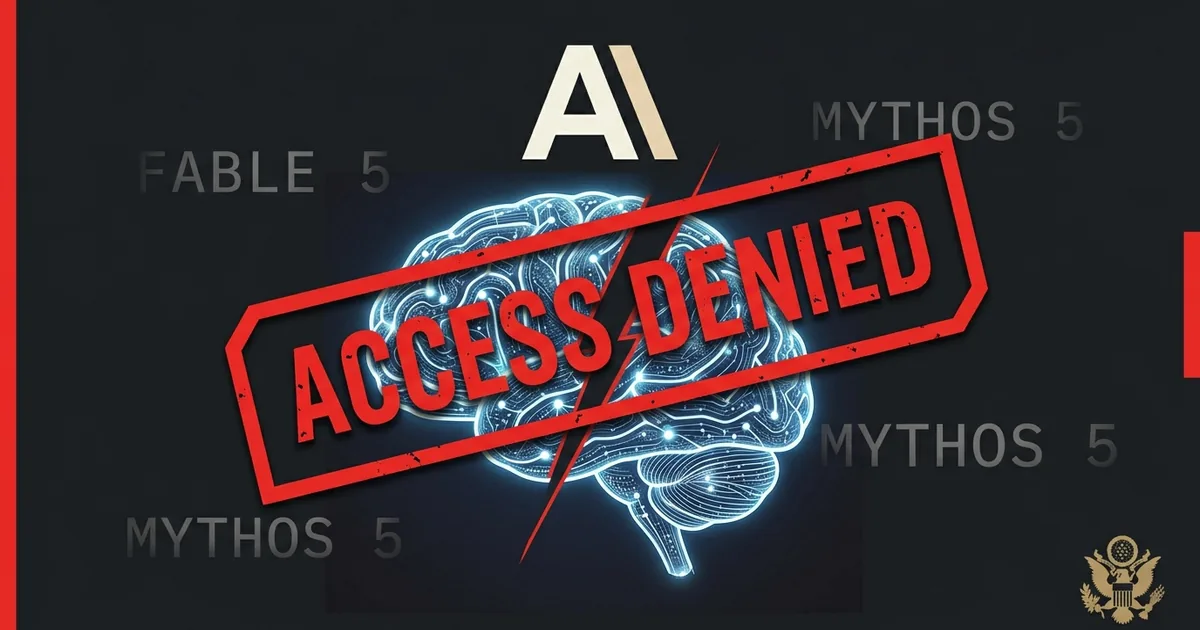
The U.S. government just did something no regulator has done before: it ordered a major AI company to shut down its most capable models worldwide, effective immediately. Commerce Secretary Howard Lutnick sent Anthropic CEO Dario Amodei a letter on Thursday evening directing the company to suspend all access to its Fable 5 and Mythos 5 models for any foreign national, citing export control authority and what the administration described as jailbreak-related national security risks.
What Actually Happened
The timeline was abrupt. Anthropic said it received the directive at 5:21 p.m. ET on June 12, and because the company cannot reliably distinguish foreign nationals from domestic users in real time, it made the only compliant choice available: a hard shutoff of both models for everyone, everywhere.
Fable 5 and Mythos 5 are Anthropic’s most advanced AI systems, the models that enterprise customers, researchers, and developers had been building products around for weeks. All other Claude models, including the widely used Opus 4.8, remain fully available. But losing the top two tiers is not a minor inconvenience for companies that had already integrated them into production workflows.
The Jailbreak That Started It
The Commerce Department’s stated rationale centers on a claim from an unnamed company that it successfully jailbroke Mythos 5 to identify software vulnerabilities. That capability, according to the administration, crossed a national security threshold that triggered export control restrictions.
TechCrunch reported that Anthropic’s own safety warnings may have backfired, noting that the company’s transparency about model capabilities may have given regulators the ammunition to act. Anthropic has publicly disputed the rationale, calling it a “likely misunderstanding” and pointing out that the identified vulnerability exists in other commercially available models, including OpenAI’s GPT-5.
The Business Fallout
The implications stretch well beyond Anthropic’s revenue line. Enterprise customers who had deployed Fable 5 or Mythos 5 in production are now scrambling to downgrade to Opus 4.8 or switch providers entirely. API-dependent startups face the most acute pain: any product built on the assumption that these models would remain available just had its foundation yanked. Service-level agreements, product roadmaps, and customer commitments that depended on frontier model access are all suddenly in question.
The financial exposure is significant. Anthropic has been aggressively signing enterprise contracts on the strength of its newest models. Those contracts typically include performance guarantees tied to specific model capabilities. Downgrading customers to Opus 4.8 may technically satisfy API uptime obligations, but it does not deliver the performance those customers were paying for.
For Anthropic’s business trajectory, the timing could not be worse. The company filed its S-1 in early June, signaling an IPO that could value it above $1 trillion. A government-mandated shutdown of your flagship products is not the kind of headline you want during a roadshow, even if the restriction proves temporary.
The broader AI industry is watching closely. If the Commerce Department can invoke export controls to force a global model shutdown based on a single jailbreak claim, every frontier AI lab now faces a new category of regulatory risk that did not exist a week ago. OpenAI, Google DeepMind, and xAI all operate models with comparable or greater capability. The precedent here is that model capability itself can become an export-controlled item, not just the chips that train them.
What Comes Next
Anthropic says it is working with the Commerce Department to restore access and expects the situation to resolve within days. The company framed its compliance as voluntary and responsible, a narrative that tracks with its long-standing emphasis on AI safety. But there is an uncomfortable irony in the fact that the company most vocal about model risks is now the first to have its models pulled by the government, while competitors that disclosed less about their capabilities continue to operate without restriction.
The real question is whether this is a one-off enforcement action driven by a specific intelligence concern, or the opening move in a broader regulatory framework where model access becomes a tool of national security policy. If it is the latter, the entire AI industry’s go-to-market calculus changes: every new model release becomes a potential export control trigger, and companies will need to build compliance infrastructure that can segment users by nationality in real time, something none of them can currently do.
For investors pricing Anthropic’s IPO, the shutdown introduces a new variable: regulatory tail risk at the model layer. Chip export controls were already priced into the industry. Model-level restrictions are a new category entirely, and one that directly impacts the revenue-generating product rather than the supply chain. How the Commerce Department resolves this situation in the coming days will set a precedent that shapes AI valuations for years.