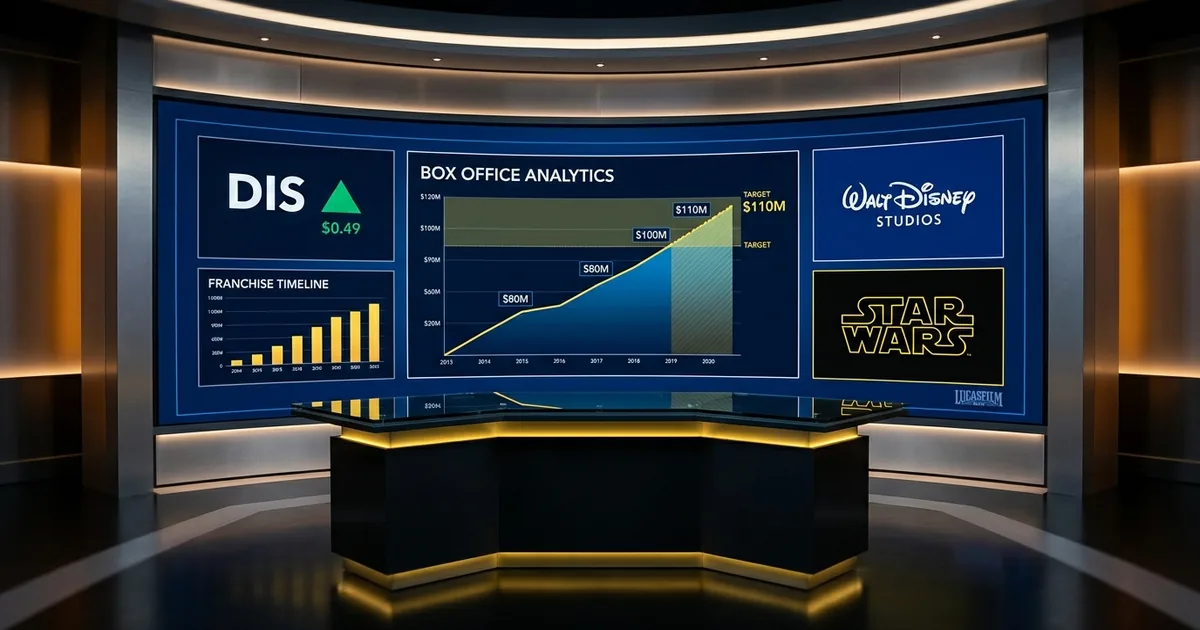
On Friday, May 22, Disney opens “The Mandalorian and Grogu” in roughly 4,200 North American theaters. It is the first new Star Wars film in seven years, the first to be adapted from a streaming series rather than feed into one, and the first major box-office test of whether Disney can still command theatrical premium pricing on a Lucasfilm property after the post-Acolyte backlash. The numbers Wall Street is watching are not nostalgia metrics. They are revenue floors. Tracking sits between $80 million (Deadline) and $90 to $100 million (Box Office Pro) for the four-day Memorial Day weekend window.
Context is what makes those numbers either a comeback or a quiet repositioning. $84.4 million was the opening for “Solo: A Star Wars Story” in 2018, the lowest in the modern Star Wars era and the film widely cited as the moment Disney admitted the franchise had been over-served. If Mandalorian and Grogu lands anywhere near that figure, Disney’s theatrical Star Wars strategy is back in conference-room rebuild mode. If it crosses $100 million, the path to the announced 2027 Starfighter feature suddenly looks defensible.
The Strategic Bet Hidden Inside The Release
Disney is doing something it has never done at this scale. It is testing whether a hit Disney+ series can be promoted to feature-length theatrical IP without losing the streaming subscriber base that originally drove demand. Jon Favreau directed and co-wrote. Sigourney Weaver joined the cast. Jeremy Allen White, currently the most bankable adult-skewing TV face in America thanks to The Bear, plays a Mandalorian heavy. Kathleen Kennedy and Dave Filoni produced. The talent assembly looks like a real movie, not a streaming spinoff dressed up for one weekend.
The risk is structural. Star Wars theatrical openings used to clear $200 million domestic on the first weekend (Force Awakens hit $248 million). The franchise has cooled at the box office while expanding on streaming. Disney is now trying to reverse-engineer the heat from streaming back into theaters. That is the inverse of what Marvel did with Loki and WandaVision, which stayed on streaming. According to Bloomberg’s pre-release analysis, Disney CEO Bob Iger and Lucasfilm chief Kathleen Kennedy explicitly framed the release as a strategic stress test for the theatrical Star Wars pipeline, not a one-off.
The Numbers That Decide The Future
Three thresholds matter for Friday through Monday. Under $80 million for the four-day opening, and Disney’s franchise problem becomes a discussion in the next earnings call. The studio segment is already underperforming the parks segment by a wide margin, and a soft Star Wars opening forces the question of whether the planned 2027 and 2028 features get budget cuts or schedule slips.
Between $85 million and $100 million is the muddy middle. That is enough to call it a successful relaunch given the standalone-adventure framing, but not enough to justify a major theatrical-pipeline expansion. According to Box Office Pro’s long-range forecast, the upper end of the projection requires strong matinee turnout on Saturday and a Sunday holds above 75%, which is closer to a true family film pattern than a fanboy-skewing genre opener.
Above $110 million, Disney has reset the franchise. The studio gets the green light to push forward on Mandalorian sequels, on Starfighter, and on the four other Lucasfilm scripts currently in development. Iger’s argument that theatrical IP is still the financial engine for Disney’s downstream parks, merchandise, and streaming businesses gets validated in front of every Wall Street analyst.
What The Streaming Numbers Already Show
Disney+ has been quietly running the Mandalorian and Grogu “Special Look” episodes for the past month, and the platform reports the content has driven its strongest week-over-week engagement bump since the holiday Star Wars Day push. That is the good news. The complication is that Disney+ engagement has historically been a mediocre predictor of theatrical conversion. Marvel learned this the hard way with Eternals and The Marvels: streaming buzz did not translate to opening-weekend tickets at scale. Star Wars has its own version of the same problem. The fans who watched all three seasons of The Mandalorian on Disney+ are not automatically the same audience willing to pay $18 for a theatrical ticket plus concessions.
The brand fatigue numbers are real. Star Wars projects since 2019 have grossed less than Marvel projects of comparable budget. The Acolyte became a cultural lightning rod last summer that hurt the broader brand perception. Disney has spent the past year quietly trimming Star Wars marketing in younger demographics where the brand has lost momentum. The Mandalorian and Grogu’s marketing push has leaned heavily on the family-friendly Grogu angle, deliberately positioning the film as more in line with the 2015 Force Awakens audience than the 2018 Last Jedi controversy crowd.
The Disney Stock Read
DIS shares have been range-bound for most of 2026, trading in the high $90s as the parks business carries the company and the studio segment limps. Wall Street has been giving Iger the benefit of the doubt on the theatrical pipeline because the alternative is harder to model. If Mandalorian and Grogu opens above $100 million, expect at least one major sell-side analyst to upgrade Disney on a “theatrical-IP-still-works” thesis. If it opens below $85 million, expect the conversation about whether Disney should accelerate selling or spinning off the studio segment to come back into the open. We have been tracking the broader consumer-pricing story in our coverage of how April CPI hit 3.8% and squeezed discretionary consumer spending, and Memorial Day movie spend is the canary inside that broader trade.
The Industry Read
Beyond Disney, the entire theatrical exhibition industry is watching this opening because Memorial Day has been a soft window for the past three years. AMC, Cinemark, and the smaller regional chains need a healthy summer kickoff to justify their valuations. The summer 2026 slate is thinner than 2023 or 2024. Star Wars functioning as a Memorial Day tentpole is what differentiates this summer from a slow recovery into the back-to-school season.
For the streaming-to-theatrical strategy more broadly, this opening is the cleanest case study available. Netflix has tried it with limited success (Glass Onion, Rebel Moon). Apple has spent billions and gotten mixed returns. Amazon’s MGM acquisition has only quietly experimented. If Disney can convert Disney+ subscribers into theater tickets profitably, every other streamer reconsiders its own pipeline. If it cannot, the conventional wisdom that streaming and theatrical operate on permanently separate economics gets reinforced.
The Forecast
The base case lands in the $85 million to $95 million range for the four-day opening. That is enough to keep the franchise alive but not enough to justify a programming-driven theatrical Star Wars relaunch. The upside scenario, which requires both Friday previews to deliver $20 million-plus and Saturday family matinees to over-perform, gets to $105 million. The downside, which kicks in if reviews land below 75% on Rotten Tomatoes and the trades pull positive coverage, sits at $72 million.
The biggest variable nobody is talking about is theater capacity utilization. Pad 2 has been closed during the holiday window in past years for renovations. AMC and Regal have both reduced screen counts in major markets. If a hit movie opens into a smaller theatrical footprint than five years ago, the per-screen averages might tell a different story than the topline gross. Expect Sunday-night thinkpieces to make that argument either way, depending on whether the opening number is being celebrated or excused.
The single number to remember Friday morning is $85 million. Above it, Star Wars is back. Below it, the franchise enters a new phase that Disney has been quietly preparing for since the last Skywalker movie. Either way, Memorial Day weekend is going to tell the company more about its theatrical future than any focus group has in a decade.