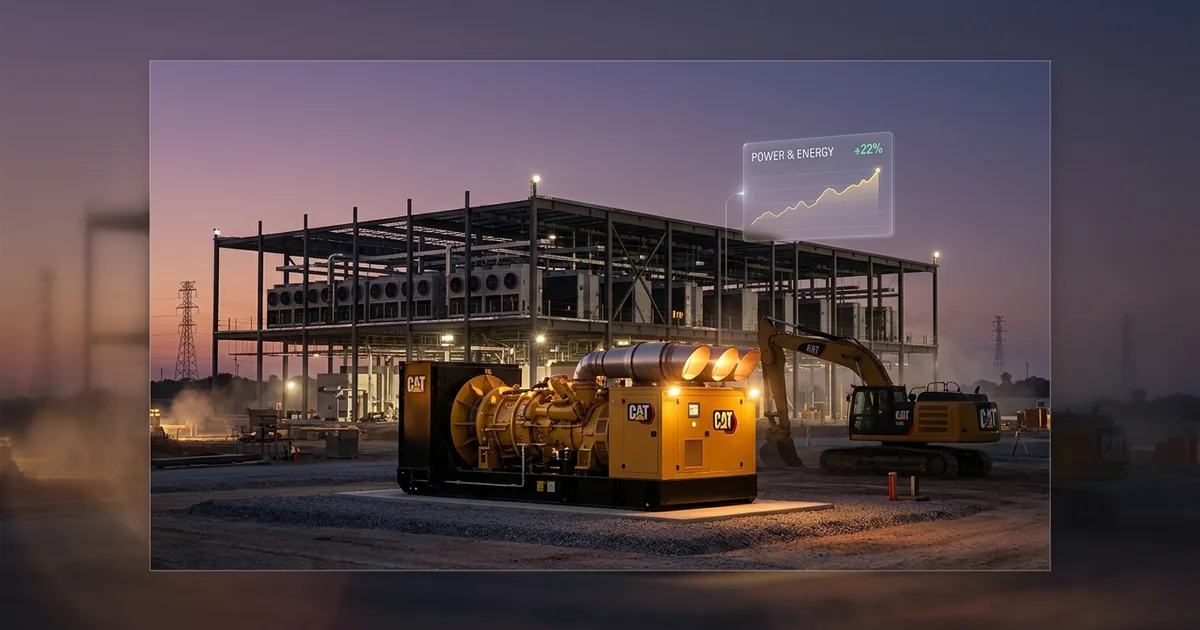
Caterpillar shares jumped more than 9% Thursday to an intraday record of $889.64 after the company reported first-quarter adjusted earnings of $5.54 per share on $17.42 billion in revenue, blowing past consensus estimates of $4.62 and $16.61 billion. Revenue grew 22% year over year. The construction segment, the part of CAT that everyone watches as a barometer of the broader cyclical economy, was up 38%. Power and energy rose 22%. Management raised the 2026 revenue outlook to low double-digit growth and trimmed its expected tariff hit for the year to a range of $2.2 billion to $2.4 billion, down from $2.6 billion. By every conventional measure of an industrial earnings print, this was a clean win.
But the real story is not the beat. The real story is what is driving the beat. Caterpillar is no longer trading like a cyclical industrial. It is trading like an infrastructure pure play on artificial intelligence, and the multiple expansion that comes with that re-rating is the most underappreciated trade on Wall Street this quarter.
Why The Power And Energy Number Matters Most
The 22% growth in Caterpillar’s power and energy segment is the cleanest signal of the AI infrastructure cycle showing up in heavy industry. CAT manufactures the gas turbines, reciprocating engines, and generator sets that hyperscale data center operators are buying in unprecedented volumes to bridge the gap between announced capacity and what the US electrical grid can actually deliver. Customers including Microsoft, Meta, Alphabet, and Amazon are committing tens of billions of dollars to data center buildouts that physically cannot rely on grid power alone. Long interconnection queues, multi-year transmission upgrade timelines, and tightening capacity reserves in regions like Northern Virginia and West Texas have turned on-site generation from a backup option into a primary load source.
That demand falls directly on Caterpillar. The company is one of a small handful of suppliers globally that can deliver large reciprocating gas engines, mobile gas turbines, and the integrated controls that hyperscalers need at the scale and timeline AI buildouts require. CEO Joe Creed told investors on the Q1 call that order activity from AI infrastructure customers had moved from “occasional” two years ago to “structural” today, with multi-year backlog visibility that the company has not had in a decade.
Construction Up 38% Without A Construction Boom
Look at the construction segment beat with that lens, and a number that initially seems implausible starts to make sense. The US is not in a traditional construction boom. Residential housing starts are flat. Commercial real estate is still working through a structural overhang in office. Public infrastructure spending has plateaued as Inflation Reduction Act dollars get reallocated and tariff uncertainty stalls some highway projects. Yet Caterpillar’s construction segment grew 38%.
The answer is the same answer as power. Hyperscale data center construction is now consuming a meaningful percentage of new commercial real estate concrete and earthmoving demand. The biggest sites in the country, which include Microsoft and Meta campuses in Wyoming, Texas, and Louisiana, look more like industrial complexes than typical buildings. Excavators, articulated trucks, and bulldozers move dirt for these sites at a scale that compares more closely to mining than to traditional construction. Caterpillar happens to be the dominant supplier in both end markets, which means hyperscalers and miners are competing for the same machines.
The Tariff Story Just Got Quieter
One of the more striking lines in the release was the trim to expected tariff impact, from $2.6 billion to a range of $2.2 billion to $2.4 billion. That reflects three things. The first is that Caterpillar’s supply chain re-engineering, accelerated since the first Trump term, has reduced exposure to the most punitive tariff lines. The second is that pricing actions taken in 2025 have absorbed more of the residual cost than initially expected. The third is that recent administration adjustments to the China tariff schedule, including the move from 40.8% to 30.8% on broad imports following the October trade truce, are flowing through more cleanly than feared.
The result is that tariffs, which were the single biggest investor concern on Caterpillar at the start of the year, have moved from a top-line risk to a manageable headwind. That is a material change in the bull case.
The Multiple Re-Rating Wall Street Is Pricing In
For most of its history, Caterpillar has traded at the kind of cyclical multiple that the market gives to global industrial bellwethers, somewhere in the 14 to 18 times forward earnings range, with the wide band reflecting macro cycle position. The current multiple is well above the upper end of that historical range, and the market clearly thinks it can stay there. Analysts at Morgan Stanley, Citi, and JPMorgan have all written in recent weeks about a structural shift in CAT’s earnings durability driven by data center exposure.
The argument is straightforward. Cyclical industrials trade at lower multiples because their earnings collapse in recessions. If Caterpillar’s most important demand driver is now an AI capex super-cycle that runs largely independent of the broader US economic cycle, then the volatility of forward earnings should fall, and the multiple the market is willing to pay should rise. That is the same argument that turned Vistra and Constellation Energy from sleepy utilities into the best-performing stocks in the S&P 500 over the past two years. Caterpillar may now be running the same play.
The Risks Bulls Should Not Ignore
Three risks deserve attention. First, AI capex itself is not invulnerable, as Meta’s 10% drop on Thursday demonstrated. If the broader hyperscaler buildout slows or rationalizes in 2027, CAT’s power and energy backlog will compress with it. Second, competition from international suppliers, including the German and Japanese gas engine manufacturers, is real, and Caterpillar’s pricing leverage is not infinite. Third, US grid policy could surprise. If transmission build-out accelerates faster than expected, on-site generation demand will moderate.
None of those is a near-term threat. All three are worth tracking on a 12 to 24 month basis.
The Bottom Line For CAT Investors
Caterpillar’s Q1 print is the latest, and arguably most convincing, piece of evidence that the AI infrastructure trade has fully escaped the boundaries of the Magnificent Seven. The same forces that pushed Alphabet up 9% on Thursday are powering record highs in a 100-year-old industrial. The implication for portfolio construction is that AI exposure no longer requires owning the obvious tech names. It can be expressed through power equipment, gas pipelines, transformers, switchgear, and earthmoving fleets, often at lower multiples and with more tangible cash flow profiles than the hyperscalers themselves.
The CAT print also offers a useful counterweight to the more anxious AI capex story. Where Meta is being asked to defend a $145 billion outlay with limited visible monetization, Caterpillar is the company collecting some of those dollars and converting them directly into beats and raises. The picks-and-shovels economy of artificial intelligence is becoming the steadiest cash flow story in industrials, and the chart is starting to reflect that. For more financial detail, the company’s Q1 2026 earnings release walks through the segment numbers in full. For broader sector context, see Reuters’ coverage of the data center power buildout.