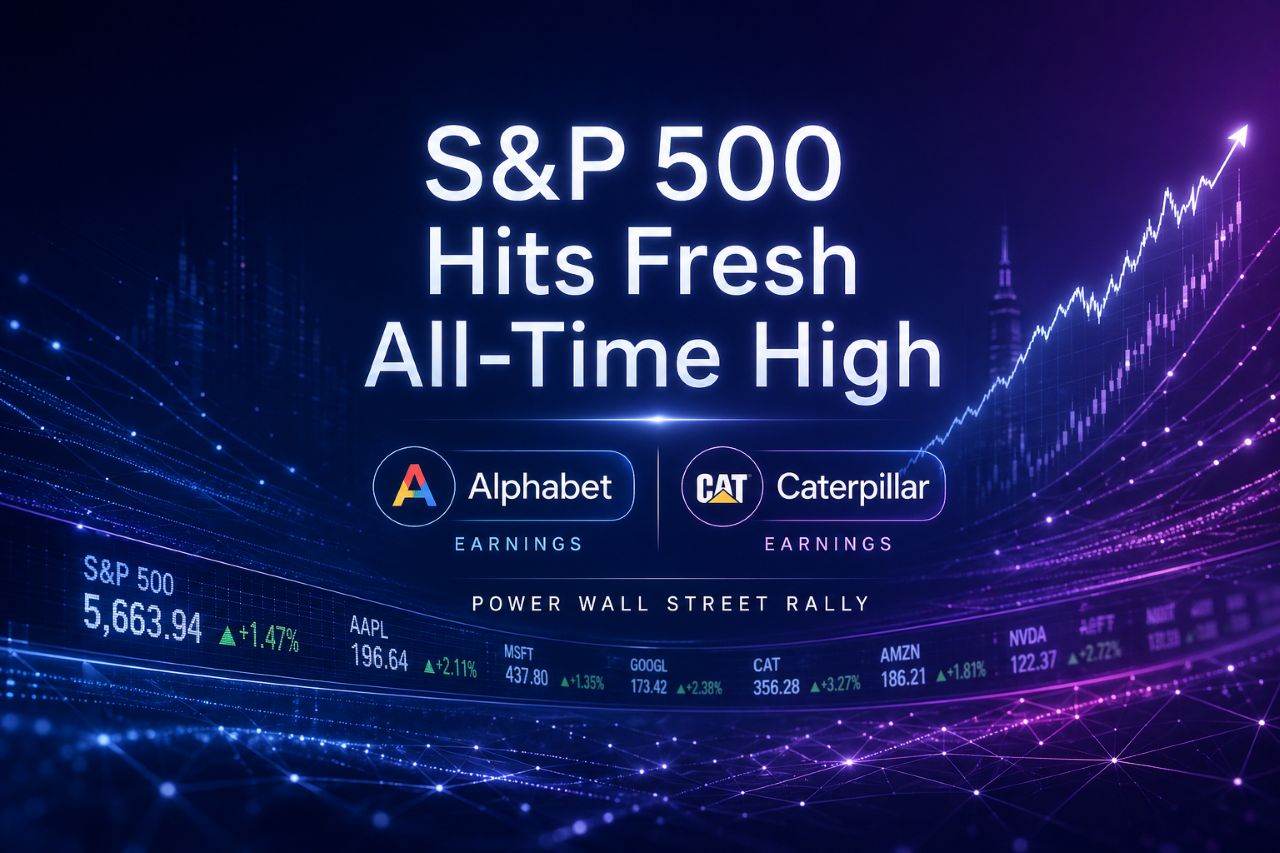
The S&P 500 ripped to a fresh all-time intraday high on Thursday, climbing roughly 0.8% as blowout earnings from Alphabet and Caterpillar dragged the broad market higher. The Dow Jones Industrial Average tacked on more than 730 points, a 1.5% jump, and the Nasdaq added 0.6%. On its face, this looks like a clean Wall Street victory lap. Look closer and you can see a very different story flickering inside the tape: a market that is rewarding two specific kinds of winners and quietly punishing everyone else.
Alphabet, the only mega-cap hyperscaler this week to come out of earnings looking unambiguously stronger, surged about 9% after posting Q1 revenue of $109.9 billion, up 22% year over year, with Google Cloud crossing $20 billion in quarterly revenue and growing 63%. Caterpillar, the kind of name that until recently was viewed mostly through the lens of construction cycles and tariff exposure, shot up more than 9% to an intraday record of $889.64 after the company crushed its first-quarter numbers and raised its full-year revenue outlook. Different industries, same story: AI is now the master variable in what used to be very different equations.
The Two Trades That Are Working
Strip out the noise and what you have on Thursday is a market that has decided, for now, exactly two trades are still working: the AI hyperscaler that can prove its capital expenditure is producing visible revenue, and the picks-and-shovels supplier whose order book is being rewritten by data center demand. Alphabet is the cleanest example of the first. CFO Anat Ashkenazi raised the company’s 2026 capex guidance to a $180 billion to $190 billion range, and rather than punishing the stock, Wall Street treated the increase as confirmation that the AI bet is paying off. Cloud operating margin expanded from 9.4% a year ago to 32.9%. Cloud backlog nearly doubled to over $460 billion. Sundar Pichai told analysts that cloud revenue would have been higher if Google could meet demand, which is the kind of complaint every CEO in tech wishes they had.
Caterpillar is the second trade, and arguably the more interesting one. Adjusted EPS of $5.54 on $17.42 billion in revenue blew past consensus by almost 20%. The construction segment grew 38%. Power and energy revenue jumped 22%. CEO Joe Creed told investors that the AI infrastructure boom was now a structural tailwind for the company’s gas turbine, generator, and engine business, and management trimmed its expected tariff hit for the year to a range of $2.2 billion to $2.4 billion from $2.6 billion. Caterpillar, in other words, is no longer being valued primarily as a cyclical industrial. It is being valued as the only American-listed company that can build the diesel and gas plants needed to power data centers when the grid cannot keep up. That is a different multiple, and the chart is telling you the market is starting to apply it.
The Trades That Are Not Working
While Alphabet and Caterpillar were doing the heavy lifting, two of the largest names in the index were heading the other way. Meta dropped roughly 9% to 10% after Mark Zuckerberg told investors capital expenditure for 2026 would land between $125 billion and $145 billion, with no associated cloud business to monetize the buildout. JPMorgan downgraded the stock to Neutral and projected capex could push toward $202 billion by 2027, sending Meta into negative free cash flow territory. Microsoft, which on the surface delivered another solid quarter, slipped about 5% as investors picked over the company’s own AI capex disclosures and demanded more visibility on the return calculus.
This is a market that has gotten very specific about which AI bets it is willing to underwrite. Google can spend $190 billion because investors can look at $20 billion in quarterly cloud revenue, $460 billion in backlog, and 33% operating margin and do the math. Meta is being asked to show its work in a more uncomfortable way: how does $145 billion in capex this year, and potentially $200 billion next year, translate into incremental advertising revenue or some other monetizable surface? “We just don’t see it yet” is the unspoken JPMorgan note. Investors are not against AI spending. They are against AI spending without a P&L.
The Earnings Underneath The Index
Beneath the headline indices, the rest of the day’s earnings tape was unusually constructive. Qualcomm jumped about 16% after a top and bottom line beat, with strong handset and automotive chip demand offsetting concerns about the China smartphone cycle. Eli Lilly soared more than 10% after blowing out Q1 numbers on the back of Zepbound and Mounjaro and disclosing that more than 20,000 people have begun taking its newly approved oral GLP-1, Foundayo. Amazon, which reported Wednesday after the bell, traded modestly higher Thursday after AWS revenue of $37.6 billion crushed estimates and grew 28% year over year, the fastest growth rate in 15 quarters.
Add it up and the actual breadth of Thursday’s rally was better than the indices alone would suggest. Industrials, healthcare, semiconductors, and communications services all participated. The losses were concentrated in two heavy names: Meta and Microsoft. That is the definition of a market that is repricing AI risk in real time, not running away from it.
The Risks Hiding In Plain Sight
None of this is happening in a vacuum. Brent crude touched $126 a barrel overnight on the latest escalation around the Strait of Hormuz, the highest level since 2022, before pulling back near $114. California gasoline averages are above $6 per gallon. The Federal Reserve held its benchmark rate in a range of 3.5% to 3.75% on Wednesday in what was almost certainly Jerome Powell’s final meeting as chair, with four FOMC members dissenting. Pershing Square’s $5 billion IPO debut closed 18% below its $50 offer price. There is plenty here for the bears to chew on.
What Thursday’s record high is telling you is that, at least for now, the market thinks AI productivity gains and cloud monetization are powerful enough to absorb a 4-year high in oil, a divisive Fed transition, and a rocky high-profile IPO. That is a confident posture. It also means the next leg lower, when it comes, is unlikely to come from a familiar place. It will come from one of the AI bets failing the same simple investor test that Meta failed Wednesday night: show me the cash flow.
The Bottom Line For Investors
The S&P 500’s new high is real, and the rally has more participation than the doomers want to admit. But this is no longer a market that pays for AI exposure in the abstract. It pays for AI revenue, AI margin, and AI infrastructure that converts directly into operating leverage. Alphabet showed it. Caterpillar showed it. The companies that cannot, no matter how big or how loved, are getting their multiples re-rated in real time. As earnings season grinds toward Apple’s report after the bell, the question is no longer whether the AI trade is alive. It is which version of the AI trade survives.
For deeper financial context on Alphabet’s quarter, see the company’s official Q1 2026 financial release filed with the SEC. For market data on the index move, refer to Bloomberg’s live markets coverage.