For anyone still wondering whether the AI spending boom is real or another tech bubble on a timer, Taiwan Semiconductor Manufacturing Company just filed the most convincing rebuttal in the industry.
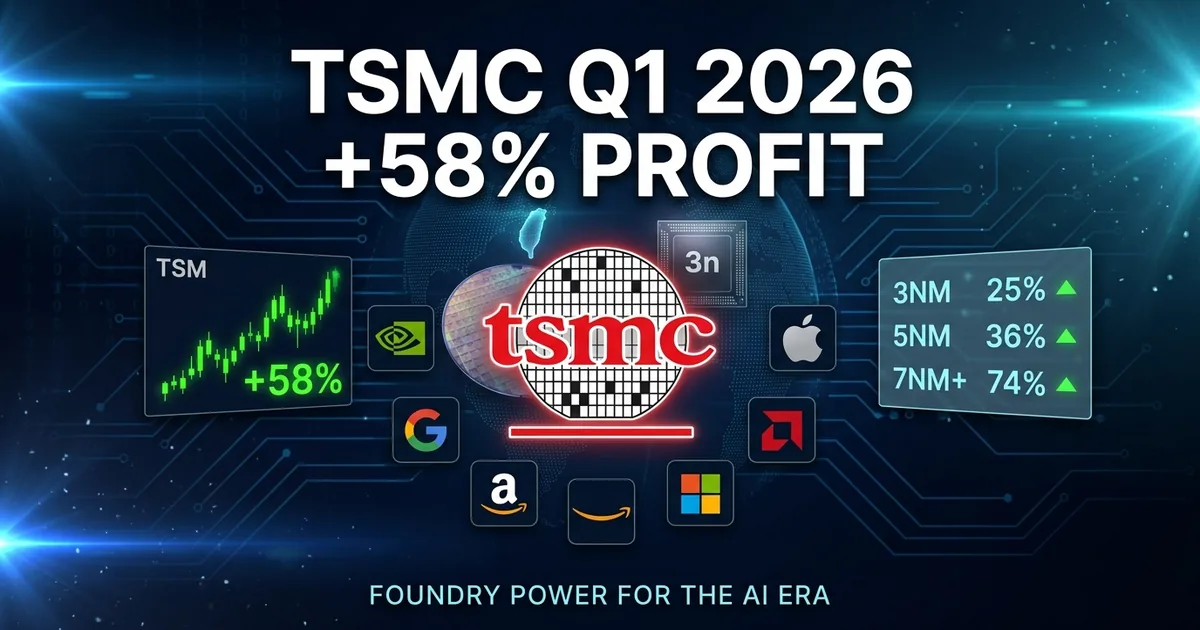
TSMC reported first-quarter net income of NT$572.48 billion, a 58% increase year over year that sailed past analyst estimates and set a fresh company record. Revenue hit NT$1,134 billion, up 40.6% from the same period last year, with gross margins expanding to 66.2% and net margins touching 50.5%. Those are not the numbers of a company riding a hype cycle. Those are the numbers of a company that cannot build chips fast enough.
The results sent Taiwan’s TAIEX index to an all-time high of 37,251, lifted semiconductor stocks globally, and reinforced a simple thesis that Wall Street has been debating for two years: AI infrastructure spending is not slowing down, it is accelerating, and TSMC sits at the exact center of the funnel.
Where The Money Is Actually Going
Strip away the macro narrative and look at what TSMC’s revenue mix tells you about who is buying and what they are building.
Advanced technology nodes, defined as 7-nanometer and below, now represent 74% of total wafer revenue. Within that, 3-nanometer chips account for 25% and 5-nanometer contributes 36%. These are the process technologies that power the most sophisticated AI training and inference chips on the planet: Nvidia’s Blackwell GPUs, Apple’s M-series processors, AMD’s Instinct accelerators, and the growing roster of custom silicon from Amazon, Google, Microsoft, and now Tesla.
The high-performance computing division, which covers AI and 5G applications, climbed to 61% of total revenue in Q1. That is not a segment. That is the business. Two years ago, smartphones were TSMC’s largest revenue driver. Today, AI has completely rewritten the company’s customer concentration, margin profile, and capital allocation priorities.
The Capacity Problem That Keeps Getting Bigger
TSMC guided full-year 2026 revenue growth above 30% in U.S. dollar terms, a number that would have seemed aggressive a year ago and now looks almost conservative. Second-quarter revenue is projected at $39 billion to $40.2 billion, representing a 10% sequential increase.
But the more important story is what TSMC cannot do: meet demand. Manufacturing capacity for leading-edge nodes is effectively maxed out. Wait times for 3-nanometer allocation slots extend well into 2027 for new customers. Existing clients, particularly the hyperscalers building out AI data centers at unprecedented speed, are locking in multi-year commitments and paying premium pricing for guaranteed capacity.
This dynamic has profound implications for the competitive landscape. Companies that secured TSMC allocation early, Nvidia, Apple, Amazon, are building a structural advantage that latecomers cannot easily replicate. Access to cutting-edge silicon is becoming a moat in itself, one that is measured not in intellectual property or software but in foundry relationships and procurement commitments signed years in advance.
Connecting The Dots: From Foundry To Cloud Revenue
TSMC’s results do not exist in isolation. They are the manufacturing layer beneath a stack of AI revenue milestones that are starting to compound.
Amazon disclosed that its cloud unit’s AI revenue run rate topped $15 billion in Q1, one of the clearest signals that hyperscaler AI spending is translating into measurable top-line growth. Microsoft, Alphabet, and Meta are all expected to report similar acceleration when they post earnings in the coming weeks. The pattern is consistent: companies are spending aggressively on AI infrastructure, their customers are paying for AI services built on that infrastructure, and TSMC is the foundry producing the chips that make all of it possible.
The virtuous cycle, or depending on your perspective, the capex treadmill, is now self-reinforcing. Higher AI revenue justifies more infrastructure spending, which requires more chips, which drives TSMC’s growth, which funds more fab construction. TSMC is investing heavily in expanding capacity in Arizona, Japan, and its home base in Taiwan. But fabs take years to build and ramp, and demand is growing faster than concrete can be poured.
What The Skeptics Get Wrong
The bear case on AI infrastructure spending has always centered on one question: what happens when the capex cycle turns? History is littered with examples of technology buildouts that overshot demand, from fiber optic cables in the late 1990s to 4G network builds that ran ahead of consumer adoption.
But TSMC’s numbers suggest something different this time. The revenue growth is not being driven by speculative capacity builds from a handful of hyperscalers placing bets on future demand. It is being driven by actual, paying customers across an expanding set of end markets: cloud AI, autonomous vehicles, edge computing, robotics, and increasingly, government and defense applications.
The concentration risk is real. Nvidia remains TSMC’s largest customer for AI-related chips, and any slowdown in Nvidia’s sales trajectory would ripple through TSMC’s order book. But the customer base is diversifying. Amazon’s Trainium chips, Google’s TPUs, Microsoft’s Maia accelerators, and Tesla’s new AI5 chip all run through TSMC’s fabs. The single-customer dependency that defined the early AI chip cycle is giving way to a broader, more durable demand base.
What This Means For Investors
TSMC is not a pure play on AI hype. It is a toll booth on the only highway that AI traffic can take. Every major AI model, every autonomous driving system, every cloud inference workload runs on silicon that, for the most advanced applications, can only be manufactured in a handful of fabs in Taiwan and, increasingly, Arizona.
The 58% profit surge is impressive on its own. What makes it significant is the forward guidance: 30%-plus revenue growth for the full year, expanding margins, and a capacity shortage that gives TSMC pricing power it has not enjoyed in decades. The company’s stock, which trades on the New York Stock Exchange as TSM, has outperformed every major semiconductor name this year.
The risk, as always with TSMC, is geopolitical. The company manufactures the majority of the world’s most advanced chips on an island that sits at the center of U.S.-China tensions. The Arizona fabs are a hedge, but they will not reach full production capacity until late 2027 at the earliest.
For now, though, the earnings speak for themselves. AI chip demand is not peaking. It is not plateauing. And the one company positioned to capture revenue from every player in the race just posted the strongest quarter in its history.
For TSMC’s full Q1 2026 earnings details, see CNBC’s coverage of the results.