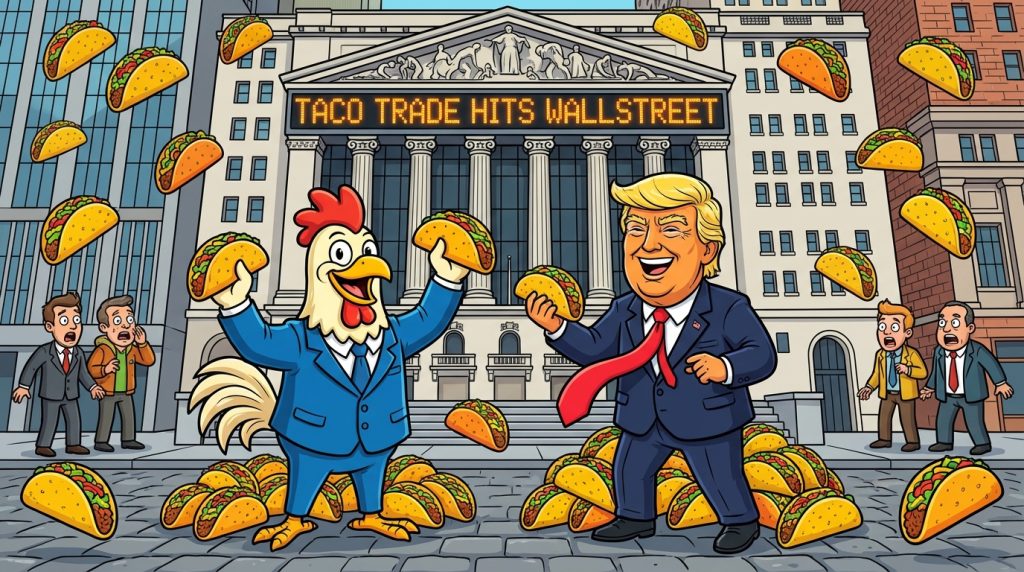
Wall Street just lived through the most exhausting 48 hours since Liberation Day. President Trump’s Greenland tariff threats sent the S&P 500 plunging 2.1% on Tuesday, its worst day since October, only for markets to roar back Wednesday after Trump announced the “concept of a deal” and canceled the threatened levies. Welcome back to the TACO trade.
The pattern should look familiar by now. Trump threatens something aggressive. Markets tank. European allies prepare countermeasures. Treasury Secretary Scott Bessent insists the administration is “not concerned at all.” Then Trump backs down, claims victory, and stocks recover most of their losses. Rinse and repeat.
Tuesday’s Carnage: $1.2 Trillion Wiped Out
The numbers from Tuesday’s session were ugly. The Dow Jones Industrial Average shed 870.74 points, or 1.76%, to close at 48,488.59. The S&P 500 dropped 143.15 points, or 2.06%, to settle at 6,796.86. The Nasdaq Composite slid 2.39%, closing at 22,954.32. All three indexes posted their worst daily performances since October 10.
The selling erased the S&P 500’s gains for 2026 entirely. The Nasdaq went negative for the year. More than $1.2 trillion in market value evaporated from the S&P 500 as investors processed the implications of Trump tying U.S. tariffs to his campaign to acquire a semi-autonomous Danish territory.
Trump had threatened 10% tariffs starting February 1 on eight European countries that opposed his Greenland push: the United Kingdom, Denmark, Norway, Sweden, France, Germany, the Netherlands, and Finland. Those levies were scheduled to rise to 25% by June 1. When asked at a White House briefing how far he would go to secure Greenland, Trump offered reporters two words: “You’ll find out.”
The European Union, facing the prospect of tariffs on its largest trading partner, was preparing more than $100 billion in retaliatory countermeasures. Some EU leaders discussed deploying the bloc’s “trade bazooka,” an anti-coercion legal mechanism that has never been used before.
The “Sell America” Trade Returns
Tuesday’s selloff wasn’t just about equities. Investors dumped U.S. Treasury bonds, driving yields higher. The dollar weakened. Gold and silver, both safe-haven assets, hit new highs. Krishna Guha of investment bank Evercore ISI labeled it a return to the “Sell America” trade that emerged during the Liberation Day tariff chaos last April.
Denmark’s AkademikerPension pension fund announced it was exiting U.S. Treasuries entirely, citing concerns about U.S. debt and policy stability. When Danish pension managers start dumping American government bonds over Arctic territory disputes, something has gone sideways in the global financial architecture.
Wednesday’s Reversal: TACO Rings Again
Then came Wednesday, and the script played out exactly as the TACO trade predicted. Speaking at the World Economic Forum in Davos, Trump softened his rhetoric, telling global business leaders he would not use military force to take Greenland. Markets perked up. Shortly after 2 p.m. ET, Trump posted on Truth Social that he had reached “the framework of a future deal” with NATO Secretary General Mark Rutte on Greenland. The tariffs were off.
Stocks exploded higher. The Dow surged 588 points, or 1.21%. The S&P 500 jumped 1.16%, its best day since November. The Nasdaq climbed 1.18%, marking its strongest session since December. The S&P 500 turned positive for the year again.
“Like a swimmer awaiting the sound of the gun before stroking to the other side in hopes of winning the race, traders piled into shares and Treasuries once the US leader delivered a more conciliatory tone than expected,” wrote José Torres, senior economist at Interactive Brokers.
What Is the TACO Trade?
TACO stands for “Trump Always Chickens Out.” The term originated on Wall Street last May after Trump’s Liberation Day tariff rollout and subsequent rollback. Financial Times journalist Robert Armstrong coined the phrase in an opinion piece noting that “the US administration does not have a very high tolerance for market and economic pressure, and will be quick to back off when tariffs cause pain.”
The TACO trade strategy is simple: buy stocks cheaply after a tariff announcement sends markets lower, then sell at a profit when Trump inevitably delays, reduces, or cancels the threatened levies. For nine months, it’s worked. NBC News has documented at least 10 instances of Trump threatening tariffs only to backtrack.
“Donald Trump’s TACO bell has rung once again, much to the joy of financial markets,” said Russ Mould, investment director at AJ Bell, in a Thursday note to clients. “Trump has form in chickening out of his threats. There are a lot of similarities with the liberation day market wobble in April 2025 and now.”
When asked about the phrase by reporters, Trump called the question “nasty” and responded: “It’s called negotiation.”
The TACO Paradox
Here’s the problem with TACO becoming conventional wisdom: it could stop working. The initial market shock from Trump’s Greenland tariff threats already rippled into other asset classes. But if investors don’t panic when Trump threatens aggressive policy, there’s no market pressure forcing him to back down.
As Henry Allen of Deutsche Bank framed it: “The paradox is that as markets discount the tariffs and perform strongly, that’s actually making the higher tariffs more likely as the administration grows in confidence.”
Ed Al-Hussainy, a portfolio manager at Columbia Threadneedle, noted that the TACO assumption is now built into how investors react to policy shocks. “If we didn’t have TACO, we would see lower Treasury yields on a safe-haven bid and a much larger spike higher in volatility,” he told Bloomberg.
Polymarket prediction markets showed only 17% of bettors believed all of Trump’s threatened Greenland tariffs would actually go into effect February 1. Wall Street had already priced in the chicken.
What Does the “Framework” Actually Mean?
The honest answer: nobody knows yet. Trump described the Greenland framework as “the concept of a deal” in an interview with CNBC’s Joe Kernen. When pressed on whether it meant the U.S. would acquire the island, Trump paused and said, “It’s a long-term deal.”
Vice President JD Vance, Secretary of State Marco Rubio, and Special Envoy Steve Witkoff will reportedly handle negotiations. Additional discussions are being held concerning something Trump called “The Golden Dome” as it pertains to Greenland, whatever that means.
Toni Meadows, head of investments at BRI Wealth Management, urged caution. “I would wait for further details to emerge regarding a deal with Greenland as well as any response from the EU before reading too much into the market moves,” she told CNBC. European markets had already closed before Trump’s reversal announcement, and the EU’s emergency summit on potential retaliation is still scheduled for Thursday.
The Bigger Picture for Investors
The S&P 500 has nearly doubled from its 2022 lows and remains near record highs. Valuations are elevated. Earnings expectations are high. Hedging against equity selloffs had fallen to some of the lowest levels in years, according to Bank of America’s latest survey. That left many investors exposed when volatility broke out this week.
Meanwhile, the Supreme Court heard oral arguments Wednesday on whether Trump has the authority to fire Federal Reserve Governor Lisa Cook. Several justices appeared skeptical of the administration’s position, with Justice Brett Kavanaugh telling a Trump administration lawyer that the argument would “weaken, if not shatter, the independence of the Federal Reserve.” A ruling limiting Trump’s tariff authority could further constrain his trade war options.
For now, markets are treating Greenland as resolved and moving on. But the same playbook that worked for nine months is getting more dangerous. At some point, TACO stops being a reliable strategy and starts being complacency. The question for 2026: when does Trump stop chickening out?
