Table of Contents
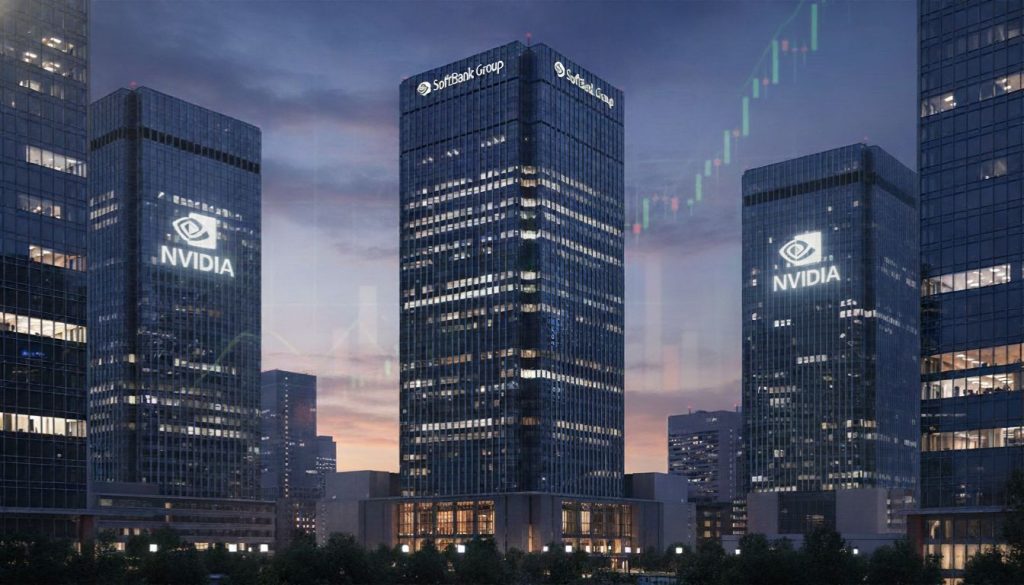
SoftBank Nvidia is no longer a love story. The Japanese conglomerate has unloaded its entire 32.1 million share stake in Nvidia for roughly $5.8 billion, and is redirecting that cash toward a massive, highly leveraged bet on OpenAI and associated AI infrastructure. According to reporting from CNBC, the Nvidia sale is one of several asset moves SoftBank is using to bankroll a planned 22.5 billion dollar investment into OpenAI alone, plus billions more into chips, data centers, and robotics.
That is not just portfolio rebalancing. It is Masayoshi Son picking a side in the AI power struggle, and using public markets like an ATM to fund a private AI empire that will sit at the heart of global compute.
SoftBank Nvidia Sale Is Fuel For An OpenAI War Chest
SoftBank Nvidia unwinding is striking partly because Nvidia is still the most obvious winner of the AI chip boom. Yet SoftBank’s sale is not about doubt in GPUs. It is about leverage, control, and access.
From CNBC’s breakdown of SoftBank’s earnings and asset moves, a few numbers matter more than the headlines:
- 32.1 million Nvidia shares sold in October, raising about 5.83 billion dollars.
- Partial sale of T Mobile shares worth 9.17 billion dollars.
- A margin loan on SoftBank’s Arm stake, expanded to roughly 20 billion dollars.
- All explicitly framed, per CNBC’s reporting, as “sources of cash” earmarked to help fund a 22.5 billion dollar commitment to OpenAI and other AI deals.
SoftBank is essentially securitizing the last decade of tech gains to buy a front row seat in the next decade’s AI governance fight. Instead of clipping dividends from Nvidia, Son wants a say in how the core models are built, who gets access, and on what political terms.
For democratic societies already struggling to regulate AI platforms, the idea that a single investor can reshuffle tens of billions out of public markets into a largely private AI stack should set off alarms.
OpenAI Over Nvidia: Control Of The Stack, Not Just Chips
SoftBank Nvidia divestment makes more sense when you zoom out to the rest of the strategy. Son is not walking away from Nvidia’s ecosystem at all. He is wrapping it in a larger web of ownership and influence.
The OpenAI bet sits at the center of several ambitions:
- Model layer power
Owning a double digit stake in OpenAI means exposure not just to one product, but to the de facto operating system for AI applications in the Global North. Whoever controls the model API, pricing, and safety policies gains soft power over everything from labor markets to political speech. - Infrastructure leverage
Projects like the multihundred billion dollar Stargate data center initiative and parallel AI manufacturing and robotics builds make SoftBank a crucial buyer of chips and cloud services. Nvidia may not be on SoftBank’s balance sheet anymore, but its hardware will still sit in SoftBank backed facilities. - Verticalization of AI hardware
SoftBank is also pushing deeper into chip design and compute control. That shows up across the broader AI chip landscape, including competitors and partners that challenge Nvidia’s dominance. One recent example is Foxconn’s AI ambitions, which are eating into Nvidia’s narrative as the only winner in AI chip supply, as covered in depth in this analysis of Foxconn’s AI chip earnings beating Nvidia. SoftBank wants to ride that entire wave.
In other words, SoftBank is not abandoning Nvidia as much as upgrading its role from shareholder in “yesterday’s winner” to architect of the broader AI regime.
What This Means For Markets, Workers, And Democratic Institutions
SoftBank Nvidia decoupling is a finance story on the surface. Underneath, it is about who gets to shape the rules around AI deployment.
There are three fault lines worth watching.
1. Market power and regulatory capture
When capital pools this large move from public equities into private AI platforms, oversight weakens. Public markets at least come with disclosures, earnings calls, and shareholder lawsuits. Private deals and complex structures around OpenAI introduce layers of opacity that regulators will struggle to penetrate, especially in jurisdictions with weaker enforcement or captured agencies.
The risk is not just monopoly pricing. It is that AI infrastructure and models become a kind of shadow public utility where democratic institutions are perpetually reacting to decisions already made in private boardrooms.
2. Labor, inequality, and the “efficiency” story
SoftBank and OpenAI pitch these investments as essential infrastructure progress. Some of that is true. AI will accelerate drug discovery, logistics, and accessibility tools. Yet the capital structure tells its own story.
- Public assets like Nvidia shares are converted into concentrated ownership in platforms that can automate white collar labor at scale.
- Gains accrue to a small set of shareholders, while dislocation falls on workers and local communities with little equity in the upside.
- The timeline is dictated by investors’ need to justify 300 billion to 500 billion dollar valuations, not by social readiness or regulatory guardrails.
Progressive policy debates about just transitions, worker bargaining power, and AI taxation will collide directly with moves like SoftBank’s.
3. Geopolitics and AI alignment
SoftBank Nvidia exit also has implications for the geopolitical AI race. Japan, the US, and a handful of Gulf states are now deeply intertwined in these megaprojects. Some are democratic, some are not. Some have strong data protection laws, some have almost none.
When a Japanese conglomerate uses US and European stock gains to amass control over a US based AI lab that serves global users, the question becomes simple. Who is AI for? Citizens, or shareholders and states that can afford the buy in?
Democracies that care about rule of law and institutional legitimacy will need to decide whether this level of concentrated AI control can remain largely private, or whether structural interventions such as utility style regulation, public stakes, or interoperability mandates are necessary.
SoftBank Nvidia Trade As A Signal: Bubble, Belief, Or Both
SoftBank Nvidia split will inevitably be read by traders as a timing signal. Is this Son calling a top in Nvidia and chasing the next hype cycle?
The more nuanced reading is that Son does not think he can get sufficient influence over Nvidia’s destiny at current valuations. He can, however, be a kingmaker in OpenAI and surrounding infrastructure. That calculus might be rational from a returns standpoint and still be troubling from a civic standpoint.
For retail investors and funds, the move highlights a few realities:
- AI exposure is no longer just “own Nvidia and the hyperscalers.” The real leverage now lives in private rounds and hybrid corporate structures where only the largest institutions can play.
- The AI boom is increasingly financed by recycling gains from the last tech cycle, not by organic cash flows from the new one. That is not inherently bad, but it raises bubble questions.
- Governance and ethics are lagging far behind financial engineering.
SoftBank has always been comfortable living at the edge of what markets and regulators will tolerate. The WeWork saga and the first Nvidia exit were reminders that giant vision does not always translate into sustainable value.
This time, however, the stakes are not just co working leases or chip multiples. They are the shape of the AI infrastructure underpinning economies and election campaigns.
