Table of Contents
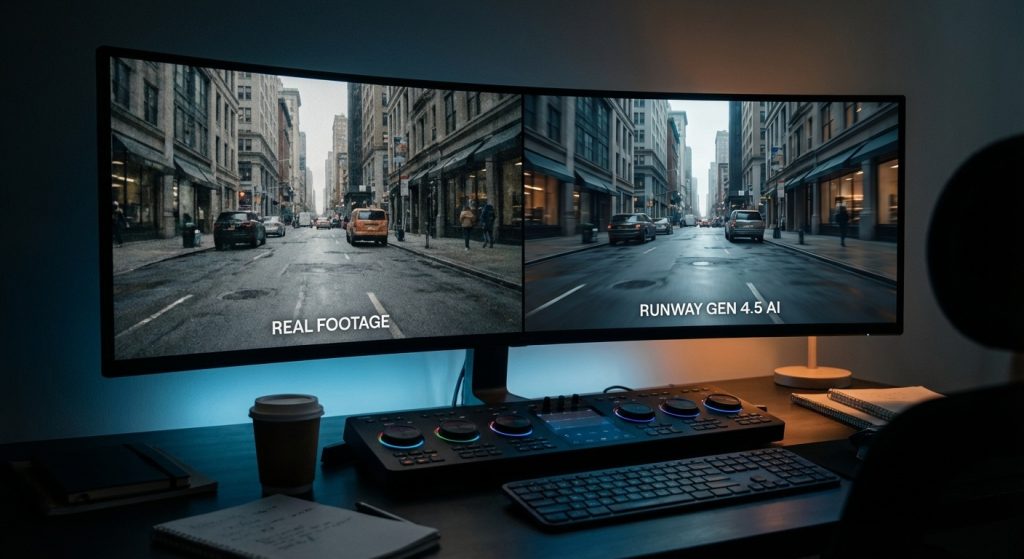
Runway Gen 4.5 AI video model arrives with the confidence of a product that knows exactly which fight it wants to win. In an independent benchmark where people blind vote on AI generated clips, this model now tops the Video Arena leaderboard, edging out Google’s Veo 3 and OpenAI’s latest Sora entries, as detailed in reporting from CNBC. A hundred person startup just beat trillion dollar incumbents at their own game.
That is a technical story about motion, physics and fidelity. It is also a political story about who gets to manufacture visual reality and on whose terms.
How Runway Gen 4.5 AI Video Model Pulls Ahead
Runway Gen 4.5 AI video model builds on years of iteration from Gen 1 through Gen 4, but the jump here is qualitative. In its own research notes, Runway highlights three intertwined capabilities.
- Motion that respects physical intuition
- Strong adherence to long, complex prompts
- Control over style from photorealistic to animated
The clips are deliberately provocative. A snowman dissolving on a city street. A polar bear trapped in ice, dragged through a landscape. A handheld, documentary style shot of a man walking through a foggy forest. The point is not just that the videos look pretty. The point is that the camera work and scene composition feel like the product of intention.
For creators, that means a sentence like “slow, continuous dolly shot past a crowded city cafe, golden hour, reflections in the glass, slightly handheld” is no longer a note to a human crew. It is a direct input to a model that returns something immediately usable in a pitch deck, a music video, or a TikTok series.
The shift in power here is subtle. You do not just save money on gear. You move creative leverage upstream, to whoever owns the prompt and the model.
Runway Gen 4.5 AI Video Model And The New Media Arms Race
Runway Gen 4.5 AI video model sits at the intersection of three races that rarely get talked about together.
- Race for creative dominance.
Big studios and tiny production houses now share access to cinematic text to video. In theory, that flattens the field. In practice, the advantage goes to whoever has distribution and brand. You can be a teenage filmmaker using Runway on a laptop and still lose to the streaming giant that uses the same model to A/B test every frame of a trailer. - Race for platform control.
Decisions about how video is delivered can matter as much as how it is made. When a company like Netflix abruptly ends Chromecast style mobile casting, as covered in this analysis of Netflix killing casting from phones, it reshapes viewing habits overnight. Add Gen 4.5 into that world and you get platforms that can flood feeds with ultra tuned synthetic clips that are cheaper, faster and more manipulable than location shooting. - Race for political influence.
The same capabilities that make a gorgeous art film short can make a disturbingly effective political spot. Long, continuous shots can communicate authenticity. Photorealistic crowd scenes can conjure enthusiasm or chaos where none exists. As these models improve, the cost of creating persuasive “evidence” drops toward zero.
Runway did not invent these races, but Gen 4.5 changes the tempo. When a small, focused team can outcompete giants on visual quality, there is every incentive for others to push harder, train more aggressively and chase even more realistic output, often with governance as an afterthought.
What Runway Gen 4.5 AI Video Model Means For Work And Culture
The day to day impact of Runway Gen 4.5 AI video model will be felt less in headline grabbing deepfakes and more in thousands of small production decisions.
- A marketing team decides that early concept reels can be AI generated, so they hire one fewer motion designer.
- A mid budget show replaces on location establishing shots with synthetic cityscapes.
- A director uses Gen 4.5 to sketch three alternate endings, then asks actors to conform to whichever version the test audience likes best.
None of those uses are inherently dystopian. Many will feel liberating. If you are a teacher creating custom explainer clips or an activist putting together a fundraiser video, a tool like Gen 4.5 is a genuine upgrade.
But the liberal question is who holds bargaining power as this becomes normal.
A pro worker, pro democracy stance would start from a few principles:
- Transparency. Viewers should know when synthetic video is used in commercial, political or news like contexts. Labeling should be a requirement, not a brand choice.
- Collective bargaining. Unions representing actors, editors, VFX staff and extras need explicit clauses that cover AI video, likeness simulation and model driven reuse.
- Public options. Open, public interest video models with tight governance should exist so the only choices are not “closed corporate model” and “unregulated underground tool.”
Runway, like any startup, answers first to its investors. That is fine. What is not fine is letting the terms of visual reality be set entirely by private contracts between model builders, GPU suppliers and media platforms.
Democratic Risks Of Runway Gen 4.5 AI Video Model
The more compelling synthetic video becomes, the more fragile democratic information systems look.
Runway Gen 4.5 AI video model heightens four specific risks.
- Weaponized doubt.
When any clip could be AI, powerful actors get an escape hatch. A leaked video of police violence, a candidate’s hot mic moment, a CEO berating staff can all be dismissed as “probably Gen 4.5 or Sora or whatever.” The goal is not to convince everyone. It is to give loyalists permission to ignore inconvenient reality. - Microtargeted manipulation.
Pair Gen 4.5 level video with granular audience data and you get bespoke political content tuned to neighborhood, age, language and grievance. Old rules for campaign advertising were built for broadcast. Synthetic video breaks those assumptions. - Regulatory theater.
Governments are scrambling to regulate AI through voluntary codes, advisory boards and half written laws. If the loudest voices at the table come from firms that either build these models or rely on them, policy risks becoming a performance. Effective, enforceable guardrails for AI video need strong civil society and independent research input, not just industry handshakes. - Global narrative imbalance.
Countries with the compute budgets, training data and corporate ecosystems to build top tier models will set the tone of global synthetic media. Others will consume it. A world where a few hubs generate most convincing synthetic imagery is a world where local narratives risk being drowned out by someone else’s simulation.
None of this is an argument for freezing innovation. It is an argument for matching each leap, like Gen 4.5, with public investment in verification tools, independent journalism and media literacy that treats synthetic video as standard, not exotic.
World Models, Runway Gen 4.5 AI Video Model And The Next Layer Of Power
Runway frames Gen 4.5 as part of its push toward “world models” that learn the dynamics of physical reality well enough to simulate complex scenes. Today, that shows up as better text to video. Tomorrow, it becomes infrastructure for robotics, AR, VR and interactive environments.
In that future, a model does not just render a protest. It simulates how a protest might evolve if the crowd grows, if the police advance, if the weather shifts. It does not just show a flood. It predicts which streets are underwater after an hour of rain.
Handled wisely, world models could be central tools for climate adaptation, disaster planning and training. Handled carelessly, they become proprietary simulation engines used by defense contractors, security agencies and platforms to forecast and shape human behavior without meaningful oversight.
Runway Gen 4.5 AI video model is not yet that system. It is, however, a clear signal that we are moving toward it, one cinematic demo reel at a time.
The real question is whether democratic institutions catch up. Legislatures, regulators, unions and civil society groups have a narrowing window to decide what counts as acceptable use, what kinds of watermarking and provenance are mandatory, and how to distribute the gains from these tools beyond shareholders and the most technically sophisticated creators.
If they do nothing, visual reality will be negotiated privately between GPU vendors, AI labs and content platforms. If they act, the leap represented by Gen 4.5 can be folded into a media ecosystem that is more creative and more honest, rather than more efficient at lying.
