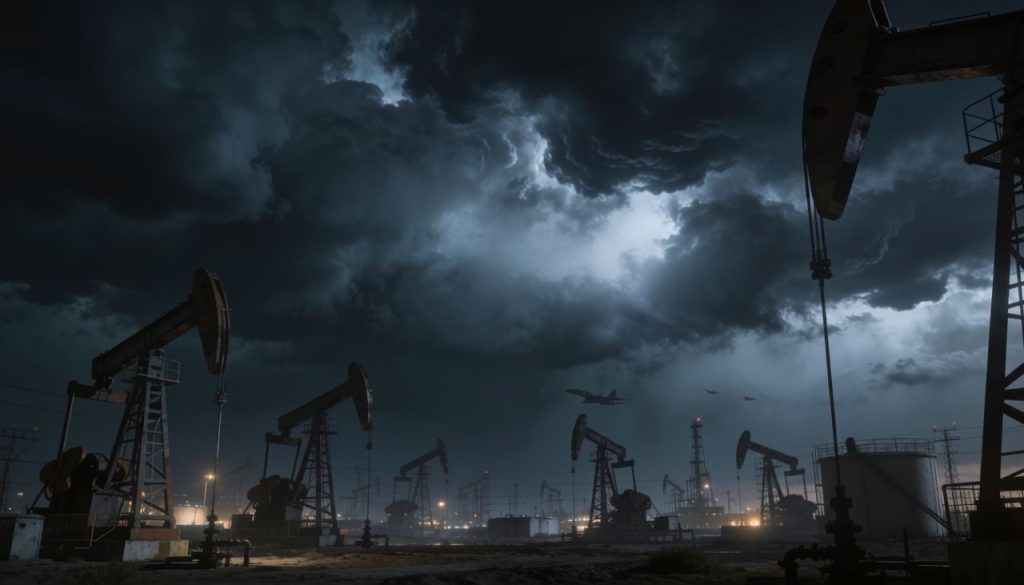
When a president posts that rising oil prices are good for America, the energy sector listens with interest. When that president is simultaneously running a war that has pushed crude toward $100 a barrel and diesel past $4.86 a gallon, the rest of corporate America and the consumer economy reads the same post very differently.
That is the schism at the center of Thursday’s now-viral Truth Social statement from President Donald Trump: “The United States is the largest Oil Producer in the World, by far, so when oil prices go up, we make a lot of money.” The sentence is not entirely wrong as a description of upstream energy economics. As a statement about the broad U.S. economy, it is a category error of significant proportions, and one that carries real consequences for markets, businesses, and Republicans defending congressional majorities in November.
Who Actually Captures the Windfall
Start with what Trump got right. The United States is the world’s largest crude producer, pumping roughly 14 million barrels per day. When global benchmark prices jump by $20 or $30 per barrel, domestic producers do capture a substantial revenue increase. Oil Change International estimated that the current price environment could translate to approximately $280 million in additional daily revenue for U.S. oil producers, or close to $100 billion over a full year if elevated prices persist. For integrated oil majors and independent producers, this is a legitimate tailwind. Energy sector equities have been among the few bright spots in a market rattled by Iran war uncertainty.
But here is the structural problem with Trump’s framing: that revenue flows to private corporations and their shareholders, not to the federal government and not to the broader economy. The U.S. government does not own its oil fields the way a state-owned enterprise like Saudi Aramco sits inside the Saudi fiscal model. Federal royalties on publicly leased acreage generate some revenue, but they are a fraction of the windfall. The overwhelming majority of the profit from $100-a-barrel crude lands with ExxonMobil, Chevron, ConocoPhillips, and the private equity-backed independents that now account for a substantial share of U.S. shale production.
The distribution of those profits matters politically and economically. A 2022 analysis of the Russia-Ukraine oil shock found that U.S.-based firms captured the largest share of the global windfall among publicly listed producers, and that the gains were concentrated heavily among the wealthiest American households through equity ownership. When Trump says “we make a lot of money,” the “we” in question is a narrow slice of the investing class, not a country.
The Costs That Spread Everywhere Else
Oil is not just a commodity. It is an input cost embedded in nearly every sector of the economy. Transportation, logistics, agriculture, manufacturing, chemicals, plastics, and consumer goods all carry petroleum costs that rise when crude prices spike. A $30-per-barrel increase does not stay contained in the energy sector. It bleeds into freight rates, food prices, airline tickets, and the price of almost anything that moves through a supply chain.
For corporate America outside the upstream energy sector, the Iran war oil shock is a margin compression event. Airlines are facing fuel bills that blow up hedging programs designed for a $70-to-$80 crude environment. Trucking and logistics companies are navigating diesel at $4.86 a gallon, a price that erodes profitability for an industry already operating on thin margins. Manufacturers with energy-intensive operations are watching input costs climb in real time, at a moment when passing those costs to consumers is increasingly difficult given existing price sensitivity.
GasBuddy’s Patrick De Haan put a consumer number on the damage: Americans are spending roughly $250 million more on gasoline per day than they did 30 days ago. That is discretionary spending diverted from retail, restaurants, entertainment, and savings. The economic multiplier runs in the wrong direction from what a consumption-driven economy needs.
The SPR Release and Its Market Limits
The administration has moved to address prices through a coordinated release from the Strategic Petroleum Reserve. Energy Secretary Chris Wright announced that the Department of Energy would release 172 million barrels beginning next week, with delivery taking approximately 120 days. The International Energy Agency coordinated a parallel 400-million-barrel combined release across 32 member nations.
Markets are watching this closely, but the mechanism has limitations that traders understand and that the administration has been less forthcoming about. The SPR release addresses domestic inventory levels. It does not reopen the Strait of Hormuz, through which approximately 20% of the world’s oil supply normally transits. Iran’s new supreme leader stated Thursday that the strait would remain closed as a pressure tool. Until tanker traffic resumes through that chokepoint, the global supply disruption persists regardless of how many barrels the U.S. releases domestically. Karen Young of Columbia’s Center on Global Energy Policy was direct about this: the market cannot fully reorient until the strait reopens. The SPR is a price stabilization tool, not a substitute for 20% of global oil trade.
Energy Secretary Wright declined to rule out $200-a-barrel crude when pressed on the question on CNN. That is not a confident market signal. The Energy Information Administration raised its 2026 average WTI price forecast by more than $20 per barrel, noting that the projection is highly dependent on the duration of the conflict. In other words, nobody in the administration actually knows where prices land, and the SPR release is as much a political gesture as a market intervention.
The Business Community’s Actual Problem With This Statement
The deeper issue for the business community is not the oil price itself. It is the signal the statement sends about how the administration is processing the economic tradeoffs of the Iran war. A president who frames rising energy costs as a national revenue event is a president who may be slower to prioritize cost-containment measures that would help the broader economy: faster diplomatic resolution, aggressive SPR deployment, coordinated pressure on OPEC partners to increase output, or a clearer timeline for Hormuz reopening.
Trump called rising gas prices “a little glitch” and “a detour” in an ABC News interview on Sunday. He told reporters the military operation is “ahead of schedule both in terms of lethality and in terms of time,” but declined to give a timeline. De Haan of GasBuddy noted that every additional day the conflict continues could add several more weeks to the price recovery period. For businesses modeling fuel, logistics, and input costs, that uncertainty compounds planning challenges. You cannot write a Q2 budget around “a little glitch” that nobody can date.
The Midterm Calculation and What It Means for Policy
Business leaders pay attention to midterm elections because they determine committee chairmanships, investigative priorities, and the legislative calendar for the final two years of an administration. Right now, the political math is deteriorating for Republicans at a pace that should concern anyone modeling the post-November policy environment.
Trump’s economic approval has fallen to 35% in the NPR/PBS News/Marist poll, described by the pollsters as the worst they have ever recorded for him. The NBC News survey found 62% of registered voters disapprove of his handling of inflation and the cost of living. Silver Bulletin’s polling average puts Trump’s overall net approval at negative 13.9, slightly worse than at the same point in his first term. Democrats hold a nine-point generic ballot advantage in the NBC survey. Three of the four biggest weekly diesel price spikes hit key Senate battleground states, including Texas, North Carolina, and Georgia, all of which Republicans need to hold to maintain their majority.
A Democratic House would mean a new set of committee chairs with subpoena authority. A Democratic Senate would mean confirmation fights for administration nominees and a harder path for any legislation requiring Senate action. For companies with regulatory exposure, federal contracting relationships, or tax policy dependencies, a midterm shift matters in concrete operational terms. The oil price post is not just a communications blunder. It is a data point in the political trajectory that determines who controls Washington’s agenda in 2027.
The Pattern Behind the Post
One final business-relevant observation. Trump has now floated canceling the 2026 midterm elections on two separate occasions, once in a speech to House Republicans at the Kennedy Center in January and once in a Reuters interview, where he said that given his administration’s record, “when you think of it, we shouldn’t even have an election.” The White House characterized both remarks as jokes. Legal experts and election administrators are unanimous that the president has no authority to cancel or postpone congressional elections, which are set by law and administered by state and local officials who have stated clearly they will proceed regardless.
But the pattern is worth noting from a political risk perspective. An executive who jokes about canceling elections he expects to lose, dismisses energy price shocks as trivial, and frames a consumer cost crisis as a revenue opportunity is an executive increasingly operating from a different set of assumptions than the economy he governs. For investors and business planners, the question is not whether Trump can actually cancel the elections. He cannot. The question is what the next eight months of policy look like when the president appears more focused on winning a war and defending his political position than on the cost-of-living pressures that are reshaping the midterm landscape beneath him.
The energy sector wins when oil prices rise. That part of Trump’s post is correct. The rest of the American economy is doing the math differently, and in November, the rest of the American economy gets to vote.
