Table of Contents
Nano Banana Pro sits at the center of Google’s latest bet on AI imagery, and it quietly tells you a lot about where power is moving in the digital economy. Nano Banana Pro is an AI image model tied into Gemini 3 Pro and spread through Google Slides, Google Ads, and the rest of the company’s productivity stack, turning visual persuasion into something closer to an API than a creative process.
According to Wired, the model dramatically improves text in images, jumps to 4K resolution, and plugs into tools that marketers, executives, and growth teams already use every day. On paper, that sounds like another performance upgrade. In practice, it is an infrastructure shift. What happens to democratic culture when one company can generate endless polished visuals, in any language, at near-zero marginal cost, and ship them through platforms it already owns.
Nano Banana Pro And The Corporate Image Factory
At a technical level, Nano Banana Pro solves a problem that made AI images feel like a party trick. Text used to be the tell. Hazy billboards with nonsense words. Misspelled product names. Bar flyers where the fonts warped at the edges like a bad dream.
Now Nano Banana Pro, running on Gemini 3 Pro, is far better at cleanly rendering words on posters, infographics, mock ads, and slides. It supports 4K output. It can combine multiple images into one composite. It can localize text on packaging so the same design turns from English to Korean to Czech without a human designer redrawing anything.
For corporate users, this is a revolution in mundane work. You can:
- Generate a full marketing flyer from one prompt.
- Iterate variants for different regions, languages, and demographics.
- Drop those visuals straight into Google Slides or Google Ads.
From a business efficiency angle, this is obviously attractive. From a social perspective, it means the cost of flooding public and semi-public spaces with polished, targeted imagery falls even closer to zero. The visuals that shape how we see work, politics, and each other become cheaper to make and easier to deploy at scale.
Nano Banana Pro And The Soft Power Of AI Slop
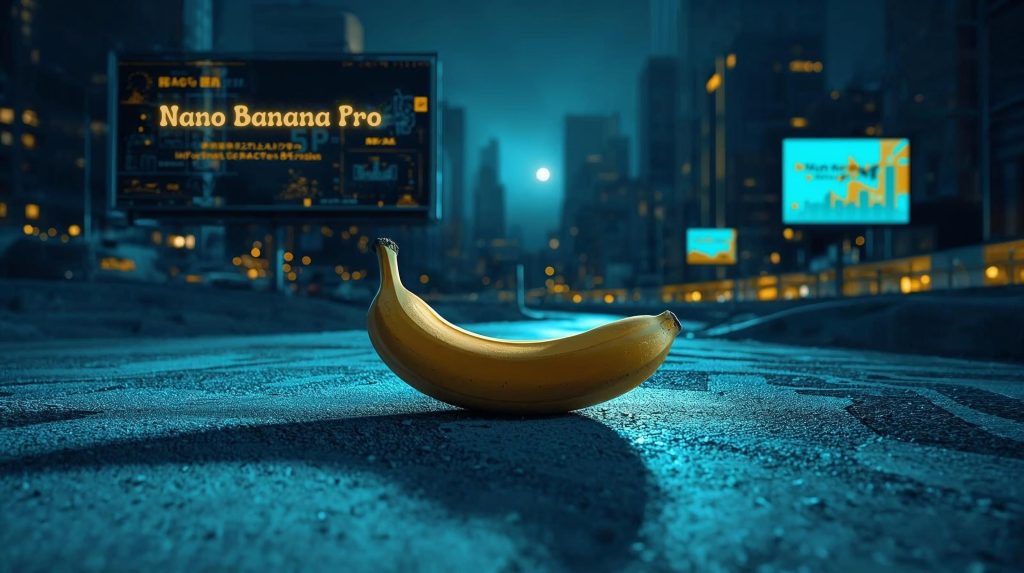
The hands-on reporting describes the world we are already living in. Corporate AI slop on websites, billboards, and bar flyers. Nano Banana Pro makes that slop more legible, more on-brand, and more persuasive.
The upgrade in text rendering is not just a user experience improvement. It is an increase in soft power. Clearer headlines on AI-generated infographics. Sharper calls to action on digital ads. More professional, credible visuals for presentations that will be used to pitch investors, lobby regulators, or persuade city councils.
The risk is not that one image lies. The risk is that image generation becomes so cheap and so tuned for corporate adoption that it subtly drowns out slower, more deliberative forms of public discourse. You cannot out-argue an image in a hallway or a rotating banner inside a productivity app that your manager controls.
In democratic theory, who controls the channels of information matters. With Nano Banana Pro living inside Google’s productivity and ad stack, the same company that shapes how billions search the web and use email is also optimizing the aesthetics of persuasion, in every language it can.
Nano Banana Pro, Localization, And Global Democracy
One of the most striking features of Nano Banana Pro is its multilingual text rendering. Google product leads highlight its ability to handle languages like Czech, diacritics and all. That is impressive engineering. It is also a political fact.
When any corporation can generate culturally tuned, linguistically accurate visuals for local markets on demand, several things happen at once.
- Local political campaigns, advocacy groups, and social movements suddenly compete with global firms that can pay to flood feeds with ads crafted by high-end AI.
- Countries with weaker media institutions or captured regulators face more sophisticated imported persuasion in their own languages.
- The line between campaigning, marketing, and astroturfing blurs as visuals can be endlessly recombined and localized by a handful of actors with global infrastructure.
Democratic norms depend on pluralism, independent media, and some friction in the creation of political communication. Tools like Nano Banana Pro punch holes in that friction. They make it trivially easy to test many variants of a visual narrative that plays on local fears or aspirations, measure which one performs best, and redeploy at scale.
When we talk about AI and democracy, the conversation often fixates on deepfakes of candidates. The quieter threat is the normalization of high-quality, low-cost propaganda pipelines for corporations and political actors aligned with them.
Where Nano Banana Pro Still Fails, And Why That Matters
Nano Banana Pro is not perfect. In early testing it struggled with precise labeling in complex scenes. A spoon became “Autumn leaves.” An empty plate was labeled as “pecan pie.” A bare spot on a table somehow turned into “dinner rolls.”
These failures reveal the current limits of the model’s semantic understanding. They also offer a small buffer for now. AI-generated visuals can still be wrong in obvious, even funny ways. That buys regulators, journalists, and civil society a little time to catch up.
Yet notice where Google focused its improvements. Text quality on posters. Infographics. Presentation visuals. Brand localization. These are not fringe uses. They are central to how institutions persuade. Even if the model still mislabels a spoon, it can produce slick infographics that look authoritative enough to pass in a busy workplace or a crowded social feed.
The Political Economy Of Nano Banana Pro: 7 Risks And Rewards
Progressive politics cares about who has power, who sets the rules, and who shapes the narrative. Nano Banana Pro lives inside that political economy, not outside it. Once you look at it through that lens, you can see at least seven clear risks and rewards emerging at the same time.
- Reward: Cheaper, Faster Creative For Small Teams
For overstretched marketing or communications teams, Nano Banana Pro is a blessing. It turns a single prompt into a usable flyer, banner, or slide background. Small nonprofits, local campaigns, and tiny startups can suddenly produce visuals that look like they came from a full design department. Used carefully, that is a genuine democratization of production. - Reward: Better Accessibility And Localization
Nano Banana Pro improves text rendering and language support. Public institutions could quickly spin up localized safety posters, public health infographics, or election reminders in many languages. Done well, this model can help governments and civil society actually reach communities that have been ignored by monolingual design systems. - Risk: Corporate Capture Of The Visual Public Sphere
The same features that empower small players supercharge big ones. Global brands can flood every surface of the internet with polished, locally tuned imagery. Because Nano Banana Pro sits inside Google’s productivity and advertising stack, the company gains even more leverage over how visual communication happens, from the first creative draft to the final ad auction. That centralization is a direct challenge to pluralistic media ecosystems. - Risk: Invisible Normalization Of AI-Generated Propaganda
As the quality and legibility of Nano Banana Pro images improve, the obvious “AI look” disappears. The line between a carefully reported infographic and a one-click corporate narrative blurs. Over time, workers and citizens may see more and more AI visuals in their feeds, inboxes, and meeting rooms without realizing how quickly those narratives were assembled or tested. That is a subtle but real threat to democratic norms that rely on informed, skeptical audiences. - Reward: New Tools For Watchdogs And Journalists
There is an upside for accountability. Journalists, watchdog groups, and advocacy organizations can use Nano Banana Pro to generate explainers, counter messaging, and visual investigations faster than before. Instead of ceding the aesthetic high ground to corporations and political consultancies, independent media can respond in the same visual language, but anchored to evidence and public interest reporting. - Risk: Dependence On A Single Closed Ecosystem
Because Nano Banana Pro is tightly bound to Gemini 3 Pro, Google Ads, and Google Slides, organizations that adopt it deeply become dependent on Google’s pricing, policy decisions, and opaque model behavior. That dependence makes it harder to switch to open or public alternatives later. It also means public discourse is increasingly mediated by a handful of proprietary models that no one outside the company can properly audit. - Risk: Unequal Regulatory Capacity And Global Spillover
Wealthy democracies may eventually regulate AI-generated political ads, require disclosures, or fund media literacy around tools like Nano Banana Pro. Many countries will not. Yet the same model will be used to generate visuals in local languages, for local elections, with almost no oversight. The reward of better tools for communication travels globally. So does the risk of more targeted, cheaper manipulation, especially in fragile democracies with weak institutions.
Seen this way, Nano Banana Pro is not neutral infrastructure. It is a concentrated package of power, wrapped in a delightful interface. Whether the rewards outweigh the risks will not be decided by Google engineers or marketing decks. It will be decided by how quickly regulators, newsroom editors, unions, educators, and voters understand what this model really does, and how willing they are to set rules around its use.
How Workers And Citizens Can Respond To Nano Banana Pro
If Nano Banana Pro is a glimpse of the next wave of AI infrastructure, how should workers and citizens respond. Several levers matter.
Inside organizations:
- Designers and communications staff can insist on review processes that treat Nano Banana Pro images as drafts, not final truth.
- Employees can push for internal policies limiting AI-generated imagery in sensitive presentations, especially those related to politics, public policy, or high stakes health and safety claims.
- Unions and worker councils can negotiate over surveillance and performance metrics that might tie job security to AI accelerated output quotas.
In the public sphere:
- Journalists and editors can disclose when visuals are AI-generated and invest in visual literacy for readers.
- Regulators can study the broader AI education and tooling ecosystem, building on reporting like the coverage of new Google skills and AI courses at BusinessTech News, and treat image models as part of a platform power issue rather than isolated curiosities.
- Civil society groups can build public campaigns explaining how AI imagery works, emphasizing that professional sheen does not equal truth.
The goal is not to ban tools like Nano Banana Pro. It is to make sure they operate inside a democratic framework where concentrated corporate power does not quietly redefine what counts as normal, persuasive, or real.
Nano Banana Pro, Next
In a narrow sense, Nano Banana Pro is a success. It cleans up AI’s most embarrassing tell, lifts resolution, and routes that capability to the people who will use it most. Businesses and institutions that communicate at scale.
In a broader sense, Nano Banana Pro is an early test of whether democratic societies can treat AI image models as political infrastructure, not just creative gadgets. The model can already pull live information through Google Search and turn it into weather infographics. It can already localize brands for nearly any market. Future iterations will only deepen that integration.
The choice ahead is simple, even if the politics are not. We can let the aesthetics of our public and corporate life be shaped by whichever closed model performs best in quarterly demos. Or we can build norms, rules, and public alternatives that push tools like Nano Banana Pro into alignment with democratic values. Transparency, accountability, and pluralism.
If we do nothing, the era of corporate AI slop will not just persist. It will learn to spell, speak your language, and smile from every slide in the next all hands.
