Table of Contents
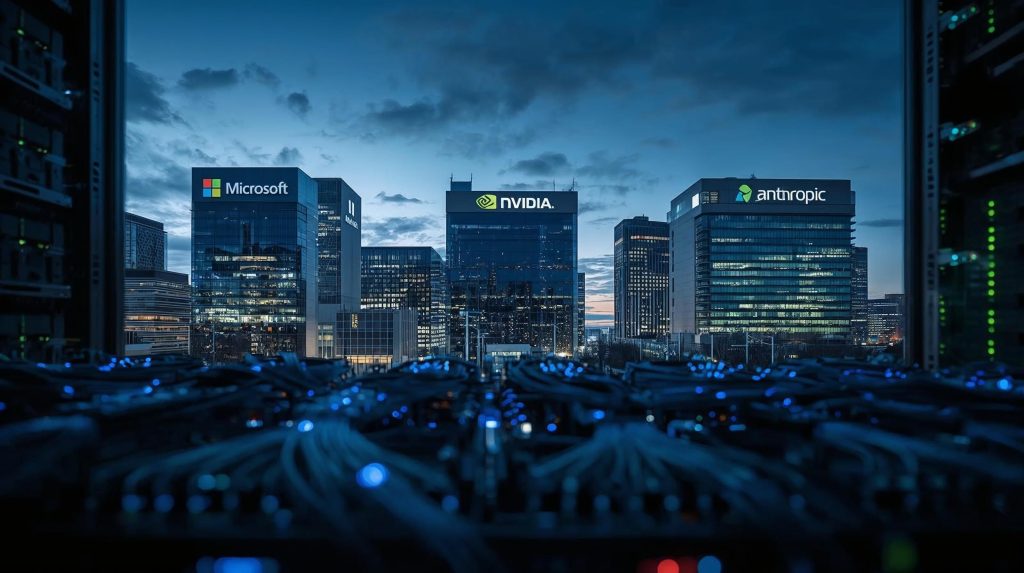
Microsoft Nvidia Anthropic partnership now anchors the next phase of the AI race. In a single announcement, three of the most powerful companies in artificial intelligence quietly redrew the map of who controls the infrastructure of thinking machines.
In November 2025, Microsoft and Nvidia agreed to invest up to 5 billion dollars and 10 billion dollars respectively into Anthropic, the AI safety focused startup behind the Claude models, while Anthropic committed to buy 30 billion dollars worth of Azure compute and up to one gigawatt of capacity on Nvidia’s Grace Blackwell and Vera Rubin systems, as reported by CNBC. That combination of capital, chips, and cloud goes far beyond a routine business deal and looks more like a long term claim on who will own the next decade of AI scale.
The Microsoft Nvidia Anthropic partnership now settles one large question in the AI race. We know which coalition will anchor the high end of model training and deployment. What remains unsettled is how democratic institutions, regulators, and the public will respond when so much cognitive power concentrates inside such a small, tightly coordinated bloc.
Why The Microsoft Nvidia Anthropic Partnership Matters More Than The Numbers
At headline level, the Microsoft Nvidia Anthropic partnership looks straightforward.
- Microsoft:
- Up to 5 billion dollars invested in Anthropic.
- Secures a 30 billion dollar Azure spend commitment.
- Deepens its access to Claude models inside Azure AI Foundry and Copilot products.
- Nvidia:
- Up to 10 billion dollars invested.
- Locks Anthropic into its most advanced chips and systems.
- Gains a flagship customer that will help shape future GPU architectures.
- Anthropic:
- Becomes the rare AI lab with multi cloud reach and multi trillion dollar backers.
- Commits to massive compute purchases that effectively prebook the future of its model scaling.
On paper, everyone wins. Azure gets more premium AI, Nvidia gets guaranteed demand, Anthropic gets capital and compute at industrial scale. But the Microsoft Nvidia Anthropic partnership sits on top of at least three deeper shifts.
First, this is Microsoft hedging. The company still has a huge, and politically fraught, stake in OpenAI. By tying itself to Anthropic, it is not abandoning OpenAI. It is making sure that no single lab can hold its AI future hostage.
Second, this is Nvidia consolidating. The chipmaker is already the default choice for AI data centers. Through the Microsoft Nvidia Anthropic partnership, it is not just selling hardware. It is shaping the workloads that will define future generations of chips.
Third, this is Anthropic choosing a path. For years the company framed itself as the cautious, safety centric alternative to more aggressive labs. Now it is committing to at least a gigawatt of compute and tens of billions in spend. Safety at this scale is no longer a purely research question. It becomes a question of corporate governance and public accountability.
Microsoft Nvidia Anthropic Partnership And The Quiet Consolidation Of AI Infrastructure
The Microsoft Nvidia Anthropic partnership also marks a new stage in the consolidation of AI infrastructure.
Claude will now be deeply integrated into Azure, powered by Nvidia systems, while remaining available on other clouds. That sounds like “choice.” In practice, it means the same handful of hyperscalers and chip providers sit beneath almost every “independent” AI provider.
This is not a traditional monopoly. It is something messier.
- The data centers are controlled by three to four U.S. based cloud giants.
- The compute hardware is controlled by one overwhelmingly dominant chipmaker.
- The most advanced models are built by a small set of labs with overlapping investors and partners.
The Microsoft Nvidia Anthropic partnership crystallizes that structure. If you are a government, a hospital system, a school district, or a newsroom, you may think you are choosing a model or a cloud. You are actually signing up to a tightly coupled industrial stack designed by a coalition of firms whose incentives do not necessarily align with democratic resilience, labor protections, or long term public safety.
This is where the progressive concern kicks in. AI is not just an app. It is fast becoming the language layer between citizens and institutions. When that layer is effectively privatized, and when its evolution is steered by a small corporate bloc, the classic liberal assumptions about markets and competition start to look painfully outdated.
The Microsoft Nvidia Anthropic Partnership As A Political Story, Not Just A Business Deal
The usual coverage of the Microsoft Nvidia Anthropic partnership focuses on valuation and market share. It misses that this is also a constitutional story.
Every time a public agency deploys a Claude powered service on Azure, running on Nvidia hardware, three private boards of directors gain quiet influence over how that service behaves, how it evolves, and what tradeoffs it makes.
Those tradeoffs are not neutral.
- How much energy is consumed to run these systems.
- Which languages and regions see first class support.
- How the models treat protest movements, unions, and political organizing.
- What data is logged, retained, or shared.
These are questions that used to be debated in legislatures and courts. Now they are being negotiated in partnership agreements and product roadmaps.
The Microsoft Nvidia Anthropic partnership is, in effect, a constitutional amendment written in cloud contracts rather than case law. It changes who gets to decide how intelligence is allocated in society.
How The Microsoft Nvidia Anthropic Partnership Reshapes Competition And OpenAI
To fully understand the Microsoft Nvidia Anthropic partnership, you have to see it in the shadow of OpenAI.
Microsoft has spent years as OpenAI’s indispensable partner and largest enterprise channel. That relationship has brought Microsoft growth, but also unpredictability. Governance crises at OpenAI instantly become material risks for Microsoft shareholders.
By investing heavily in Anthropic, and promising to integrate Claude deeply into Copilot and Azure, Microsoft is sending a clear message: there will be no single point of failure for its AI ambitions.
That is good risk management for one company. Yet it also intensifies the arms race dynamic. OpenAI responds by scaling faster. Anthropic responds with larger models and more compute commitments. Nvidia responds by pushing the frontier of chips as quickly as possible to keep everyone supplied.
In the background sit regulators who are still writing AI rules, often at a pace far slower than the cadence of these partnerships. From a democratic perspective, the Microsoft Nvidia Anthropic partnership shows how private coordination outpaces public oversight. The companies have already decided to spend 15 billion dollars and deploy a gigawatt of AI compute before any meaningful public debate on whether that scale is wise, sustainable, or fair.
For readers looking at the broader ecosystem, this deal also rhymes with the shifting alliances captured in the SoftBank Nvidia OpenAI story, which we explored in detail here: SoftBank Nvidia Sale OpenAI. Together, these moves sketch a map of AI power that is as much about financing and chip supply as it is about clever algorithms.
Democratic Norms, Safety Promises, And The Microsoft Nvidia Anthropic Partnership
Anthropic has always framed itself as an AI safety first lab. The Microsoft Nvidia Anthropic partnership will test what that means when you are on the hook for 30 billion dollars of spend and serving the world’s largest enterprise customers.
Safety is not an abstract virtue at this scale. It is a set of specific choices that can frustrate short term revenue goals.
- Slower deployment of risky features.
- Tighter content moderation that might anger powerful clients.
- Transparent reporting that may expose system weaknesses.
Microsoft and Nvidia both say the right things about responsible AI. But their fiduciary duty runs to shareholders, not to future generations. When there is a conflict between quarterly expectations and long term risk, democratic societies cannot simply hope that the right thing will be done inside a boardroom.
The Microsoft Nvidia Anthropic partnership should therefore be a trigger for stronger, not weaker, public governance.
At a minimum, lawmakers and regulators should be asking:
- Should there be explicit public reporting on compute usage, training runs, and model risks above certain investment thresholds.
- Do large AI partnerships require competition reviews focused not only on price, but on concentration of cognitive infrastructure.
- How can labor groups, civil society, and affected communities gain standing in oversight of systems that will shape their working lives and information environments.
Without that, safety becomes a brand strategy, not a binding constraint.
What The Microsoft Nvidia Anthropic Partnership Means For The Rest Of Us
It is tempting to treat the Microsoft Nvidia Anthropic partnership as a distant corporate chess move. For most people, it will show up in subtler ways.
Over the next few years:
- More workplace tools will quietly route “smart” features through Claude on Azure, optimized for Nvidia chips.
- Public services might adopt AI driven triage, translation, and support, powered by this same stack.
- Political campaigns and advocacy groups will experiment with targeting and messaging tools built on top of it.
In that world, choices made by three companies on November 18, 2025 will echo in classrooms, hospitals, city halls, and group chats.
The real test for democratic societies is not whether they can keep up on model benchmarks. It is whether they can keep up on institutional design. The Microsoft Nvidia Anthropic partnership is a preview of how quickly corporate constellations can form in AI. Our laws and norms will need to evolve just as quickly if we want intelligence infrastructure that serves more than the balance sheets of its largest shareholders.
For now, this partnership looks like a masterstroke of strategic positioning. Whether history judges it as a turning point toward shared prosperity or a missed chance to rebalance power will depend on what we build around it: regulators with technical depth, antitrust tools updated for cloud era realities, and civic movements that understand that the future of AI is too important to be negotiated only in private.
