
Table of Contents
Meta tax charge Trump bill impacts hit hard in Q3 2025. The social media giant’s shares plummeted 9% after disclosing a massive $15.93 billion tax charge directly tied to President Trump’s One Big Beautiful Bill Act. Meta tax charge Trump bill consequences transformed what should have been a banner quarter into an earnings disaster that sent shockwaves through Silicon Valley.
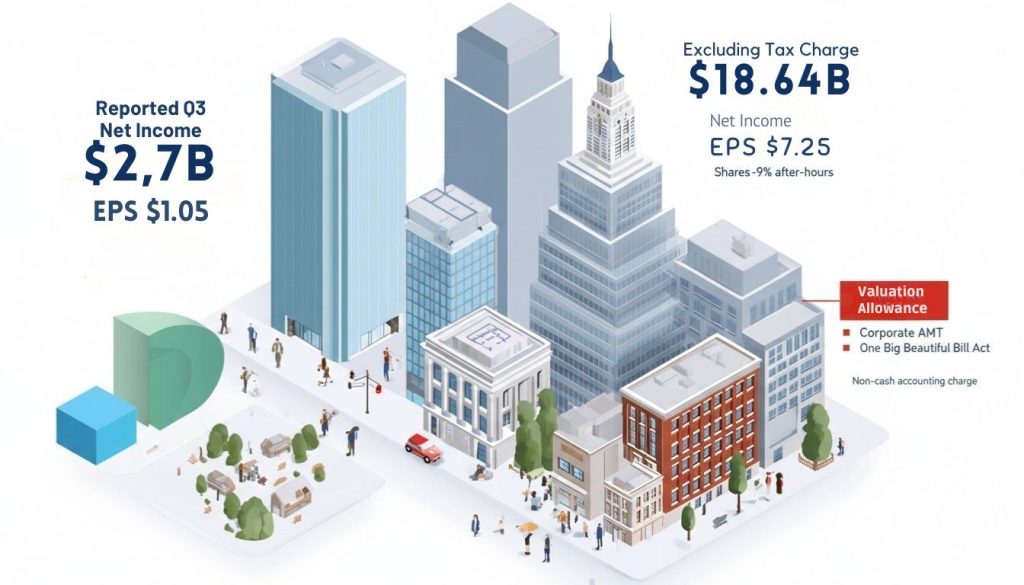
The tax charge resulted from the recognition of a valuation allowance against Meta’s U.S. federal deferred tax assets, reflecting the impact of the U.S. Corporate Alternative Minimum Tax, a provision embedded in Trump’s sweeping tax legislation signed into law on July 4, 2025.
Understanding Meta Tax Charge Trump Bill Consequences
Meta’s net income plunged 83% to $2.7 billion in the third quarter. Without the Meta tax charge Trump bill imposed, the company would have posted net income of $18.64 billion, representing a 19% increase year-over-year. The stark difference between these figures illustrates the sheer magnitude of the accounting adjustment forced by the new tax law.
Revenue told a different story. Meta generated $51.4 billion in revenue, up 26% from last year, beating Wall Street forecasts. The company’s advertising business remained strong, with average price per ad growing 10% year-over-year. But the tax charge overshadowed these operational wins entirely.
Earnings per share collapsed from expectations of $6.70 to just $1.05. Excluding the one-time tax charge, Meta’s diluted EPS would have been $7.25, comfortably ahead of analyst estimates. The market’s reaction was swift and brutal, wiping billions off Meta’s market capitalization in after-hours trading.
How the One Big Beautiful Bill Act Created This Meta Tax Charge Trump Bill Crisis
The One Big Beautiful Bill Act represents President Trump’s second major tax overhaul, following the Tax Cuts and Jobs Act of 2017. The law made permanent the reduced individual tax rates and brackets established by the Tax Cuts and Jobs Act while modifying numerous important tax provisions affecting businesses, according to the Joint Committee on Taxation analysis.
For Meta specifically, the Corporate Alternative Minimum Tax provisions created an immediate accounting headache. The company was forced to recognize a valuation allowance against deferred tax assets, essentially acknowledging that certain tax benefits it had been counting on would no longer materialize under the new tax regime.
This isn’t just Meta’s problem. The Corporate Alternative Minimum Tax applies to large corporations with substantial book income, ensuring they pay a minimum level of federal tax regardless of deductions and credits. While designed to prevent tax avoidance, the provision’s implementation created immediate balance sheet consequences for major tech companies that had accumulated significant deferred tax assets.
Meta Tax Charge Trump Bill: A Silver Lining in Future Tax Payments
Despite the painful quarterly hit from the Meta tax charge Trump bill delivered, Meta indicated the long-term outlook might be brighter. The company expects a significant reduction in U.S. federal cash tax payments for the remainder of 2025 and future years due to the implementation of the One Big Beautiful Bill Act.
Meta reported an effective tax rate of 87% for the quarter, but expects the fourth-quarter tax rate to be 12-15%, assuming no additional changes to the tax landscape. This dramatic reduction in future cash tax obligations represents the trade-off: an enormous one-time accounting charge today in exchange for lower actual tax payments tomorrow.
The distinction between accounting charges and cash impact matters enormously. This was a non-cash charge, meaning Meta didn’t write a $15.93 billion check to the IRS. Instead, the company adjusted how it accounts for future tax benefits on its books. The real financial benefit comes from reduced cash tax payments going forward, potentially saving the company billions in actual dollars over the coming years.
Meta’s Operational Strength Remains Intact Despite Tax Hit
Strip away the Meta tax charge Trump bill created, and Meta’s underlying business continues firing on all cylinders. The company saw family daily active people of 3.54 billion on average for September 2025, an increase of 8% year-over-year. Instagram hit a milestone with 3 billion monthly active users, while Threads recently surpassed 150 million users.
CEO Mark Zuckerberg highlighted progress in artificial intelligence during the earnings call. More than one billion monthly active users already use Meta AI, with usage increasing as the company improves its underlying models. The recently launched short-form AI video feed called Vibes is seeing strong retention and week-over-week growth.
The company’s Reality Labs division, focused on virtual and augmented reality technology, continues burning cash but delivered intriguing product launches. Meta’s new Ray-Ban Displays glasses with a built-in screen sold out at most stores within 48 hours, prompting the company to ramp up production.
Big Tech Faces Growing Regulatory Complexity Beyond Meta Tax Charge Trump Bill
Meta’s tax situation reflects broader challenges facing the technology sector as governments worldwide reassess how to tax digital giants. The Corporate Alternative Minimum Tax provision in Trump’s bill didn’t emerge in a vacuum. It builds on global efforts to ensure large multinational corporations pay meaningful taxes regardless of where they book profits or what credits they claim.
The timing creates particular challenges for tech companies investing heavily in infrastructure. Meta raised its full-year 2025 capital expenditures outlook to $70-72 billion from a prior range of $66-72 billion. The company expects capital spending will be “notably larger” in 2026 as it expands computing infrastructure for AI initiatives.
These massive infrastructure investments typically generate substantial tax deductions through depreciation and other benefits. The Corporate Alternative Minimum Tax limits how much companies can use such deductions to reduce their tax bills, creating tension between encouraging business investment and ensuring adequate tax collection.
For context, similar quantum computing breakthroughs are reshaping tech investment priorities across the industry. Google recently announced a quantum computer delivering 13,000x speedup, underscoring the capital-intensive nature of next-generation computing technologies that companies like Meta must pursue to remain competitive.
What the Meta Tax Charge Trump Bill Means for Investors and Tech Policy
The market’s 9% haircut to Meta’s stock price, despite strong operational results, reveals investor anxiety about regulatory uncertainty. When tax policy can swing quarterly earnings by $16 billion on a technicality, it becomes harder to value companies based on fundamental business performance.
This episode highlights the ongoing tension in American tax policy between encouraging business investment and ensuring corporations contribute fairly to federal revenue. The One Big Beautiful Bill Act attempted to thread this needle by making certain pro-growth provisions like full expensing permanent while imposing alternative minimum tax requirements to guarantee minimum tax collection.
Meta’s experience with this tax charge suggests the balance may need refinement. A one-time accounting charge of this magnitude distorts financial reporting and makes it difficult for investors, analysts, and the public to assess a company’s true economic performance. Better policy design might phase in such changes more gradually or structure them to avoid creating massive one-time impacts that overwhelm operational results.
Looking Ahead: Meta’s Q4 Outlook After Tax Charge
Despite the Meta tax charge Trump bill drama, Meta provided upbeat guidance. The company anticipates Q4 total revenue to be $56 billion to $59 billion, ahead of analyst consensus estimates. The advertising business continues benefiting from improved targeting through AI, and engagement across Meta’s family of apps remains strong.
The company’s willingness to increase spending on AI infrastructure, even while digesting this tax hit, demonstrates confidence in its strategic direction. Zuckerberg has bet heavily on “superintelligence,” believing it represents a paradigm shift in computing and customer relationships. Whether this vision materializes remains to be seen, but Meta is putting real money behind it.
For now, Meta’s third quarter will be remembered not for 26% revenue growth or 3.54 billion daily active users, but for a $15.93 billion tax charge that briefly made one of America’s most profitable companies look unprofitable. The company’s real test comes next year, when investors will see whether those promised tax savings materialize and whether the underlying business can maintain its impressive growth trajectory.
The One Big Beautiful Bill Act achieved its goal of ensuring large corporations pay minimum taxes, but the Meta tax charge Trump bill created demonstrates that achieving tax policy objectives through complex accounting provisions can create chaos in corporate earnings reports. As other tech giants report their quarterly results, investors should watch for similar tax-related surprises lurking in the footnotes.
