Table of Contents
Amazon Nvidia AI Integration marks a pivotal moment in the evolution of cloud computing and artificial intelligence. Amazon Web Services (AWS) is making a significant leap forward by embedding Nvidia’s cutting-edge NVLink Fusion technology directly into its forthcoming AI chips. This strategic alliance promises to redefine the very infrastructure that powers the global AI revolution, deepening a partnership poised to reshape the competitive landscape of cloud services.
The Core of Amazon Nvidia AI Integration
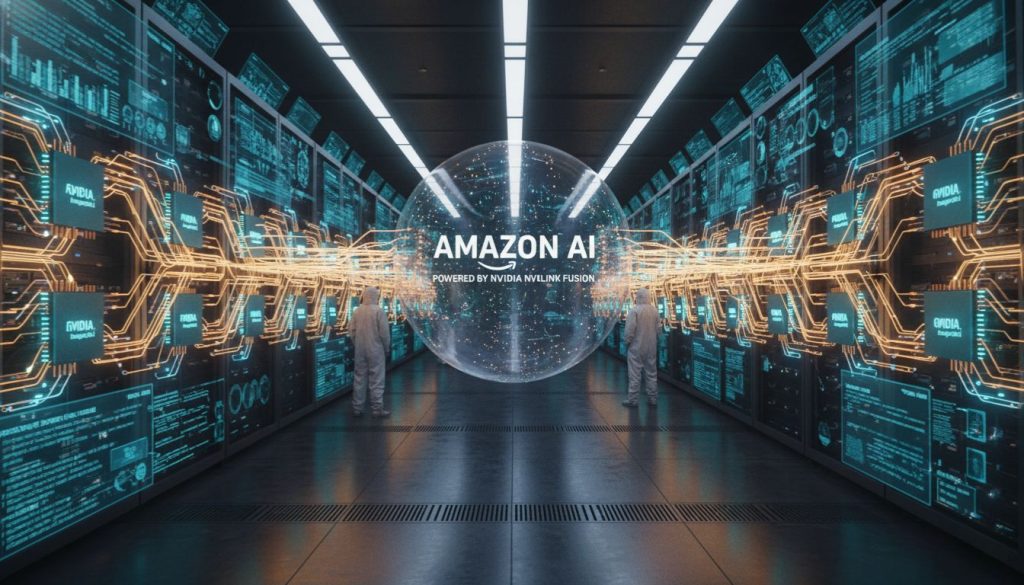
At AWS re:Invent 2025, Amazon unveiled its plans to incorporate Nvidia’s NVLink Fusion into its next-generation Trainium4 chip. This high-speed interconnect technology is crucial for enabling rapid communication between AI chips, a fundamental requirement for the efficient training and deployment of large-scale AI models. Nvidia’s NVLink Fusion, already adopted by industry players like Intel and Qualcomm, now becomes a cornerstone of AWS’s AI strategy, solidifying Nvidia’s pervasive influence across the AI hardware ecosystem.
Redefining AI Infrastructure with Amazon Nvidia AI Integration
The adoption of Nvidia’s NVLink Fusion by AWS transcends a mere hardware upgrade; it represents a profound strategic alignment with the prevailing AI ecosystem. Nvidia’s CUDA platform has long been the industry standard for AI application development. By ensuring seamless compatibility with Nvidia GPUs, AWS is strategically positioning itself as the preferred platform for AI developers and enterprises. This move also bolsters AWS’s innovative AI Factories initiative, which provides customers with dedicated AI infrastructure within their own data centers, directly addressing critical concerns regarding data sovereignty and regulatory compliance.
The current Trainium3 UltraServer, powered by AWS’s proprietary chips, already delivers impressive performance gains, boasting four times the speed and 40% greater energy efficiency than its predecessor. The upcoming Trainium4, enhanced by Nvidia’s NVLink Fusion, is set to further amplify these capabilities, facilitating seamless interoperability with Nvidia GPUs while leveraging AWS’s cost-effective server architecture. This hybrid approach has the potential to disrupt the market by offering superior performance without the traditional premium associated with Nvidia’s hardware.
Democratizing AI: Sovereignty and Scale Through Amazon Nvidia AI Integration
A particularly compelling aspect of this integration is its capacity to democratize AI access while upholding democratic norms and data sovereignty. AWS AI Factories empower governments and enterprises to deploy robust AI systems on-premises, ensuring that sensitive data remains under their direct control. This is an indispensable feature in an era increasingly defined by data privacy concerns and national security imperatives. By synergizing AWS’s extensive cloud expertise with Nvidia’s hardware prowess, this partnership is establishing a new benchmark for secure, scalable, and sovereign AI infrastructure.
This development also carries significant global democratic implications. As AI increasingly becomes a strategic national asset, the ability to control AI infrastructure locally enables nations to actively participate in the AI revolution without ceding autonomy to external cloud providers. AWS’s collaboration with Nvidia, exemplified by the deployment of AI Factories in regions such as Saudi Arabia, illustrates how technological partnerships can foster sovereign AI ecosystems that align with local regulations and values.
Competitive Dynamics and the Broader AI Landscape
Amazon’s Nvidia AI Integration unfolds within a broader industry context where major cloud providers are making substantial investments in AI hardware and hybrid cloud solutions. Microsoft, for instance, has also unveiled its own Nvidia-powered AI Factories, underscoring an intense competitive race to deliver the most advanced and flexible AI infrastructure. This dynamic mirrors the early cloud computing rivalries, with AI now serving as the central battleground.
For enterprises, this heightened competition translates into a wider array of choices and enhanced performance, potentially at reduced costs. AWS’s strong emphasis on energy efficiency and cost-effectiveness directly addresses growing concerns about the environmental footprint of large-scale AI data centers. The capability to interconnect thousands of Trainium3 chips in UltraServers, and soon Trainium4 with Nvidia’s interconnect, provides unparalleled scalability for demanding AI workloads.
The Software Layer: A Holistic Approach Beyond Hardware
The partnership extends well beyond hardware. Nvidia’s Nemotron open models are now seamlessly integrated with Amazon Bedrock, AWS’s serverless platform designed for generative AI applications. This integration streamlines the developer experience, enabling companies to construct and deploy sophisticated AI agents capable of processing text, code, images, and video with remarkable efficiency. Furthermore, AWS offers GPU-accelerated vector search through Amazon OpenSearch Service, powered by Nvidia’s cuVS library, which dramatically accelerates unstructured data processing.
This comprehensive, full-stack collaboration—spanning from silicon to software—solidifies AWS and Nvidia’s positions as leaders in delivering end-to-end AI solutions that meet the rigorous demands of modern enterprises.
The Future Trajectory of AI Cloud Services
The Amazon Nvidia AI Integration unequivocally signals that the future of AI cloud services will be shaped by strategic hardware-software partnerships that prioritize performance, scalability, and sovereignty. As AWS continues to roll out Trainium4 and expand its AI Factories, the company is not merely competing on technological advancements but also on fundamental principles of data control and democratic governance.
For those keenly observing the broader AI cloud ecosystem, this development complements other significant industry movements, such as the OpenAI and AWS collaboration on Nvidia GPUs, which further illustrates the intricate interdependencies among these tech giants in shaping the future of AI (read more here).
Amazon’s integration of Nvidia technology represents more than a technical enhancement; it is a strategic reorientation that could accelerate the AI industrial revolution while embedding democratic values into the very infrastructure that underpins it.
