Table of Contents
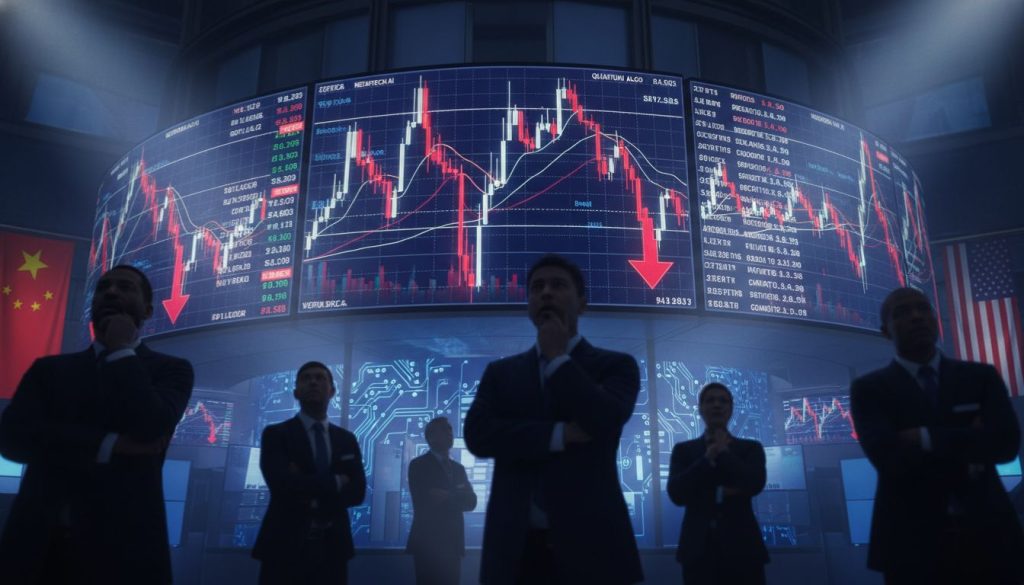
AI stock volatility has become the canary in the coal mine for American financial markets. When Chinese startup DeepSeek launched its R1 reasoning model in late January 2025, the tremors reverberated from Silicon Valley to Wall Street with seismic force. Nvidia shed $590 billion in market value in a single trading session, the largest one-day loss for any company in stock market history. That wasn’t just a bad day. It was a warning shot about how dangerously concentrated the entire market has become around artificial intelligence bets.
The question isn’t whether AI represents genuine technological innovation. It clearly does. The question is whether markets have built a house of cards where seven companies hold 31% of the S&P 500’s entire value, and any wobble in their AI narratives sends shockwaves through retirement accounts and pension funds nationwide. This isn’t diversification. This is dependency. Here are five concrete ways AI stock volatility reveals the depth of this concentration crisis.
1. Seven Companies Now Control One-Third of Market Value
AI stock volatility matters exponentially more today because the so-called Magnificent Seven (Apple, Amazon, Alphabet, Meta, Microsoft, Nvidia, and Tesla) now represent nearly a third of the S&P 500’s entire value. When investors lean this heavily on a handful of stocks, what once resembled unstoppable momentum quickly morphs into glaring vulnerability.
The DeepSeek episode exposed this structural weakness with brutal clarity. The Chinese company claimed it built a competitive AI model for just $5.6 million, trained on older Nvidia H800 chips that don’t even represent the chipmaker’s most advanced technology. By contrast, OpenAI CEO Sam Altman has acknowledged spending over $100 million developing GPT-4, while American tech giants collectively plan to invest roughly $1 trillion in AI infrastructure over the coming years, according to Goldman Sachs.
That gap between American investment and Chinese efficiency rattled the core assumption propping up astronomical valuations: that building competitive AI requires unlimited capital and cutting-edge hardware. If that assumption collapses, so does the justification for current market concentration.
2. Algorithmic Trading Amplifies Volatility Through Herd Behavior
AI stock volatility isn’t just about fundamentals anymore. It’s about machines trading with other machines in synchronized panic. The IMF has warned that AI-driven trading systems, particularly those using deep learning techniques, could converge on similar strategies when exposed to identical price signals. In stress scenarios, these systems amplify swings by acting in unison, creating destabilizing feedback loops precisely when markets need liquidity most.
Patent filings underscore how rapidly this risk is accelerating. Since large language models emerged in 2017, the share of AI content in patent applications related to algorithmic trading has surged from 19% to over 50% annually since 2020. That wave of innovation suggests even higher trading volumes ahead, with greater potential for volatility spikes during periods of uncertainty.
The semiconductor-focused VanEck SMH ETF plummeted 9.8% in a single session following the DeepSeek announcement. The nuclear energy sector, riding high on AI-driven electricity demand expectations, saw the VanEck Uranium & Nuclear ETF crater 11.1%. Power giant Vistra Corp lost more than 28% of its value. These weren’t rational repricing events. They were algorithmic stampedes.
3. Chinese Innovation Rewrites the Capital-Intensive AI Narrative
DeepSeek’s breakthrough fundamentally challenges the AI investment thesis that justified massive concentration in American tech giants. The startup reportedly used tens of thousands of Nvidia GPUs, but because the U.S. banned export of advanced AI chips to China in September 2022, the company was forced to innovate around hardware limitations. The result: a model that costs 55 cents per million input tokens and $2.19 per million output tokens, compared to OpenAI’s $15 and $60 respectively.
This efficiency matters because it democratizes AI development. When cutting-edge models become accessible without billion-dollar price tags, the competitive landscape shifts dramatically. Investors who previously bet on AI dominance through pure capital deployment now face the uncomfortable reality that algorithmic optimization might trump hardware superiority.
The geopolitical implications amplify AI stock volatility concerns. DeepSeek’s timing, launching during President Trump’s inauguration week, wasn’t accidental. The move mirrored Huawei’s 2023 strategy of releasing a new mobile phone model during a high-profile U.S. diplomatic visit to China. Both instances signal a pattern: Chinese tech companies using product launches as strategic counterpunches in an ongoing technology rivalry.
Financial regulators, including the Monetary Authority of Singapore and the Bank of England, have already issued warnings about potential disorderly corrections in equity markets if AI optimism retreats. These aren’t idle concerns. They reflect genuine worry about systemic risk posed by current valuations.
4. Pension Funds and Retirement Accounts Carry Concentrated AI Exposure
The concentration of market power in a handful of AI stocks raises fundamental questions about democratic capitalism and economic resilience. When seven companies control nearly a third of the S&P 500’s value, AI stock volatility stops reflecting broad economic health and starts reflecting the fortunes of an oligopoly.
This concentration creates systemic vulnerability that extends beyond individual portfolios. Pension funds, retirement accounts, and institutional investors all carry heavy exposure to these mega-cap tech names. When AI stock volatility spikes, it doesn’t just hurt Silicon Valley executives or venture capitalists. It impacts teachers’ retirement funds, municipal pension obligations, and the financial security of millions who never consciously chose to bet their futures on artificial intelligence.
The deeper concern involves innovation incentives. If market concentration continues rewarding a handful of dominant players regardless of competitive developments, it undermines the creative destruction that drives genuine technological progress. DeepSeek’s efficiency breakthrough should theoretically benefit consumers and accelerate AI democratization. Instead, markets initially interpreted it as a threat to established players, triggering broad selloffs rather than welcoming increased competition.
5. Winners and Losers Emerge Along Clear Fault Lines
AI stock volatility creates clear demarcation lines between resilient companies and vulnerable ones. Meta stands out as a relative winner despite market turbulence. The company’s core advertising business, built on 3.35 billion daily active users across Facebook, Instagram, WhatsApp, and Threads, generates enough cash flow to fund $60 billion to $65 billion in AI infrastructure investments without immediate pressure for returns. That financial buffer positions Meta to weather volatility that would crush less diversified competitors.
Software companies emerged as surprising beneficiaries. Since the DeepSeek announcement, productivity-focused software stocks have outperformed AI infrastructure plays by an average of 7%. This shift reflects a crucial market realization: if AI model creation becomes commoditized through open-source innovation, competitive advantage migrates to the application layer built on top of those models.
Conversely, smaller AI startups with unproven business models and high cash burn rates face existential risk. When investor appetite for speculative bets diminishes and capital becomes constrained, companies lacking sustainable revenue streams get exposed. The ultimate survivors will be those translating AI innovation into profitable business models, not those riding purely on speculative momentum.
What Investors Actually Need to Navigate This Volatility
Understanding AI stock volatility requires recognizing that we’re witnessing the early stages of a technology revolution, not its conclusion. Historic data shows that average years experience nearly 15% peak-to-trough declines, even during positive-returning years. Volatility is normal. What’s abnormal is the degree of market concentration amplifying those swings.
Investors should focus on companies with genuine moats beyond pure AI hype. Meta’s advertising empire, Microsoft’s enterprise software dominance, and Alphabet’s search monopoly all provide diversified revenue streams that can sustain extended AI investment cycles. These businesses can absorb volatility that would devastate pure-play AI startups.
The analyst community remains broadly optimistic. Thirty-eight AI stocks tracked by Morningstar closed 27.3% higher in recent periods, outpacing the broader tech index. But forward-looking price-to-earnings ratios for the Magnificent Seven, excluding Tesla, remain substantially below historic bubble levels. The median 25.9x forward P/E compares to 35.5x during the Nifty 50 era, 52.8x during Japan’s financial bubble, and 53.2x during the 2000 dot-com peak.
Those metrics suggest current valuations, while elevated, haven’t reached irrational exuberance territory. However, they also indicate limited margin for error. Any meaningful slowdown in AI adoption, revenue realization, or competitive positioning could trigger substantial repricing.
The path forward requires investors to maintain exposure to genuine AI innovation while building portfolio resilience through proper diversification, consistent rebalancing, and realistic expectations about volatility. AI stock volatility isn’t a bug in the system. It’s a feature of investing in transformative technology during its adolescence.
The companies that will thrive are those harnessing AI to drive efficiency, innovation, and substantial new revenue streams rather than those with inflated valuations based purely on speculative positioning. As competition intensifies and the technology matures, markets will eventually reward sustainable business models over narrative dominance.
That transition won’t be smooth. It will be volatile, unpredictable, and occasionally terrifying for concentrated portfolios. But it will also separate genuine innovation from speculation, rewarding investors who maintain discipline rather than chasing momentum. The five warning signals are flashing. The only question is whether investors will heed them before the next volatility shock hits.
