Table of Contents
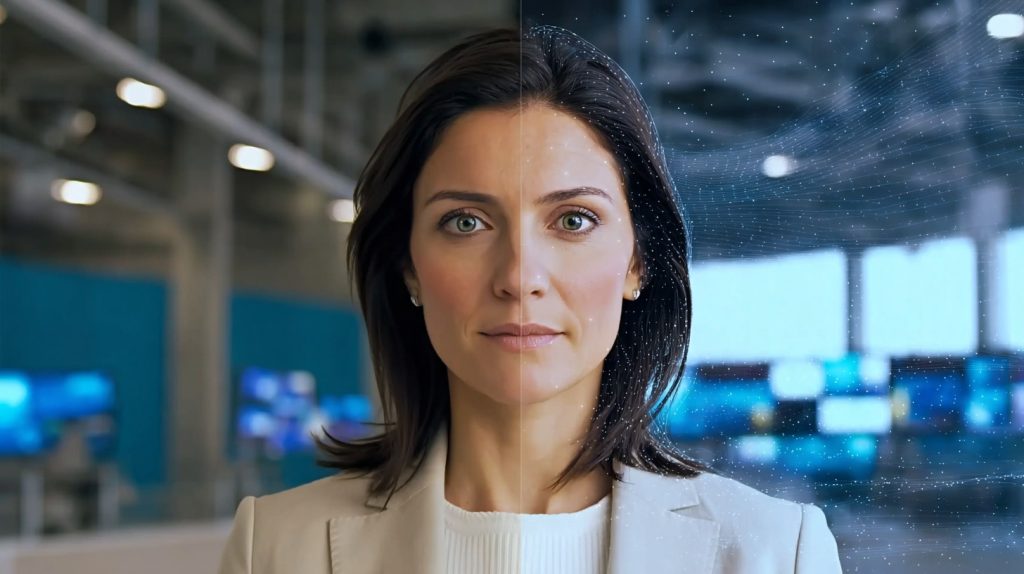
AI news presenter Aisha Gaban fooled thousands of viewers on Britain’s Channel 4 before revealing a truth that should unsettle anyone who consumes media: she doesn’t exist. The October 20 broadcast of “Will AI Take My Job?” marked the first time a British television program deployed an entirely AI-generated host, complete with synthetic voice, facial movements, and what appeared to be authentic emotional range. The hourlong documentary investigated whether artificial intelligence could outperform humans across medicine, law, fashion, and music. But the real test happened in living rooms across the UK, where viewers struggled to distinguish digital fabrication from human presence.
In the program’s closing moments, Gaban delivered her final report: “AI is going to touch everybody’s lives in the next few years. And for some, it will take their jobs. Call center workers? Customer service agents? Maybe even TV presenters like me. Because I’m not real. In a British TV first, I’m an AI presenter. I don’t exist. I wasn’t on location reporting this story. My image and voice were generated using AI.”
The reveal landed like a gut punch. Some viewers caught the telltale mouth blurring on larger screens. Others sensed something uncanny in her movements. But many saw nothing unusual until Gaban confessed her non-existence, raising an uncomfortable question: if we can’t spot the difference now, what happens when the technology improves next week?
How Channel 4 Created the UK’s First AI News Presenter
Kalel Productions partnered with Seraphinne Vallora, an AI marketing agency, to engineer Gaban through iterative prompt engineering. The production team scripted every word while algorithms generated her appearance, vocal patterns, and on-screen presence. Louisa Compton, Channel 4’s head of news and current affairs, admitted the speed of Gaban’s evolution was “quite scary,” with the digital presenter becoming increasingly convincing through each production iteration.
Yet limitations remain obvious to those building these systems. Producers couldn’t recreate Gaban sitting in chairs or conducting live interviews, restricting her contributions to pre-scripted pieces delivered to camera. The technology excels at controlled environments but crumbles under the unpredictable demands of actual journalism, where thinking, analyzing, and reacting with human empathy still matter.
The production approach mirrors broader industry experimentation. China’s Xinhua News Agency introduced AI anchors years ago, but Channel 4’s editorial guidelines require transparency and disclosure when using AI-generated content, distinguishing this stunt from state media deployments where synthetic presenters operate without clear labeling.
The Economics Driving AI News Presenter Adoption
Nick Parnes, CEO of Kalel Productions, acknowledged the uncomfortable truth: “It gets even more economical to go with an AI presenter over human, weekly. And as the generative AI tech keeps bettering itself, the presenter gets more and more convincing, daily. That’s good for our film, but maybe not so good for people’s careers.”
The business case writes itself. No salary negotiations. No sick days. No personality conflicts. AI presenters work 24/7 without demanding healthcare or retirement benefits. A Channel 4 survey of 1,000 UK business leaders found that 76% have already introduced AI to replace human labor, while 66% expressed excitement about deploying the technology at work. The economics pressure every media organization to consider similar moves, regardless of ethical reservations.
This trajectory intersects with recent controversies over AI performers. SAG-AFTRA condemned the deployment of AI-generated “actress” Tilly Norwood, stating: “It’s a character generated by a computer program that was trained on the work of countless professional performers without permission or compensation. It has no life experience to draw from, no emotion and, from what we’ve seen, audiences aren’t interested in watching computer-generated content untethered from the human experience.”
The union’s objection cuts deeper than job protection. It challenges whether audiences actually want synthetic performers, questioning assumptions driving billions in AI investment. Meanwhile, the technology races toward human-level intelligence, compressing timelines that once stretched across decades into months or weeks.
What Television Presenters Actually Think About AI News Presenter Competition
Jonathan Shalit, chairman of InterTalent Rights Group representing major UK broadcasting personalities, applauded Channel 4’s provocation: “Rather than look at AI as the enemy, look upon it as a new friend. It’s not going to actually replace a personality. Big stars develop a relationship with the viewers. But for a one-off stunt, it’s brilliant.”
That perspective divides industry professionals. Mary Greenham, agent to Andrew Marr and Fiona Bruce, argued AI frees resources for actual journalism: “What AI can do is help with certain elements of production. That, in turn, will free up resources so that they can be directed towards actual frontline journalism, to uphold standards and make the editorial judgements that underpin trust.”
But optimism competes with darker realities. Andrew Marr characterized AI as “a method of hoovering up past events and past knowledge and reconfiguring it and passing it off as new.” The critique exposes AI’s fundamental limitation: it synthesizes existing material without generating genuine insight or experiencing events firsthand. Journalism requires more than recombining data points. It demands judgment shaped by context, experience, and human stakes that algorithms cannot authentically replicate.
One anonymous British news anchor told reporters that live television journalism remains far beyond current AI capabilities, requiring the ability to “think, analyse and react” with “experience, knowledge and human empathy.” That gap matters less if broadcasters conclude audiences won’t notice or care about the difference.
The Deepfake Democracy Problem Nobody’s Solving
Louisa Compton framed the Gaban experiment around a core concern: “This stunt does serve as a useful reminder of just how disruptive AI has the potential to be and how easy it is to hoodwink audiences with content they have no way of verifying.” The admission carries weight. Channel 4 deployed the technology responsibly, revealing the deception and sparking necessary debate. But nothing prevents bad actors from using identical tools without disclosure.
The same technology that created Gaban can generate fake political speeches, fabricate evidence, or manufacture crises that trigger real-world consequences before verification catches up. We’ve entered an era where seeing no longer equals believing, yet our institutions and psychological frameworks still operate as if video evidence carries inherent authority.
Channel 4 continues exploring AI applications beyond on-screen presenters, testing how the technology can anonymize interviewees and create documentary reconstruction scenes. Each experiment pushes boundaries while raising questions about trust, authenticity, and the infrastructure society needs to navigate synthetic media saturation.
The Gaban stunt succeeded precisely because it demonstrated vulnerability. The documentary drew 564,000 viewers, making it Channel 4’s second most-watched show that day. Audiences engaged with the provocation, confronting uncomfortable truths about their ability to distinguish reality from fabrication. That discomfort matters more than technical achievement.
Why This AI News Presenter Matters More Than You Think
Channel 4 emphasized that using AI presenters won’t become standard practice: “Our focus in news and current affairs is on premium, fact checked, duly impartial and trusted journalism, something AI is not capable of doing.” The promise rings hollow against economic pressures and accelerating capabilities. If AI presenters become indistinguishable from humans while costing a fraction of traditional talent, how long before that principled stance crumbles under financial reality?
The generative AI healthcare market alone projects growth from $1.1 billion in 2024 to $14.2 billion by 2034, according to research cited by MIT Technology Review. Media represents just one battlefield in a broader war over which human capabilities remain genuinely irreplaceable versus which merely seem that way until technology catches up.
Gaban’s debut forces a reckoning. Not about whether AI can fool audiences (it obviously can), but about what we lose when synthetic presenters become normalized. Journalism derives authority from humans witnessing events, applying judgment, and staking reputations on accuracy. An AI news presenter has no reputation to stake, no career to lose, no conscience to trouble. It optimizes for engagement without bearing consequences.
The technology will improve. Mouth blurring will disappear. Movement will feel natural. Eventually, AI presenters will conduct interviews and react spontaneously in ways indistinguishable from human journalists. The question isn’t whether this happens, but whether society builds frameworks to preserve truth and accountability before the distinction vanishes entirely.
Compton acknowledged that further AI experiments are planned but declined to specify when Gaban might reappear. Channel 4 treats this as exploration rather than inevitability, but the economics and capabilities point in one direction. The line between real and fake didn’t just blur on October 20. It vanished. What we do next determines whether journalism survives the transformation or becomes another industry optimized into irrelevance.
