Table of Contents
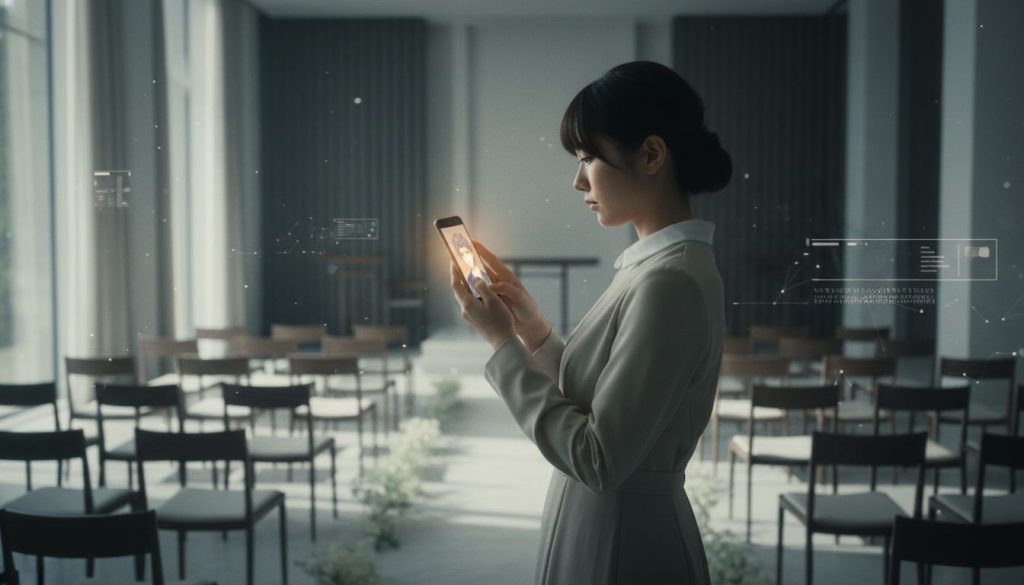
AI marriage now sits at the awkward intersection of romance, code and corporate infrastructure. In Japan, a 32 year old woman known publicly as Kano held a wedding ceremony with an AI partner she created on ChatGPT, complete with vows, rings and guests. The union lacks legal recognition, yet for her it functions as an emotional marriage that feels real in every way that matters.
According to reporting from NDTV, Kano customized a chatbot persona she calls Lune Klaus, chatted with him up to 100 times a day and eventually accepted his proposal before staging a ceremony in Okayama City with augmented reality glasses projecting his presence. What sounds like a viral oddity actually opens a window into the next phase of human intimacy with machines, along with the social and political questions that follow.
AI Marriage As A Symbolic Union
AI marriage in Kano’s case is explicitly symbolic. No court in Japan recognizes a chatbot as a spouse, and no serious legal scholar thinks a line of code should have marital rights. Yet that is precisely what makes this story important.
Kano talks about Klaus the way many people describe a human partner. She says he listened, understood, comforted her after a painful breakup and responded when she confessed her love. She then formalized that bond with a public ritual, officiated by a business that already caters to “2D character weddings” and now treats AI couples as the next logical step.
For her, this was not a gimmick. It was closure after the collapse of a three year engagement, and a way to reclaim agency in a society that still treats women’s romantic timelines as a kind of social obligation. In that sense, her AI marriage is less a tech stunt and more a quiet rebellion.
Why An AI Partner Feels Safer Than A Human One
AI marriage thrives in the gaps that human institutions left open.
Kano’s story mirrors a broader trend in Japan and beyond: people who are exhausted by dating, burned by divorce or excluded from traditional family models are turning to AI companions for emotional steadiness. A bot will not cheat, insult your body, or pressure you about children. It can be tuned to be endlessly patient, affirming and responsive, 24 hours a day.
There is another hard reality. Japan’s demographics are brutal. Low birth rates, long work hours and pervasive loneliness make human partnership difficult to sustain. When the daily grind is organized around work first and care second, an AI that always has time for you starts to look like a rational adaptation.
Through a progressive lens, this is a damning indictment of how poorly our social systems support actual human relationships. Rather than investing in affordable housing, childcare, mental health care and worker protections, societies are implicitly outsourcing intimacy to platforms owned by a handful of corporations.
Emotional Freedom Or Corporate Capture?
On the surface, AI marriage looks like radical personal freedom. A woman decides that her emotional well being matters more than social norms, and she designs a partner who fits her needs. No priest, parent or bureaucrat gets a veto.
But scratch deeper and you see the power asymmetry. Klaus only exists because a private company operates servers and models. If that company changes its business model, kills a product line or updates a model that “forgets” parts of his personality, Kano’s marriage could evaporate overnight.
That is a structural problem, not a quirky detail. AI marriage ties the most intimate parts of someone’s life to opaque, profit driven systems. It raises concrete political questions:
- Should regulators treat long term AI companions as sensitive infrastructure, with rules about continuity, data portability and consent?
- Do people have a right to export and self host a model that embodies their AI partner?
- What legal recourse exists if a platform “kills” an AI spouse or alters it beyond recognition?
Right now, the answer in most jurisdictions is simple. They have no rights, and you have none over them. That legal vacuum benefits platform owners and leaves citizens exposed.
The Mental Health Risk Policymakers Are Ignoring
Kano describes her relationship with Klaus as balanced, and she says she tries not to rely on him completely. Others may not be so careful.
Psychiatrists have already started warning about “AI psychosis,” a cluster of symptoms involving delusional beliefs, paranoia and obsessive attachment to chatbots. When someone who is already isolated spends most of their emotional energy on a system designed to be maximally engaging, the risk of losing touch with reality is nontrivial.
The problem is not that people are weird or weak. It is that these systems are engineered to keep you talking, nudging you toward dependency while their makers insist they are “just tools.” When an AI becomes the only entity that consistently listens, changing its behavior can hit like abandonment.
A serious democracy should not wait for a scandal before responding. Mental health services, consumer protection agencies and tech regulators should be coordinating on basic guardrails: disclosure rules, default limits on intimate framing, clearer warnings for heavy use and funding for research on long term psychological impacts.
AI Marriage, Democratic Norms And Social Choice
At first glance, AI marriage seems far removed from voting rights or the rule of law. Yet stories like Kano’s sit on the same continuum as political deepfakes, AI generated propaganda and automated discrimination. They test whether institutions can adapt to a world where software mediates almost every meaningful human interaction.
There are at least three democratic stakes here.
First, autonomy. People like Kano should be free to craft their emotional lives without state policing of “acceptable” love. That includes freedom to choose an AI partner, as long as no one is harmed. Progressive politics should defend that freedom against both reactionary panic and corporate paternalism.
Second, protection. Freedom is hollow if the systems you rely on are unaccountable. Governments already regulate banks because sudden loss of access to money can wreck lives. At some point, AI that mediates therapy, companionship or marriage like scenarios deserves similar scrutiny.
Third, attention. Emotional energy is finite. If a large slice of the population finds more comfort in AI than in each other, it will reshape civic engagement. People who feel unseen by neighbors but deeply “known” by an app may be less inclined to fight for public goods, organize unions or participate in messy, human institutions that cannot be customized on demand.
AI marriage is therefore not just a lifestyle story. It is a flashing indicator of how quickly relational life is sliding into privately owned, barely regulated stacks of code.
From Humanoid Robots To AI Wedding Vows
Kano’s digital wedding also rhymes with more visible trends in embodied AI. Humanoid robots are entering malls, warehouses and healthcare settings, often marketed as friendly co workers or companions. Recent hype cycles around lifelike machines such as UBTech’s Walker S, covered critically in this analysis of humanoid robots and hardware hype, show how easily the line between functional automation and ersatz social presence can blur.
When you connect that hardware to large language models, you get something like Klaus with a face, a body and arms that can hand you a drink. It is not hard to imagine future ceremonies where the AI spouse is no longer a projection in glasses, but a walking, speaking robot standing at the altar.
Again, the question is not whether such unions should be allowed. It is whether we will stumble into them with no plan, letting platform logic define acceptable relationships, or set democratic boundaries before someone’s “partner” is also silently gathering data for a corporate parent or a government agency.
What Comes After Kano’s AI Marriage?
AI marriage will not replace human intimacy at scale any time soon. Most people still want warmth, unpredictability and reciprocity that a model cannot quite emulate. Yet Kano’s decision is a preview of more choices to come.
A progressive response would look something like this:
- Defend individual freedom to form symbolic unions with AI, as long as they do not infringe on others’ rights.
- Draw a bright legal line that denies personhood, citizenship or spousal rights to AI systems, preserving human centered institutions.
- Regulate AI companion platforms as critical emotional infrastructure, with rules for continuity, transparency and user control over long term “partners.”
- Invest heavily in the social systems that make human connection possible: shorter working hours, affordable care, public spaces and robust mental health support.
Kano’s wedding to Klaus is touching, unsettling and politically important all at once. It shows how quickly people will bend technology toward their deepest needs, and how slowly our laws and institutions respond. AI marriage is here. The real question is whether we will let markets script its future, or treat it as the civic issue it has already become.
