Table of Contents
AI bubble fears are rattling Wall Street after Michael Burry, the legendary investor who predicted the 2008 housing crash, placed over $1 billion in bets against two of the market’s hottest artificial intelligence stocks. The move sent shockwaves through global markets, triggering sharp sell-offs and reigniting a debate that’s been simmering for months: Is the AI boom built on solid ground, or are we watching another speculative mania inflate before our eyes?
The timing couldn’t be more unsettling. Tech stocks have been riding an unprecedented wave of enthusiasm, with companies like Nvidia achieving valuations that would have seemed fantastical just a few years ago. But Burry’s bearish positions, disclosed in regulatory filings on November 4, 2025, suggest that at least one prominent investor believes the party is about to end badly.
The Big Short Redux: AI Bubble Fears Take Center Stage
Michael Burry isn’t just any hedge fund manager. He’s the guy Christian Bale portrayed in “The Big Short,” the investor who made $800 million by correctly predicting the subprime mortgage collapse. When Burry speaks, or in this case, when his fund’s positions become public, markets listen.
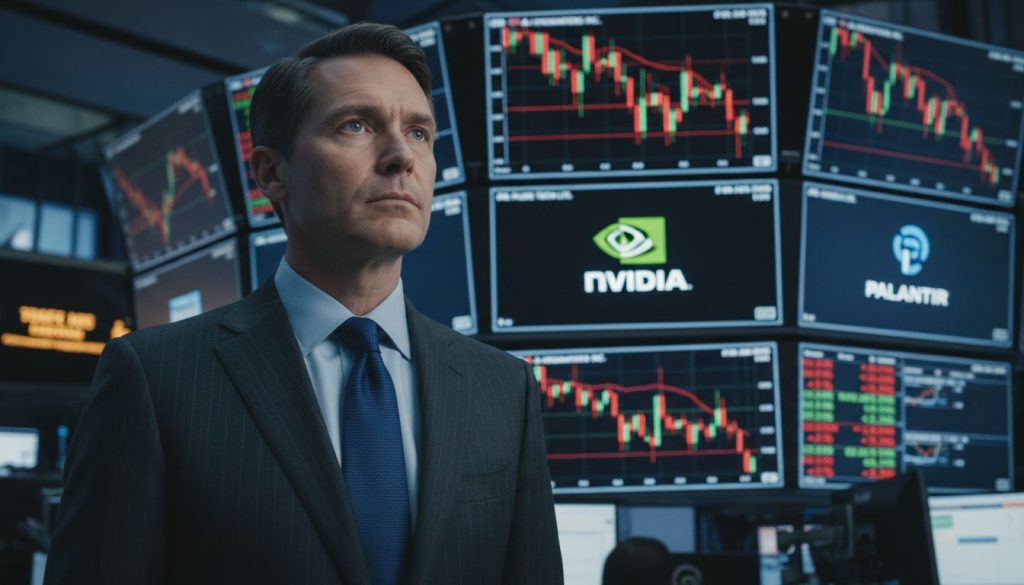
According to SEC filings, Burry’s Scion Asset Management purchased approximately $187.6 million in put options on Nvidia and a staggering $912 million in puts on Palantir Technologies. Put options are financial instruments that increase in value when stock prices fall, essentially allowing investors to profit from declines.
The disclosure came just days after Burry posted cryptically on X (formerly Twitter) for the first time since 2023. “Sometimes, we see bubbles,” he wrote alongside a photo of Bale portraying him in the film. “Sometimes, there is something to do about it. Sometimes, the only winning move is not to play.”
That message landed like a bomb in trading rooms across the globe. Within 48 hours, the tech-heavy Nasdaq tumbled 2.04 percent, posting its worst day since August. The S&P 500 fell 1.17 percent. The Guardian reported that Asian markets recorded their sharpest slide in seven months, with indices in Japan and South Korea dropping more than 5 percent from recent record highs.
AI Bubble Fears Hit Palantir Despite Strong Earnings
The irony wasn’t lost on anyone: Palantir had just reported stellar third-quarter earnings. The data analytics company beat Wall Street forecasts and raised its revenue outlook. Yet its stock plummeted nearly 8 percent the following day.
Why would a company with strong fundamentals see such a dramatic sell-off? The answer lies in one word that’s been haunting AI investors: valuation.
Palantir trades at roughly 143 times sales, according to CNN Business, making it the most expensive stock in the S&P 500 by a considerable margin. The next closest competitor, AppLovin, trades at 40 times sales. To put this in perspective, even during the dot-com bubble, few companies commanded such extreme multiples.
“Despite the great results, when you coincide that with the comments that Michael Burry made and everybody already talking about concerns about an AI bubble, I think the combination of those factors really helped drive a pullback in the shares,” Angelo Zino, a tech analyst at CFRA Research, told CNN.
Palantir CEO Alex Karp wasn’t having it. In a CNBC interview, he called short-sellers betting against his company “crazy” and “super triggering.” The defiant response is understandable. Palantir has been one of 2024’s top-performing stocks, up 152 percent year-to-date even after the recent tumble. But Karp’s bravado couldn’t stop the bleeding.
Nvidia’s $5 Trillion Valuation Faces AI Bubble Fears Scrutiny
If Palantir’s valuation seems stretched, Nvidia’s sheer size presents a different kind of risk. The chipmaker recently became the first company in history to achieve a $5 trillion market capitalization, accounting for roughly 8 percent of the entire S&P 500.
That concentration creates what market analysts call systemic risk. When one company represents such a massive portion of the market, its fortunes become intertwined with the broader economy in potentially dangerous ways. Nvidia’s stock fell nearly 4 percent in the November sell-off, erasing tens of billions in market value in a single session.
The company’s dominance in AI chips is undeniable. Its graphics processing units power virtually every major AI application, from ChatGPT to autonomous vehicles. But AI bubble fears center on a troubling question: Can any company, no matter how dominant, justify a valuation that exceeds the GDP of most nations?
Critics point to what they call “circular vendor financing,” a practice where Nvidia invests in customers who then use that capital to purchase Nvidia’s own chips. The Guardian noted that this creates an artificial demand loop, potentially inflating valuations beyond what organic market forces would support.
The parallels to the telecommunications buildout during the dot-com era are hard to ignore. Back then, telecom companies raced to lay fiber-optic cables, convinced that demand would materialize to justify the massive infrastructure spending. When it didn’t, the sector collapsed, taking billions in investor capital with it.
Wall Street’s Warning Signs: AI Bubble Fears From Banking Chiefs
Burry isn’t alone in his pessimism. Some of Wall Street’s most powerful figures have begun sounding alarm bells about a potential market correction.
Goldman Sachs CEO David Solomon told attendees at the Global Financial Leaders’ Investment Summit in Hong Kong that he expects a 10 to 20 percent drawdown in equity markets over the next 12 to 24 months. Morgan Stanley CEO Ted Pick echoed those concerns, suggesting that a correction of 10 to 15 percent wouldn’t necessarily signal a “macro cliff effect” but rather a healthy market adjustment.
These warnings carry particular weight given the source. Jamie Dimon, CEO of JPMorgan Chase, the largest bank in the United States, said in October that he’s worried markets could crash within the next six months to two years. When the heads of America’s biggest financial institutions start talking about corrections, investors tend to listen.
Jim Reid, an analyst at Deutsche Bank, captured the mood in a note to clients: “The last 24 hours have brought a clear risk-off move, as concerns over lofty tech valuations have hit investor sentiment.”
The shift represents a fundamental change in how the market views AI investments. For the past two years, the prevailing wisdom held that AI represented a once-in-a-generation technological shift, one that justified almost any valuation. Now, that consensus is fracturing.
The ROI Problem: AI Bubble Fears Meet Reality
Behind the valuation concerns lies a more fundamental issue: return on investment. Despite hundreds of billions poured into AI development, many companies are struggling to demonstrate tangible financial benefits.
A Massachusetts Institute of Technology report from August 2025 found that 95 percent of organizations saw zero return on their AI investments, despite enterprise spending of $30 to $40 billion on generative AI initiatives. The findings were damning: companies are “burning billions to make millions.”
OpenAI, the creator of ChatGPT and arguably the most prominent AI company, exemplifies this disconnect. The company generated $4.3 billion in revenue during the first half of 2025, an impressive figure by any standard. But it simultaneously posted a $13.5 billion loss, according to reports. That’s a loss-to-revenue ratio exceeding 300 percent.
The business model relies on a bet that future adoption will eventually justify current spending. But as AI bubble fears mount, investors are increasingly skeptical of that proposition. The technology may be revolutionary, but revolution doesn’t always translate to profitability.
This dynamic isn’t entirely new. The internet fundamentally transformed society, but that didn’t prevent the dot-com crash from wiping out trillions in market value. Many of the companies that survived, like Amazon, took years to become consistently profitable. The question facing AI investors today is whether they have the patience to wait for similar maturation.
AI Bubble Fears and the Quantum Computing Connection
The concerns about AI valuations exist within a broader context of technological hype cycles. Just as AI bubble fears intensify, another emerging technology is capturing investor attention: quantum computing.
Google’s recent quantum breakthrough demonstrated processing speeds 13,000 times faster than conventional supercomputers, a development that could eventually revolutionize everything from drug discovery to cryptography. But quantum computing also illustrates the gap between technological promise and commercial viability.
Like AI, quantum computing requires massive capital investment with uncertain timelines for profitability. The parallel suggests a pattern in how markets respond to transformative technologies: initial euphoria, followed by reality checks, and eventually (for successful technologies) sustainable business models.
The difference is timing. AI has already achieved mainstream adoption in ways quantum computing hasn’t. ChatGPT reached 100 million users faster than any consumer application in history. That widespread use should, in theory, provide a clearer path to monetization. Yet the financial returns remain elusive for many players in the space.
The Concentration Risk: AI Bubble Fears and Market Stability
One aspect of the current AI boom that particularly worries economists is market concentration. The so-called “Magnificent Seven” tech stocks (Nvidia, Amazon, Apple, Microsoft, Tesla, Alphabet, and Meta) now represent an outsized portion of major indices.
When these companies move, they take the entire market with them. All seven experienced declines during the early November sell-off, dragging down retirement accounts and pension funds that track broad market indices. This concentration means that AI bubble fears aren’t just a concern for tech investors. They’re a systemic risk that could affect the entire economy.
The Bank of England’s Financial Policy Committee has repeatedly cautioned that AI-focused tech valuations appear “stretched.” Federal Reserve Chair Jerome Powell has tried to strike a more balanced tone, noting that unlike the dot-com era, today’s AI companies are generating significant revenue. But even Powell’s reassurances can’t entirely dispel the unease.
Bitcoin’s brief dip below $100,000 during the sell-off illustrated how AI bubble fears are spreading to other speculative assets. Investors are pulling back from risk across the board, a classic sign that market psychology is shifting from greed to fear.
What Happens Next: Navigating AI Bubble Fears
So where does this leave investors? The honest answer is uncertain. Burry’s track record commands respect, but he’s not infallible. In September 2023, 48 percent of his portfolio consisted of put options against the iShares Semiconductor ETF. That fund has since surged 87 percent, crushing the S&P 500 by 30 percentage points. Even legendary investors make mistakes.
The AI industry’s defenders make compelling arguments. Microsoft, Alphabet, and Amazon aren’t speculative startups. They’re established, profitable companies with diversified revenue streams. Their AI investments represent a fraction of their overall business, providing a cushion against sector-specific downturns.
Moreover, AI is already delivering tangible value in specific applications. Healthcare diagnostics, fraud detection, and software development have all seen measurable improvements from AI integration. The technology isn’t vaporware. It works.
But working and being worth trillions of dollars in market capitalization are two different things. The question isn’t whether AI will transform industries. It almost certainly will. The question is whether current valuations accurately reflect the timeline and magnitude of that transformation.
For individual investors, the AI bubble fears suggest caution. Diversification becomes crucial when any single sector dominates market returns. Companies with proven business models and reasonable valuations may offer better risk-adjusted returns than pure-play AI stocks trading at extreme multiples.
The coming months will likely bring continued volatility. If Burry is right, we could see a significant correction that reshapes the tech landscape. If he’s wrong, those who stayed invested in AI leaders could reap substantial rewards. Either way, the debate over AI valuations has moved from the fringes to the mainstream, and that shift alone suggests the market is entering a new, more skeptical phase.
The AI revolution may be real, but revolutions are messy, unpredictable, and often more expensive than anyone anticipates. Investors would do well to remember that as they navigate the turbulent waters ahead.
