Table of Contents
Nvidia Israel is becoming one of the most important experiments in AI industrial policy anywhere in the world. The company is scouting sites for a huge new campus in northern Israel, planning thousands of hires and expanded AI R&D as demand for its GPUs keeps outstripping supply and rivals scramble for whatever capacity is left.
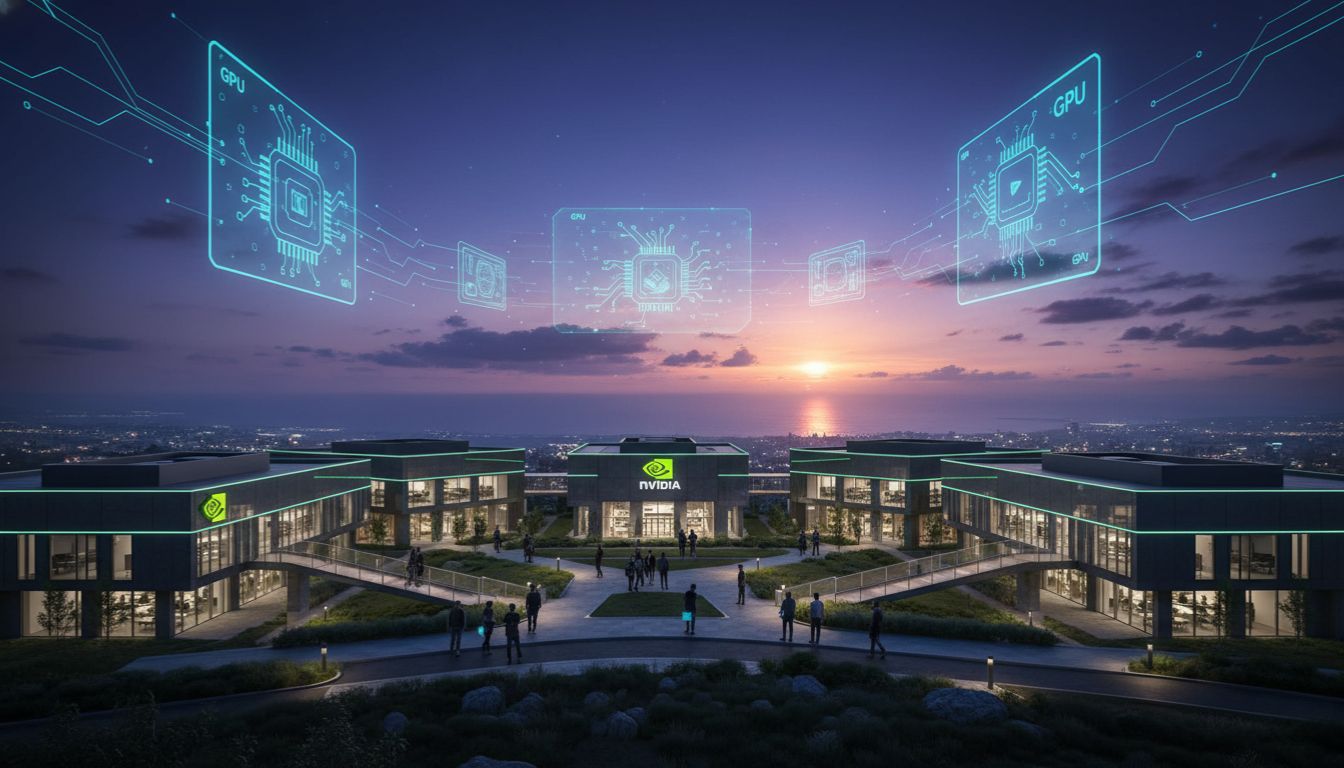
According to reporting from Reuters, Nvidia has issued a request for information to buy land for a northern Israel campus of up to 180,000 square meters that could cost billions of dollars and create thousands of jobs, with municipalities around Haifa and the Jezreel Valley flooding the company with proposals.
This is not just another office park. It is a bet that Israel’s chip and AI expertise can anchor Nvidia’s long war for compute dominance in an era of U.S. China tension and fragile supply chains.
Nvidia Israel Expansion And The New AI Hardware Map
The Nvidia Israel expansion sits on top of a footprint that already includes more than 5,000 employees and multiple R&D centers inherited and grown out of the Mellanox acquisition. Many of Nvidia’s most important networking technologies for AI data centers originate in Israel, including high speed interconnects that make its GPU clusters usable at hyperscale.
The new northern campus would serve several overlapping goals:
- Concentrate chip design, networking and inference engineering talent near Haifa, Technion and the Carmel tech corridor.
- Expand data center and AI infrastructure labs for training and serving large models.
- Provide long term certainty for Israeli engineers who might otherwise be lured by U.S. big tech or European industrial policy packages.
Compared with traditional fabs, this is a brain hub more than a smokestack facility. The capital spend goes into labs and data centers, but the real asset is human capital: the chip architects, networking wizards and AI systems engineers whose work translates directly into Nvidia’s ability to keep selling more H100s, B100s and whatever comes next.
This is why the company is willing to entertain “dozens and dozens” of site bids from municipalities, as Reuters notes. Local governments understand that a single Nvidia campus can reshape a regional economy and crowd in university programs, suppliers and startups.
Nvidia Israel AI Strategy In A U.S. China Cold Tech War
To understand Nvidia Israel AI moves, you have to look at Washington and Beijing, not just Haifa.
The U.S. has tightened export controls on high end GPUs to China, effectively making Nvidia the central chokepoint in a geopolitical contest over advanced compute. That has two consequences:
- Nvidia must keep scaling capacity for everyone else to compensate for restricted China sales.
- The company needs politically reliable jurisdictions for its most sensitive work, from networking firmware to next generation AI accelerators.
Israel fits that bill, at least for now. It is tightly aligned with U.S. defense and intelligence ecosystems, has deep semiconductor roots and has shown it can absorb massive foreign tech footprints. For Nvidia, expanding AI R&D in northern Israel is a hedge against both Chinese industrial espionage and the fragility of single country dependence in places like Taiwan or South Korea.
But there is a cost. When a single U.S. company hoovers up a region’s best engineers, it shifts power away from smaller local firms and even from democratic institutions that are supposed to steer national innovation priorities. As Nvidia’s leverage grows, so does its quiet political influence on everything from tax incentives to education policy.
Nvidia Israel Campus And The Global Talent Squeeze
The Nvidia Israel campus is landing in the middle of a vicious global chip talent war.
Intel is trimming staff and has paused or delayed some major factory investments, including in Israel, even as Nvidia’s valuation surges into multi trillion dollar territory. That divergence sends a clear signal to students, mid career engineers and policymakers about who looks like the “future” of chips.
The new northern campus and its thousands of expected roles will almost certainly:
- Bid up salaries for senior chip designers and verification engineers.
- Pull top graduates from Technion, Tel Hai and Ben Gurion University into Nvidia’s orbit before local startups can compete.
- Increase pressure on Israel’s already stretched housing, transport and infrastructure in the north.
There is upside. Regions outside Tel Aviv and Jerusalem have long complained that the innovation economy passes them by. A giant Nvidia AI campus near Haifa or Kiryat Tivon could finally push serious public investment into public transit, power and zoning in those areas.
Yet the danger is that this becomes another “company town” dynamic where local planners optimize for what Nvidia wants rather than for broad based, democratic development. The progressive question is whether the tax breaks, land deals and regulatory waivers that will almost certainly be offered are tied to enforceable public obligations: training programs, open research partnerships, and labor protections that outlast a single corporate business cycle.
How Nvidia Israel Shapes Democratic Norms And Digital Power
When we talk about Nvidia Israel AI infrastructure, we are really talking about who owns the engine of future democratic and authoritarian systems.
The same clusters that help Israeli hospitals train medical models will also power military targeting, surveillance analytics and predictive policing. The more that decision making infrastructure is concentrated in one private U.S. corporation, the fuzzier the line becomes between democratic oversight and outsourced sovereignty.
Several systemic risks come into focus:
- Regulatory capture
If Nvidia is the indispensable partner for national AI ambitions, regulators are far less likely to confront it on competition, labor or privacy issues. That erodes rule of law in practice, even if the statutes sit untouched on the books. - Data and model dependency
As public institutions and local firms adopt Nvidia’s full stack from GPUs to networking to software, they become dependent not just on the hardware but on Nvidia’s roadmap and licensing terms. Migrating off that stack gets harder over time. - Cross border political leverage
In a crisis, Washington will have far more influence than Brussels, Beijing or even Jerusalem over what Nvidia ships where and under what conditions. That dynamic might favor liberal democracies in the short term, but it also exposes smaller states to the whims of U.S. domestic politics.
Israel is not just gaining jobs. It is tying its AI future to the fortunes and governance of one U.S. mega cap. That may be rational under today’s incentives, yet it deserves far more public scrutiny than it currently gets.
What This Means For Startups, Workers And Investors
For Israeli founders, Nvidia’s northern expansion is both a blessing and a warning.
On the plus side, the company has already acted as an “anchor and accelerator” for local AI and chip startups, as other outlets have reported, through acquisitions, partnerships and validation. Startups that plug into Nvidia’s ecosystem can scale faster and access global customers who trust the brand.
At the same time, hiring against a $4 trillion company that can outbid you on equity and perks is brutal. The most sophisticated chip architects may decide their best shot at meaningful work is inside Nvidia, not in a risky pre seed startup.
Globally, investors already watching Nvidia’s every move will read the Nvidia Israel expansion as confirmation that:
- Networking and inference are as strategically important as raw training compute.
- Talent nodes like northern Israel, not just factory locations, are the new battlegrounds of chip industrial policy.
- The AI hardware stack is consolidating around a few “national champions” that act like shadow infrastructure ministries.
For U.S. and European regulators worried about AI concentration, this is a flashing red light. For portfolio managers, it is another reason they keep treating Nvidia less like a cyclical chipmaker and more like a structural utility for AI.
For context on how tightly Nvidia’s stock price is now linked to AI expectations, you can see how market sentiment around rival platforms like Meta and Google has whiplashed in response to AI news cycles in this recent analysis of Nvidia and big tech AI volatility.
How Israel And Its Allies Can Respond
If Israel wants the Nvidia Israel AI bet to pay off without surrendering the steering wheel, several guardrails are essential:
- Tie incentives to openness. Tax breaks and land deals should require Nvidia to support open academic research, joint public data centers and shared training programs, not just private IP.
- Protect labor and mobility. Strong worker protections and noncompete limits are key so engineers can move between Nvidia, startups and public institutions without being locked in.
- Invest beyond one company. Public funding should flow into independent compute resources, alternative chip research and public interest AI labs that are not fully dependent on Nvidia hardware.
- Coordinate with allies. The U.S. and EU should treat Nvidia style hubs in Israel, Europe and Asia as shared democratic infrastructure, aligning export controls and antitrust to prevent any single corporate actor from becoming untouchable.
The question is not whether Nvidia will expand in northern Israel. All signs suggest it will. The question is whether democratic institutions can keep up with the speed and scale of AI industrialization that this campus represents.
If they cannot, Nvidia Israel may be remembered less as a tech success story and more as an early chapter in how democratic control over core digital infrastructure quietly slipped away.