Table of Contents
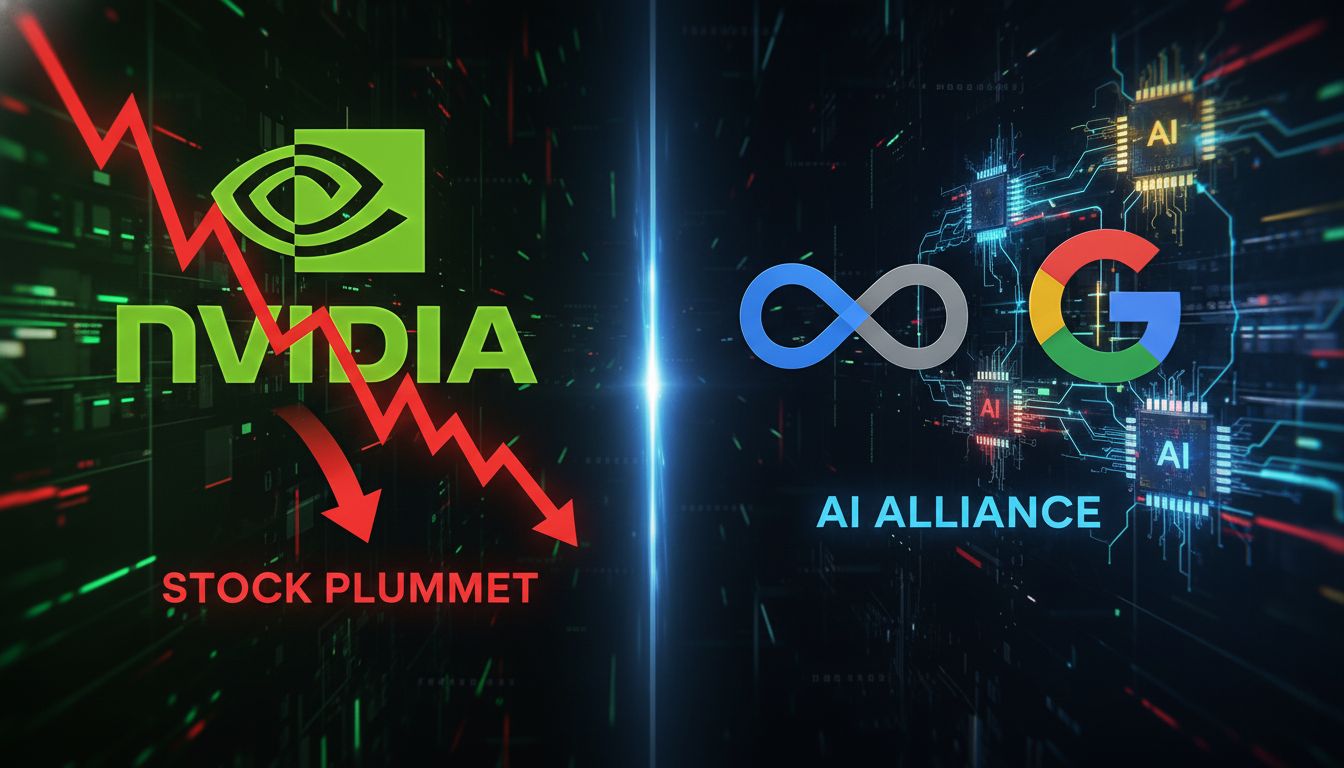
Nvidia shares fall 4% on Monday after reports emerged that Meta Platforms will begin deploying Google’s custom-designed AI chips in its data centers, marking a significant strategic shift that threatens the chipmaker’s dominance in artificial intelligence infrastructure. The stock decline erased roughly $140 billion in market value, underscoring Wall Street’s sensitivity to any hint that Nvidia’s near-monopoly on AI computing might be fracturing.
The news, first reported by The Information, signals that Meta is actively diversifying its hardware suppliers beyond Nvidia’s ubiquitous H100 and newer H200 graphics processing units. According to the report, Meta plans to use Google’s Tensor Processing Units (TPUs) for training and inference workloads across its AI-powered products, including recommendation algorithms, content moderation systems, and the company’s ambitious large language model projects.
For Nvidia, which has captured an estimated 80% to 95% of the AI accelerator market, the development represents more than a minor customer defection. It reflects a broader industry trend: hyperscale tech companies are increasingly designing their own silicon or turning to alternative suppliers to reduce costs, improve efficiency, and decrease dependency on a single vendor.
Why Nvidia Shares Fall on Meta’s Decision to Use Google AI Chips
Meta’s move carries weight precisely because of the company’s enormous infrastructure footprint. The social media giant operates some of the world’s largest data center networks, processing trillions of posts, images, and videos daily. Any shift in its hardware procurement strategy reverberates through the entire semiconductor supply chain.
Google’s TPUs, which the company has developed internally since 2015, were originally designed for Google’s own workloads, particularly search, YouTube recommendations, and now its Gemini AI models. Google Cloud has offered TPU access to enterprise customers for years, but landing Meta as a major customer represents a significant validation of Google’s chip design capabilities and a direct challenge to Nvidia’s market position.
The timing is notable. Nvidia CEO Jensen Huang has spent the past two years riding an AI boom that transformed his company into one of the world’s most valuable corporations, briefly surpassing Apple and Microsoft in market capitalization. Demand for Nvidia’s data center GPUs has been so intense that tech giants reportedly compete for allocation, sometimes waiting months for chip deliveries. But that scarcity has also motivated companies to explore alternatives.
Microsoft, OpenAI, Amazon, and now Meta have all invested heavily in custom chip development or partnerships with alternative suppliers. Microsoft recently deepened its collaboration with Nvidia while simultaneously developing its own Maia AI accelerator. Amazon Web Services offers its Trainium and Inferentia chips alongside Nvidia hardware. The pattern is clear: big tech wants optionality.
Nvidia Shares Fall and the Broader AI Chip Competition
The 4% drop in Nvidia shares reflects investor concerns that the company’s pricing power and market share may have peaked. Nvidia’s data center revenue grew 427% year-over-year in its most recent quarter, reaching $47.5 billion, but maintaining that trajectory requires continued dominance. Any meaningful erosion of market share, particularly among the handful of customers who account for the bulk of AI chip purchases, poses a structural risk.
Wall Street analysts have been watching for signs of “Nvidia fatigue” among hyperscalers. The company’s H100 chips reportedly cost between $25,000 and $40,000 per unit, with next-generation Blackwell GPUs expected to command even higher prices. For companies deploying hundreds of thousands of accelerators, even marginal cost savings from alternative chips translate into billions of dollars over multi-year deployment cycles.
Google’s TPUs offer certain advantages for specific workloads. They’re optimized for matrix multiplication operations central to neural network training and inference, and Google claims superior power efficiency compared to general-purpose GPUs. More importantly, Google controls both the hardware design and the software stack, allowing tighter integration than third-party chips typically provide.
However, Nvidia retains significant competitive advantages. Its CUDA software ecosystem, developed over 17 years, has become the de facto standard for AI development. Thousands of AI researchers and engineers train on Nvidia hardware, creating powerful network effects. Switching costs remain high. Even companies developing custom chips often use Nvidia GPUs for prototyping and certain workloads.
The relationship between major cloud providers and Nvidia increasingly resembles coopetition, the awkward dance where companies are simultaneously customers, competitors, and partners. Microsoft’s recent partnership with Nvidia and Anthropic illustrates this dynamic, as Microsoft invests in alternatives while maintaining deep Nvidia ties.
What This Means for AI Infrastructure Going Forward
Meta’s decision to integrate Google AI chips into its infrastructure highlights a maturing AI hardware market where differentiation increasingly matters. The earliest phase of the generative AI boom was characterized by a desperate scramble for any available compute. Now, as deployment patterns stabilize and companies gain experience running AI workloads at scale, they’re making more strategic, cost-optimized decisions.
This evolution mirrors earlier technology transitions. In the 2000s, companies built data centers around expensive proprietary servers before shifting to commodity hardware and eventually cloud services. The AI chip market appears headed toward similar diversification, where different workloads run on different accelerators optimized for specific tasks.
For Nvidia, the challenge is managing a transition from unconstrained growth fueled by AI hype to sustainable, competitive growth in a more mature market. The company still possesses formidable technological advantages and an unmatched ecosystem, but it can no longer assume customers have no viable alternatives.
The broader implications extend beyond any single company. As AI becomes infrastructure rather than experiment, the economics shift. Efficiency, total cost of ownership, and vendor diversity matter more than raw performance alone. Governments and regulators increasingly scrutinize concentration in critical technology supply chains. The European Union and U.S. lawmakers have both expressed concerns about overreliance on single semiconductor suppliers for strategic technologies.
According to research from TechCrunch, the custom AI chip market is projected to grow from roughly $10 billion in 2024 to over $45 billion by 2028, driven primarily by hyperscaler investments. That growth represents opportunity, but it also represents competition for Nvidia’s core business.
Meta hasn’t announced plans to completely abandon Nvidia chips. The company will likely maintain a hybrid approach, using different accelerators for different purposes. But even a 20% or 30% shift away from Nvidia hardware across Meta’s infrastructure would represent billions in lost revenue for the chipmaker.
The 4% share decline, while significant, shouldn’t be read as a fundamental collapse in Nvidia’s business. The company remains extraordinarily profitable and technologically advanced. But Monday’s stock movement reflects a recalibration of expectations. The era of unlimited pricing power and captive customers is evolving into something more competitive, more complex, and ultimately more sustainable for the broader AI ecosystem.
For an industry built on the premise of disruption, watching the disruptors face their own competitive pressures feels almost poetic. Nvidia revolutionized AI by making powerful computing accessible. Now it must prove it can thrive when accessibility includes genuine choice and when headlines like “Nvidia shares fall” signal real competition rather than temporary volatility.