Table of Contents
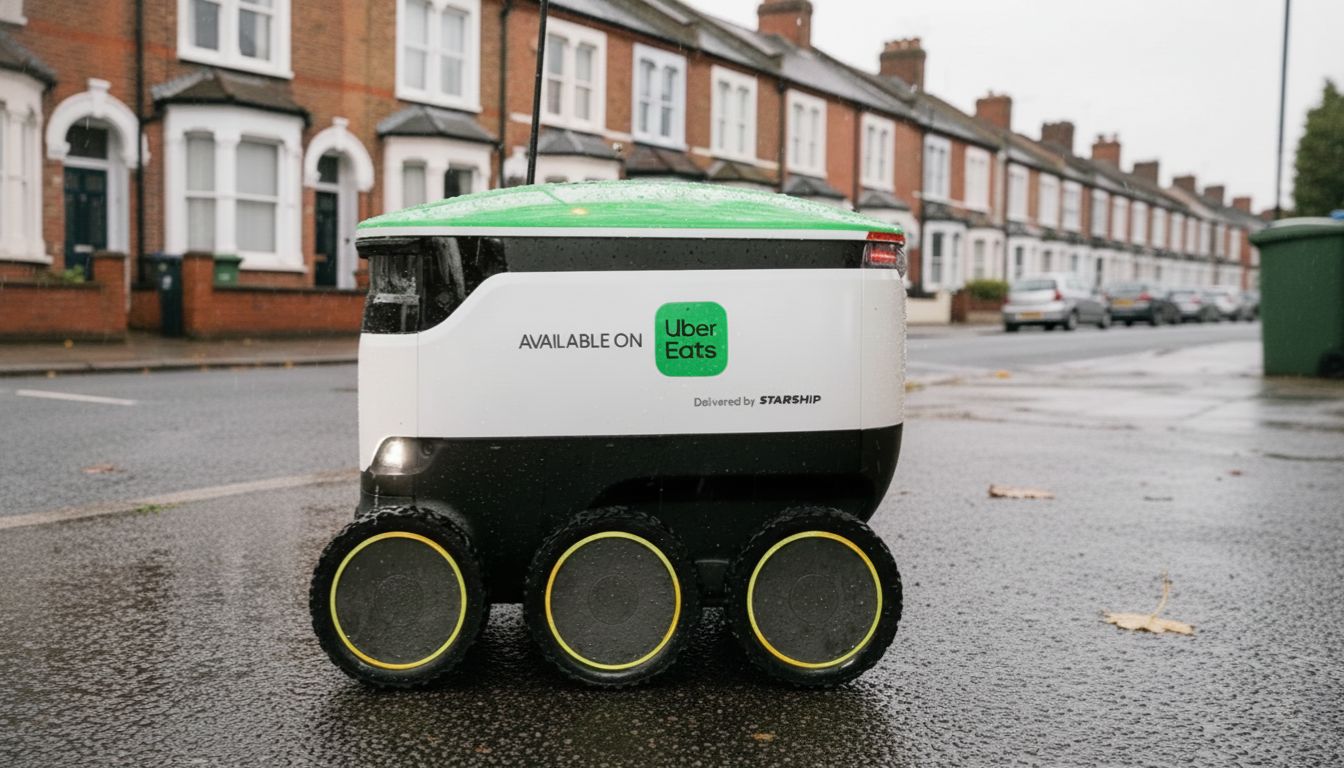
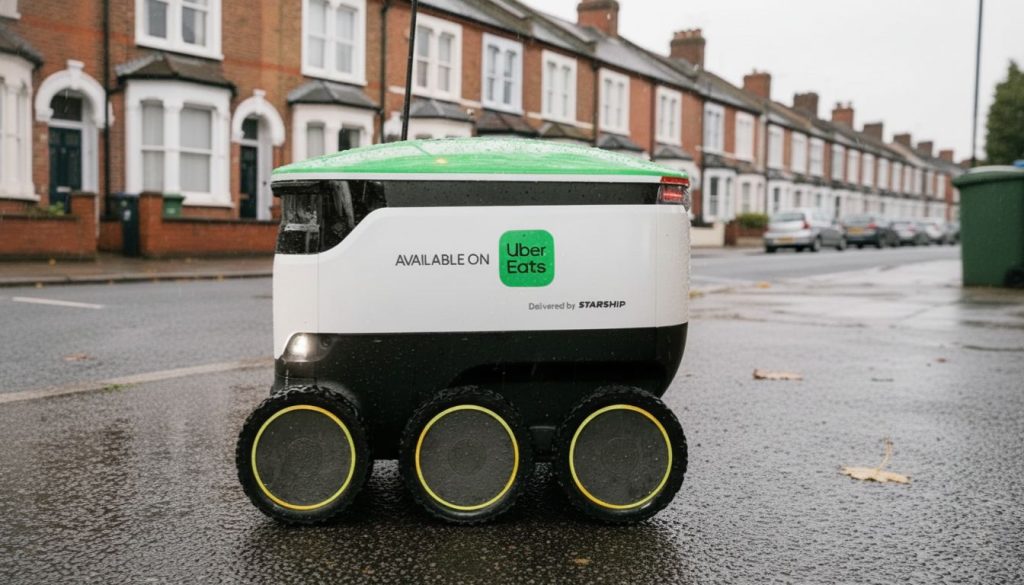
Uber Eats Starship robots UK is the phrase that quietly signals a turning point in how food moves through British cities. With its new partnership with Starship Technologies, Uber Eats is starting to replace at least some riders on bikes and scooters with small, six‑wheeled autonomous robots that trundle along pavements at walking speed. The image is disarming, almost comic: lunch inside a robot cooler on wheels. The implications are not.
This is where the politics of sidewalks meets the economics of last mile logistics. What looks like a cute logistics experiment is, in fact, a live test of how a democracy wants artificial intelligence, precarious labor, and public space to intersect. It forces a blunt question that rarely appears in glossy launch videos: when platforms automate the most visible parts of service work, who actually benefits, and who simply disappears from the frame?
How The Uber Eats Starship Robots UK Partnership Works
At its core, the Uber Eats Starship robots UK deal is simple. Instead of a courier on a bike or scooter, some orders will be assigned to Starship’s autonomous sidewalk delivery robots. These machines:
- Move at walking speed.
- Use cameras, sensors, and GPS for navigation.
- Travel on pavements rather than streets.
- Are monitored remotely by human operators who can intervene if needed.
Customers place an order in the Uber Eats app. If their address is inside a robot‑enabled zone, they may get the option to pick robot delivery. The robot rolls to a restaurant, a worker loads the food, and the robot trundles to the customer’s location. When it arrives, the customer unlocks the compartment by phone.
Starship’s robots already operate on university campuses and in a few European and U.S. cities. What changes here is scale and symbolism. Uber is not a campus cafeteria. It is the emblematic gig‑work platform of the 2010s, now experimenting with physical automation in the same streets where it once flooded the market with human drivers and riders.
The Political Economy Behind Uber Eats Starship Robots UK
The official story emphasizes innovation and convenience. But the political economy story is more complicated, and more interesting.
From a corporate perspective, sidewalk robots help solve several problems at once:
- Labor costs and flexibility
Robots do not unionize, strike, or demand sick pay. Human workers do, or at least could. Moving a fraction of orders from riders to robots gives Uber another lever to discipline the labor market. When humans can be replaced by machines at the margin, it subtly shifts bargaining power toward the platform. - Regulatory arbitrage
Cities are increasingly skeptical of delivery platforms’ treatment of couriers and the congestion caused by bikes and scooters. Sidewalk robots let Uber say: we are solving the problem you keep yelling at us about. This can be a persuasive pitch to city councils tired of helmet debates and blocked cycle lanes. - Data extraction and urban intelligence
Each robot is a rolling sensor array. It is not only transporting food. It is mapping pavements, observing traffic patterns, and learning the texture of the built environment at a granular level. That data can feed better routing, but it is also a new kind of urban intelligence that sits in private, not public, hands.
This is why democratic norms and institutions should care about what look like toy robots. The deal is not only about how your next takeaway arrives. It is about who sets the rules for automated systems moving through shared public space.
Who Wins, Who Loses When Sidewalk Robots Deliver Dinner
When platforms pitch automation, they usually foreground the winners: consumers and investors. But if we want a more democratic technology policy, we have to widen the lens.
Likely winners
- Affluent consumers in dense areas
The first neighborhoods to get sidewalk robots typically have high delivery volume, relatively smooth pavements, and low crime. These are not the most precarious blocks in Britain. They are usually the ones that already enjoy fast delivery, abundant options, and political attention. - Platforms and investors
If robots can cover even a modest share of short‑distance orders at lower marginal cost, that improves unit economics on every slide deck. It gives Uber and Starship a better story to tell markets about “profitable growth” and “autonomous logistics.” - Tech‑friendly city leaders
Being the first council to allow robot delivery can be framed as a symbol of modernity. It looks good in glossy brochures and tech conferences. That halo effect is real political capital.
Likely losers
- Gig workers on the margins
No, this is not a full replacement of human couriers. But it does skim some of the easiest, shortest, and most predictable orders away from workers, especially at off‑peak times. For riders living close to the edge, a small drop in order volume can mean a big hit to income. - Pedestrians with the least voice
The elderly person with a walker trying to navigate a narrow pavement. The parent pushing a buggy. The blind pedestrian relying on predictable sidewalk geometry. These are the people who will notice robots first, but who are least likely to be in the rooms where deployment rules are written. - Public planners without public data
When detailed, high‑frequency maps of sidewalk usage sit inside corporate servers, city planners are negotiating blind. They get “partnerships” instead of sovereignty.
Automation almost never hits everyone equally. It redistributes friction: from the consumer’s ordering experience to someone else’s body, job, or neighborhood.
What Sidewalk Robots Tell Us About AI, Consent, And Public Space
The Uber Eats Starship robots UK rollout is also a case study in what democratic consent looks like for AI in the wild.
Did residents vote, explicitly or implicitly, to share pavements with delivery robots? Were disability advocacy groups meaningfully consulted, with power to say no or demand strict conditions? Is there a clear complaints mechanism when a robot blocks a curb cut or startles someone with sensory sensitivities?
These questions echo other AI frontiers, like the emergence of “synthetic relationships” and virtual companions. In Japan, for example, one woman’s story of what she describes as an AI marriage with a ChatGPT‑based partner has sparked debate about how deeply algorithmic systems should entwine with intimate life. Sidewalk robots are not spouses. Yet they are another form of AI moving into everyday spaces where norms used to be human‑only.
The through‑line is that we keep inviting software into domains that law and custom never anticipated. Our institutions are playing catch‑up, and they are losing.
Five Things Cities Should Demand From Uber Eats Starship Robots UK
If democratic institutions are going to remain meaningful in an era of automated logistics, they cannot treat this as a private pilot between two firms. They need clear, enforceable conditions. Here are five that should be non‑negotiable.
- Public Rules For Public Space
Sidewalks are not private delivery corridors. Local governments should pass explicit ordinances on where robots may operate, at what speed, in what density, and with what right‑of‑way relative to pedestrians. These rules should be written in public, not codified quietly in memoranda between city staff and platform lawyers. - Accessibility As A Hard Constraint, Not A Press Release
Disability and elder‑advocacy groups should have veto power over deployment plans that affect key routes: crossings, curb cuts, transit hubs, hospital areas. If robots cannot operate without creating new hazards for vulnerable pedestrians, they should not operate there at all. - Labor Impact Assessments And Transition Funds
Before scaling robot delivery, cities could require an independent assessment of how many courier hours are likely to be displaced and under what conditions. Based on that, councils could levy a modest per‑delivery fee on robot orders and channel it into training, income supports, or co‑operative alternatives for human couriers. - Open Data For Public Planning
If robots are mapping pavements, a negotiated share of that data should be shared with local authorities, stripped of personal identifiers and governed by strict privacy rules. This would give public planners a better understanding of sidewalk conditions, rather than letting observational power concentrate entirely inside corporate stacks. For context on how similar AI deployments are being scrutinized, consider coverage in outlets like The New York Times that documents how algorithmic systems reshape urban life. - Sunset Clauses And Real Evaluations
Every authorization for autonomous delivery robots should come with a time limit and a mandatory evaluation phase. Are collisions or near‑misses rising? Are complaints clustered in certain neighborhoods? Is there measurable impact on courier incomes? Renewals should hinge on hard evidence, not marketing promises.
This is not about stopping technology. It is about insisting that public institutions remain more than spectators at a private demo.
A Progressive Tech Policy For The Sidewalk Age
It is easy to mock sidewalk robots. They look like high‑tech coolers with wheels. But they are also emissaries from a future where algorithms and sensors govern more of the infrastructure that used to be managed by law, human judgment, and social norms.
A progressive approach to the Uber Eats Starship robots UK partnership would not be reflexively anti‑robot. It would be skeptical of power concentrations and attentive to distributional impacts. It would ask:
- Who owns the gains from efficiency?
- Who absorbs the new risks and annoyances?
- What recourse do ordinary people have when something goes wrong?
If we answer those questions with real policy instead of vibes, we can have robots and rights, automation and accountability. The burrito can arrive in a robot, and the worker who used to deliver it can live in a city where public institutions still set the terms of technological change, not the other way around.