Table of Contents
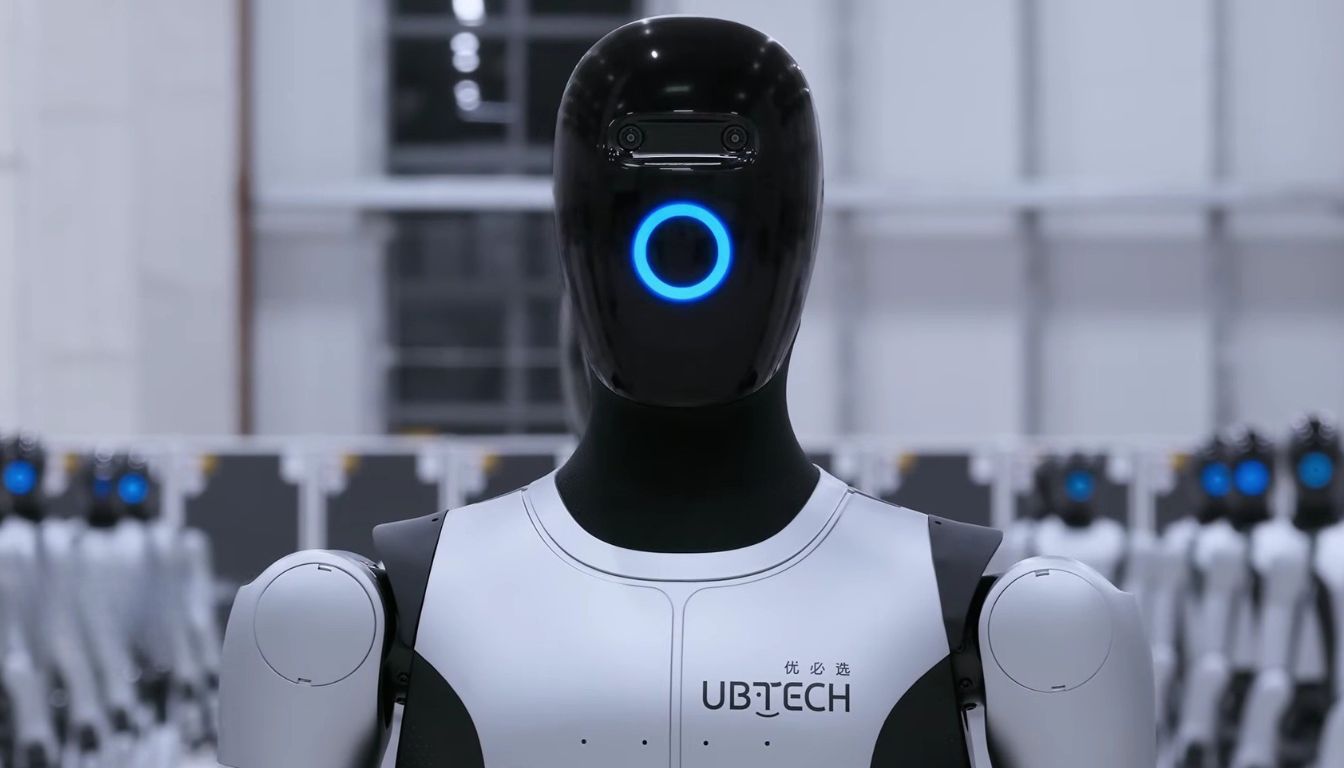
On a polished factory floor somewhere in southern China, a UBTech humanoid robot stares back at you with a glowing blue ring where its face should be. Behind it, a small army of identical machines stands in formation, like an iPhone launch line for people who can deadlift pallets.
If you squint, this is the future that robotics companies have been promising for decades: upright, human sized robots strolling through warehouses and factories, doing the dull, dirty jobs people do not want. If you stop squinting and look at the fine print, you will see the real question:
Are UBTech humanoid robots actually the next platform for work, or just another very expensive demo reel?
Why Everyone Suddenly Cares About Humanoid Robots
Humanoid robots have been around in labs for years. Most of them were either clumsy, falling down stairs on YouTube, or wildly over engineered research pets that cost more than a house.
So why are UBTech humanoid robots and their competitors suddenly showing up in earnings calls and investor decks?
Because the math on labor is breaking.
- Aging populations are shrinking workforces in countries that do a lot of manufacturing.
- Warehouses cannot hire or retain enough people to move boxes for $17 an hour in 100 degree summers.
- Companies have already squeezed most of the easy gains out of conveyor belts and industrial arms.
The pitch from UBTech and others is straightforward: instead of redesigning your entire building for robots, send in robots that can use the buildings you already have. Humanoid robots, the logic goes, are plug and play automation for a world built around human bodies.
The form factor, two legs, two arms, human like reach, is not about cuteness. It is about compatibility.
Inside a UBTech Humanoid Robot (And What Is Still Missing)
Strip away the sci fi shell and a UBTech humanoid robot is a carefully balanced stack of actuators, sensors, and AI running very close to the limits of what current hardware can do.
- Mobility: Multi joint legs keep the robot upright on smooth floors, ramps, and the occasional threshold. Walking looks good on video. In practice, it is a constant negotiation with physics. Any mis step can mean an expensive fall.
- Manipulation: The arms can pick up boxes, operate simple controls, move totes from point A to point B. Delicate manipulation, the kind humans do absent mindedly all day, is still an unsolved problem across the industry.
- Perception: Cameras and depth sensors give UBTech humanoid robots a three dimensional view of their surroundings. Computer vision tells boxes from people, pallets from pillars. It works until it does not. Dust, glare, or unexpected clutter still confuse even the best models.
- Brains: Task planning AI turns “move that stack of cartons” into hundreds of micro decisions: where to walk, how to grip, how not to clip a conveyor. The robot does not understand the warehouse. It executes a controlled improvisation constrained by safety rules and probability.
UBTech’s glossy videos suggest a general purpose worker. The reality, for now, is narrower. These robots are good at repetitive physical tasks in reasonably controlled environments, with a lot of engineering support behind the scenes.
If that feels underwhelming, remember that this is exactly how early industrial robots started. They looked unimpressive until one day they quietly ran three shifts without calling in sick.
From Demo to Deployment: Where UBTech Humanoid Robots Actually Fit
Ignore the sizzle reels for a moment. Where can UBTech humanoid robots plausibly earn their keep today?
1. The Boring Middle of the Factory
Robots do not need bathroom breaks or ergonomic accommodations. Plant managers know exactly which stations chew through temp workers: lifting heavy parts, shuttling bins, tending machines that require standing in one spot for hours.
Those are prime targets for UBTech humanoid robots. They can:
- Load and unload CNC machines or test rigs
- Move components between workstations
- Handle ergonomically bad motions such as overhead reaching, twisting, and repetitive bending
This is not glamorous, but it is where the return on investment case starts to look real. If a robot can reliably do the job of a hard to fill role on three shifts, the spreadsheet does not care that it sometimes walks a little awkwardly.
2. Logistics and E Commerce
Warehouses are chaos with barcodes. Humans constantly adapt to slightly wrong inventory locations, mislabeled boxes, and surprise obstacles. Traditional automation hates that.
Here, UBTech humanoid robots can act as a strange blend of autonomous forklift and human picker:
- Carry boxes between shelves and packing stations
- Restack pallets, sort parcels, move items off a backed up conveyor
- Work in “brownfield” facilities that were not built around automated storage systems
They are not going to replace Amazon’s robotics fleet tomorrow, but they can nibble around the edges of tasks that are too unstructured for existing bots and too miserable for humans.
3. Human Shaped Sensor Platforms
There is another, quieter use: inspection and patrolling.
A UBTech humanoid robot can be told to walk a route, read gauges, listen for abnormal noises, or point a thermal camera at pipes. It does not get bored on the five hundredth lap around the plant. Over time, models can learn what “normal” looks like and flag deviations.
Is this glamorous? No. Is it valuable? If one robot catches a compressor about to fail or a leak before it turns into a shutdown, absolutely.
Workers, Meet Your Robot Colleague
Companies love to describe robots as collaborative. Workers often hear replaceable.
The way UBTech humanoid robots are marketed tries to walk that line. They will augment people, take over dangerous, dull, and dirty tasks, and free humans for higher value work. That pitch ignores a simple truth: if a robot does a job alone, the job is automated. Full stop.
The more honest version is this:
- Some roles will shrink or disappear.
- New roles will appear, robot technicians, maintenance specialists, process designers, data analysts.
- The transition will be messy and uneven.
If the rollout is done well, workers should be moved up the value chain, with fewer hours pushing carts and more time supervising flows and handling exceptions. If it is done badly, you get a handful of highly paid automation specialists and a lot of displaced people wondering why a glowing ring mannequin took their shift.
Unions and regulators are already circling this space. As UBTech humanoid robots move from pilot projects into real operations, expect sharper questions about safety standards, job protections, and what happens when a 70 kilogram robot and a human collide.
The Economics: Can UBTech Humanoid Robots Ever Be Cheap Enough?
For all the talk of the future of work, this comes down to numbers.
To make sense, a humanoid robot has to undercut, or dramatically outperform, the fully loaded cost of a human worker over time. That includes:
- Purchase price of the robot
- Maintenance, spare parts, and downtime
- Software licenses and integration
- The engineering effort required to set up and update tasks
UBTech, like its rivals, is betting that economies of scale and better hardware will push costs down fast enough to clear that bar. That is a big bet.
Historically, many robotics startups have died on this hill. The demo worked, the pilot impressed, and the unit economics quietly killed the rollout. The danger for UBTech is to become the Segway of industrial automation, technically clever, visually iconic, and economically marginal.
The flip side is brutal but simple. If they do get the numbers right, the adoption curve could look very much like early industrial arms or early personal computers. First the skeptics scoff, then one day you look around and every mid sized plant has three of the machines.
The Hype Cycle, Again
Right now, UBTech humanoid robots live in the uncomfortable space between science experiment and boring infrastructure.
- On one side, highly produced launch videos promising the future of intelligent robotics.
- On the other, the actual deployments, guarded pilots, constrained tasks, and a lot of engineers lurking off camera.
If you have watched Silicon Valley for more than five minutes, you know this pattern. Autonomous cars, delivery drones, crypto, there is always a phase where the marketing runs years ahead of what the technology can reliably do.
The interesting question with UBTech is not whether the hype is ahead of reality. It is. The question is by how much, and whether the underlying trajectory is steep enough to matter.
Unlike a lot of vaporware, humanoid robotics is built on decades of hard earned progress: better motors, cheaper sensors, stronger batteries, smarter AI. Every time a robot falls less often, lifts slightly more, or fails a task more gracefully, the economics move a little closer to viability.
So, What Are UBTech Humanoid Robots Really?
Reduce the buzzwords and you get something like this:
UBTech humanoid robots are early, imperfect attempts to put a pair of strong legs and capable hands on top of modern AI, then let that package loose in real workplaces.
They are not general intelligences. They are not about to take every job. They are also not toys.
In their current form, they are best understood as:
- High end tools for specific kinds of physical work that people are increasingly unwilling or unable to do
- Mobile sensor platforms that can go wherever people go, without forcing you to redesign the building
- A bet on the future that once the hardware is cheap and reliable enough, software updates will keep making them useful in new ways
If you are a factory manager or logistics operator, the right stance is neither panic nor dismissal. It is simple: watch the pilots closely, understand the failure modes, and be brutally honest about where a humanoid robot actually beats a human or a simpler machine.
Because if UBTech can push these blue ringed mannequins over the line from impressive prototype to boring necessity, the future of work will not arrive with a sci fi boom. It will arrive the way most revolutions in automation do.
Quietly, on the night shift, when a robot finishes its run and the supervisor realizes nobody had to call in a temp.
For a deeper look at how close AI is to human‑level reasoning, see our analysis of AI and human‑level intelligence.