Table of Contents
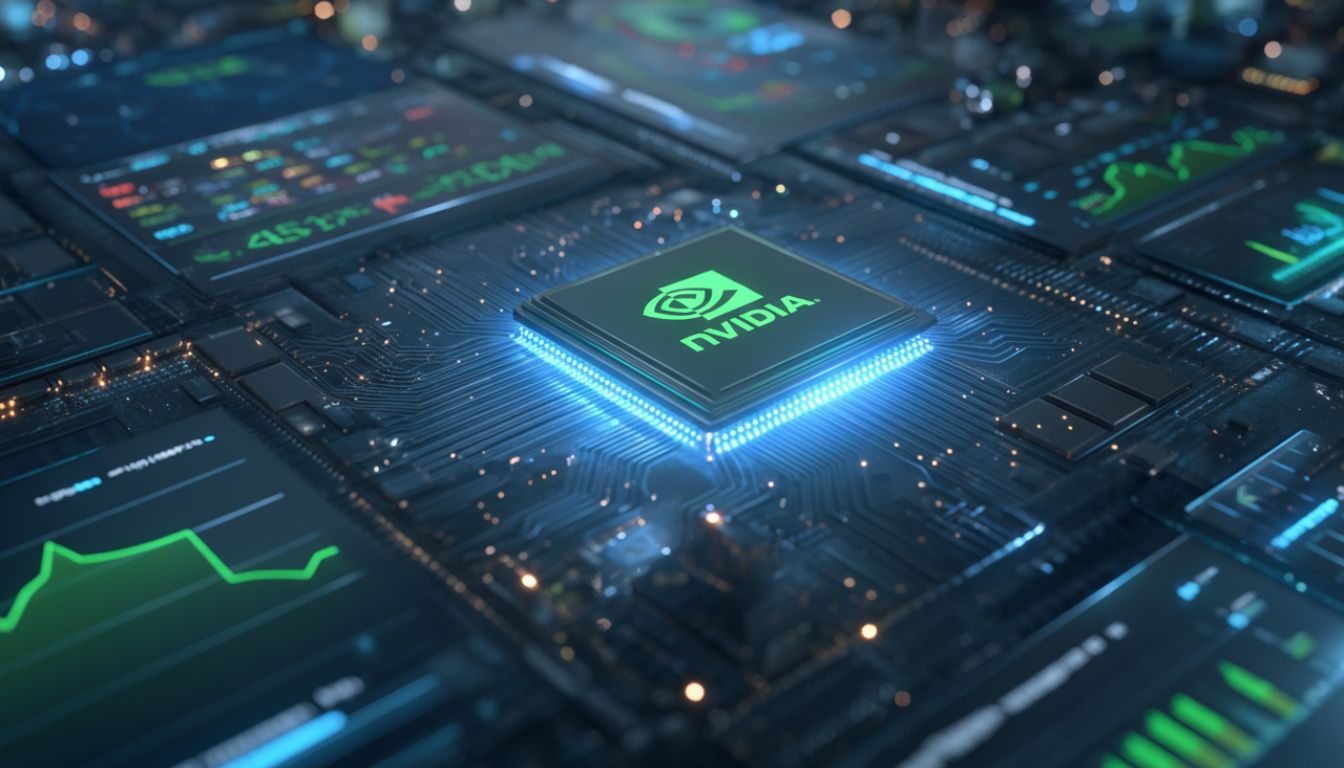
Nvidia crossed the $5 trillion market capitalization threshold this week, a milestone that cements its position as the world’s most valuable company and underscores how deeply artificial intelligence has reshaped corporate America’s power structure. The Nvidia market cap achievement represents more than just another record for a tech stock. It signals a fundamental rewiring of where investors believe value will be created over the next decade.
Nvidia Market Cap Surge Reflects AI Infrastructure Race
The $5 trillion Nvidia market cap achievement didn’t happen in isolation. It arrived amid a broader frenzy among hyperscalers and enterprise customers scrambling to secure access to the company’s GPU architecture. Microsoft, Amazon, Google, and Meta have collectively committed hundreds of billions toward AI infrastructure buildouts, and nearly all roads lead back to Santa Clara. Jensen Huang’s company now commands roughly 80% of the data center GPU market, a position that would make Standard Oil blush.
This dominance creates uncomfortable questions about market concentration. When a single vendor controls the computational backbone of the AI economy, price discovery becomes less about competitive dynamics and more about existential necessity. Companies don’t shop around for Nvidia alternatives the way they might compare cloud providers. They queue up, checkbooks ready, hoping to avoid being left behind in what increasingly resembles an arms race with silicon instead of warheads.
The comparison to historical monopolies isn’t hyperbolic. During the mainframe era, IBM wielded similar power over corporate computing infrastructure. That dominance eventually attracted regulatory scrutiny and forced architectural shifts. Whether Nvidia faces similar pressures remains an open question, though antitrust enforcers in Washington and Brussels have begun circling. The difference this time: the technology moves faster than regulatory frameworks can adapt.
How Nvidia’s Blackwell Chip Powers the Next AI Wave
Nvidia’s latest earnings report revealed that demand for its Blackwell AI chip architecture has created supply constraints that will persist well into 2025. The Blackwell platform promises significant performance improvements over its predecessor, Hopper, particularly for training large language models and running inference workloads at scale. But the chip’s technical specifications matter less than what they enable: a new generation of AI applications that require exponentially more computational horsepower.
Training GPT-4 required an estimated 25,000 Nvidia A100 GPUs running for months. The next generation of multimodal models, capable of processing video, audio, and real-time interaction, will demand far more. Blackwell’s architecture addresses these requirements with higher memory bandwidth and more efficient interconnects between chips. According to Reuters reporting on Nvidia’s supply chain challenges, production bottlenecks at Taiwan Semiconductor Manufacturing Company have created delivery timelines stretching beyond six months for some configurations.
This supply-demand imbalance drives Nvidia’s pricing power and, by extension, its market valuation. When customers face a binary choice between waiting for Nvidia hardware or abandoning AI initiatives entirely, bargaining leverage disappears. The company can maintain premium pricing because alternatives remain years behind in both performance and ecosystem maturity. AMD and Intel have announced competing products, but software developers have spent years optimizing for CUDA, Nvidia’s parallel computing platform. Switching costs are measured in engineering time, not just hardware expenses.
The Democratic Implications of Concentrated AI Infrastructure
Beyond Silicon Valley, the Nvidia market cap milestone carries implications for democratic institutions and global power dynamics. Artificial intelligence increasingly shapes information flows, economic opportunities, and national security capabilities. When access to foundational AI infrastructure concentrates in the hands of a few American technology companies, it creates dependencies that extend far beyond commercial relationships.
European governments have recognized this vulnerability. The European Union’s AI Act attempts to establish regulatory frameworks that preserve competition and prevent monopolistic control over critical infrastructure. Meanwhile, China has invested billions in domestic semiconductor manufacturing, explicitly aiming to reduce reliance on Western suppliers. These efforts reflect a growing understanding that AI infrastructure represents a new form of strategic resource, comparable to energy or telecommunications networks in previous eras.
The concentration also affects smaller players and emerging markets. Startups building AI applications face GPU costs that consume the majority of their funding. Researchers at universities outside elite institutions struggle to access sufficient computational resources for cutting-edge work. This creates a two-tiered system where innovation becomes increasingly capital-intensive and exclusive, raising questions about who gets to shape AI’s trajectory and whose values get encoded into these systems.
What $5 Trillion Nvidia Market Cap Means for Tech Valuations
From a pure market mechanics perspective, the Nvidia market cap valuation requires believing in sustained hypergrowth across multiple product cycles. The company trades at roughly 35 times forward earnings, a premium justified only if AI demand continues accelerating without meaningful competition emerging. History suggests caution. Cisco commanded similar dominance during the dot-com boom, selling networking equipment essential for internet infrastructure. Its stock price never recovered after the crash, even as internet traffic grew exponentially.
The counterargument: AI represents a more fundamental shift than the initial internet buildout. Every enterprise will require AI capabilities, not just technology companies. Every application will eventually incorporate intelligent features. If that thesis proves correct, today’s infrastructure spending represents the early innings of a multi-decade transformation. Nvidia would capture value across that entire period, justifying current multiples.
But valuations this extreme require everything to go right. Product cycles must execute flawlessly. Competitors must fail to close the gap. Regulatory challenges must remain manageable. Customer spending must continue growing despite economic headwinds. Any deviation from this optimistic scenario could trigger violent repricing, particularly given how much institutional capital has piled into Nvidia shares as a pure-play AI proxy.
The Road Ahead for Nvidia and AI Economics
Nvidia’s journey to a $5 trillion market cap reflects both genuine technological achievement and the market’s tendency toward momentum-driven excess. The company has executed brilliantly, making early architectural bets that positioned it perfectly for the AI explosion. Jensen Huang deserves credit for vision and discipline in building a platform rather than just selling chips.
Yet the same forces that propelled Nvidia to these heights create fragility. Markets that price in perfection leave little room for stumbles. Competitors motivated by existential necessity will eventually close performance gaps. Customers uncomfortable with dependence on a single supplier will fund alternatives, even at a premium. Regulators worried about market concentration will scrutinize business practices.
The AI boom is real, and Nvidia sits at its center. But a $5 trillion valuation assumes that advantage persists indefinitely, that competition remains perpetually behind, and that customers accept whatever terms Nvidia sets. History suggests humility about such assumptions. The companies that dominate one technological era rarely maintain that position through the next. Whether Nvidia proves the exception will determine if today’s Nvidia market cap represents foresight or just another chapter in the recurring story of irrational exuberance dressed up in new technology.