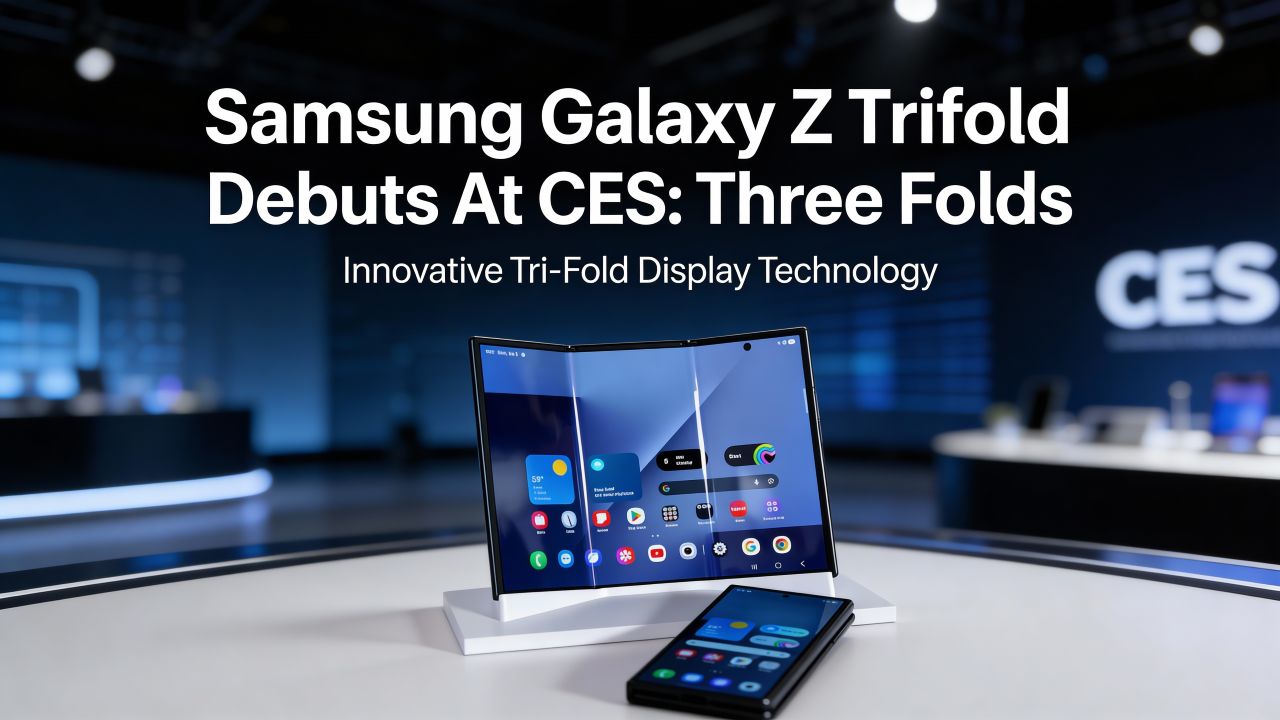
Samsung’s grand CES 2026 reveal wasn’t a television. It wasn’t a washing machine with an AI chip. It was a phone that folds twice, costs nearly $2,500, and has already sold out in South Korea before most Americans even knew it existed.
The Galaxy Z TriFold made its U.S. debut in Las Vegas this week, offering the press its first extended look at Samsung’s most ambitious mobile hardware bet yet. After years of incremental improvements to the standard Galaxy Fold format, Samsung is betting that more folds equals more sales in a premium smartphone market desperate for reasons to upgrade.
A Tablet That Actually Fits In Your Pocket
The pitch is straightforward: unfold the Z TriFold completely, and you get a 10-inch AMOLED display. That’s larger than an iPad Mini. When folded, a 6.5-inch cover screen handles basic smartphone duties, and the entire package compresses to roughly the dimensions of a thick wallet.
Samsung’s dual-hinge Armor FlexHinge mechanism makes this possible, allowing the device to bend at two points rather than one. Early hands-on impressions suggest the crease lines remain visible but less intrusive than previous generations. The hinge feels more substantial than competitors’ attempts at multi-fold designs, though that engineering comes at a cost: the TriFold weighs 10.9 ounces and measures 12.9mm thick when folded. For comparison, the Galaxy Z Fold 7 comes in at 7.58 ounces and 8.9mm.
Flagship Specs Without Compromise
Samsung didn’t cut corners on components. The Z TriFold runs Qualcomm’s Snapdragon 8 Elite, the same silicon powering every flagship Android phone worth mentioning this year. A 200-megapixel camera system reportedly matches the Galaxy S25 Ultra’s imaging capabilities, addressing the historical weakness of foldables: cameras that couldn’t keep up with their flat-screen siblings.
Battery capacity jumps to 5,600mAh to power that expansive screen real estate, with 45W wired charging helping offset the inevitable drain of pushing pixels across a display this size. Samsung DeX runs natively on the device, transforming the unfolded TriFold into something approaching a portable workstation when connected to a monitor and peripherals.
The $2,500 Question
Pricing starts around $2,500 for U.S. buyers when the TriFold launches in Q1 2026. That’s a significant premium over the Z Fold 7’s roughly $1,800 starting price and places the TriFold firmly in “luxury purchase” territory alongside Hermès watches and designer handbags.
Samsung is betting that productivity-focused buyers will pay for true three-app multitasking on a screen large enough to make it useful. The foldable market has proven buyers exist who prioritize screen real estate over traditional smartphone conventions. The question is whether that audience extends to devices approaching $3,000 all-in with accessories and taxes.
Sold Out Before America Showed Up
Samsung soft-launched the TriFold in South Korea in December 2025, where it promptly sold out. That limited rollout suggests either constrained manufacturing capacity, genuine blockbuster demand, or both. Korean tech enthusiasts have historically served as bellwethers for ambitious Samsung hardware, embracing foldables and Galaxy Notes while U.S. consumers remained skeptical.
The sellout provides Samsung’s marketing team with a convenient talking point, but it raises questions about supply chain readiness. Manufacturing devices with two precision hinges presumably demands tolerances that single-fold devices don’t require. Whether Samsung can produce TriFolds at scale remains unclear.
What’s Actually New Here
Tri-fold phones aren’t entirely novel. Huawei unveiled its own version in 2024, though U.S. sanctions kept it out of American hands. What Samsung brings is manufacturing scale, brand recognition, and carrier partnerships that Chinese competitors can’t match in Western markets.
The software experience matters more than it might seem. Samsung has spent years optimizing One UI for foldable workflows, and the TriFold benefits from that accumulated knowledge. Apps actually know how to behave when the screen configuration changes. Multitasking features developed for two-panel displays extend naturally to three. The polish suggests Samsung understood this launch needed more than impressive hardware to succeed.
The Business Case
Samsung’s smartphone division needs wins. The broader smartphone market has plateaued, with upgrade cycles stretching longer as consumers struggle to justify replacing phones that work perfectly well. Ultra-premium devices like the TriFold target buyers who always want the newest thing, regardless of whether their current phone needs replacing.
More cynically, devices like the TriFold generate buzz that benefits Samsung’s entire lineup. Every headline about the fancy folding phone reminds consumers that Samsung makes phones at all. In a market where Apple dominates mindshare and Chinese manufacturers dominate value, Samsung is carving out territory as the company willing to take hardware risks.
The Galaxy Z TriFold arrives in U.S. stores during Q1 2026. Whether it remains perpetually sold out or eventually finds its way to carrier stores nationwide will tell us whether the tri-fold future Samsung envisions is coming for everyone or just the few thousand early adopters willing to pay for it.