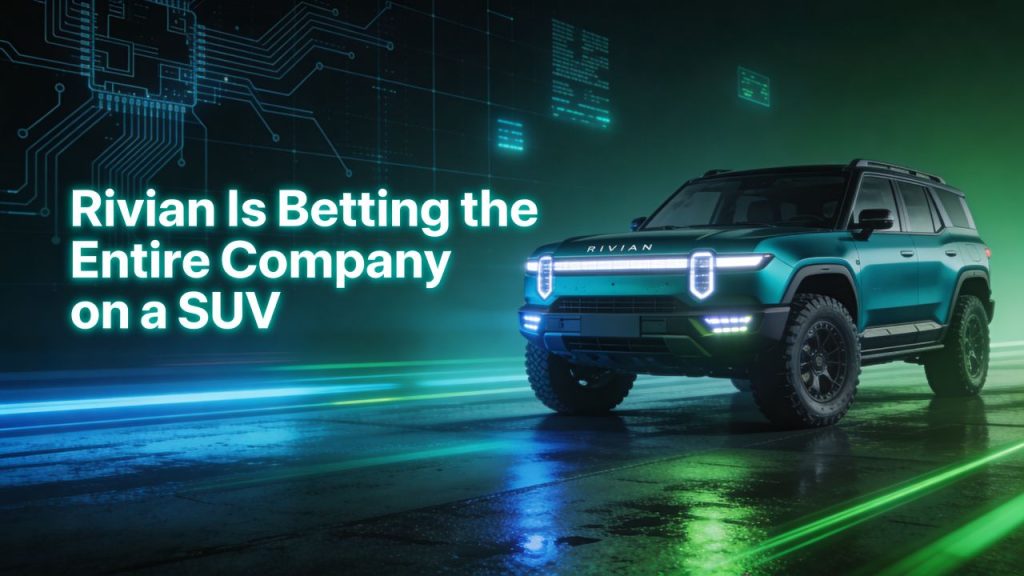
Rivian has a simple pitch for 2026: buy the cheaper truck, save the company.
The R2, a compact five-seat SUV starting at $45,000, is scheduled to reach reservation holders by June. It is, without exaggeration, the single most consequential vehicle launch in the EV industry this year. Not because it reinvents the wheel. Because if it flops, Rivian is running out of runway.
The math is brutal and clarifying. Rivian burned through $3 billion in the first three quarters of 2025. It has roughly $7 billion in cash. Analysts expect it to burn $5 billion more in 2026. That’s not a business model. That’s a countdown clock.
The R1 Problem Nobody Talks About
Here’s what CEO RJ Scaringe won’t say outright: the R1 was always a proof of concept disguised as a product line. At nearly $80,000 for the R1S, Rivian built gorgeous, capable trucks that won every consumer satisfaction survey and sold to exactly the kind of buyer who already owns a Tesla and a Patagonia vest. The R1S is the best-selling premium electric SUV in the United States. It’s also a niche product in a niche segment, and Rivian delivered just 42,247 vehicles in all of 2025, an 18% decline from the prior year.
You cannot build a car company on 42,000 trucks a year. Tesla figured this out a decade ago when it pivoted from the Roadster to the Model 3. Rivian is now attempting the same playbook, just with less margin for error and a hostile policy environment that’s stripped away EV tax credits and layered on tariffs.
What Rivian Actually Built
CNBC got an early test ride of the R2 near Rivian’s Palo Alto office, and the reports are encouraging if not exactly surprising. The vehicle looks like a shrunken R1S: same signature oval headlights, same flat roofline that gives a 6-foot-1 passenger rear-seat headroom, same adventure-ready DNA. Five seats instead of seven. More than 300 miles of range on the base battery. Single, dual, and tri-motor configurations, with the top spec allegedly hitting 60 mph in under three seconds.
The engineering story is more interesting than the spec sheet. Rivian reduced the computing units in the R2 to seven, the same number as its second-generation R1, but slashed two miles of wiring from the vehicle. That’s not a rounding error. That’s a fundamental rethinking of how a car gets built, and it translates directly into lower material costs and faster assembly times. “It’s a dramatic reduction in the cost structure to build it,” Scaringe told CNBC.
The company claims the R2 will cost less than half as much to manufacture as its first-generation vehicles. If that holds, Rivian might actually make money selling cars. Eventually.
The Factory Gamble
Rivian originally planned to build the R2 at a $5 billion factory in Georgia. That plant is still in early development, with serious construction expected later this year. Instead, the company pivoted and built a 2.6-million-square-foot expansion at its existing Normal, Illinois facility, rated for 215,000 vehicles per year, with 155,000 of those earmarked for R2 production.
Validation build units have already started rolling off the line. The production line is up and running, at least for testing purposes, and Rivian recently posted video on X showing the R2 assembly process. The company has also hired a Mercedes-Benz veteran, Michael Schwaeble, as Vice President of Logistics, a signal that the supply chain buildout is being taken seriously.
Analysts expect Rivian to deliver roughly 66,000 total EVs in 2026. Needham analyst Chris Pierce thinks the consensus estimate of about 15,000 R2 units this year is too conservative. He points to something that should make Wall Street pay attention: Rivian ranks first in Consumer Reports‘ owner satisfaction survey. People who own Rivians love them and tell their friends. That kind of organic advocacy is worth more than any marketing budget.
The Volkswagen Lifeline
Rivian’s $5.8 billion joint venture with Volkswagen is the financial backstop keeping this entire operation alive. VW is licensing Rivian’s “zonal” electrical architecture, the same technology platform that powers the R2, for use across Volkswagen, Audi, and Porsche vehicles globally. The deal has already delivered $1 billion in cash, with another $2 billion expected in 2026 and milestone payments continuing through 2028.
Think about the irony for a moment. One of the world’s largest automakers, a company that builds 9 million vehicles a year, decided that a startup in Illinois had better EV software than anything Volkswagen could develop internally. That’s either a devastating indictment of legacy auto’s technology capabilities or a remarkable validation of what Scaringe’s engineering team built. Probably both.
The VW money, combined with a $6.6 billion Department of Energy loan for the Georgia plant, gives Rivian a financial cushion that most EV startups would kill for. But cushions compress. If the R2 doesn’t generate meaningful revenue by late 2026, even $7 billion in cash won’t save Rivian from a reckoning.
The Competition Has Not Been Sleeping
At $45,000, the R2 lands squarely in Tesla Model Y territory. Tesla still controls about 43% of the U.S. EV market. The Model Y starts at roughly $51,000, but Elon Musk has demonstrated a willingness to slash prices when threatened. Ford’s Mustang Mach-E occupies similar ground. Hyundai and Kia’s EV lineups keep getting better and cheaper. GM is finally getting serious about affordable electrics. And VW-backed Scout Motors is building a factory in South Carolina that could have vehicles on the road before Rivian’s R2 hits full production stride.
The window for a $45,000 adventure-ready electric SUV with 300 miles of range is real, but it’s not infinite. Every quarter of delay, every production hiccup, gives the competition more time to close the gap.
The Stock Tells the Story
Rivian went public in November 2021 at a valuation that briefly exceeded Ford’s. The stock touched $180. Today it trades around $14.50, down roughly 87% from its all-time high. The market cap sits near $18 billion, a fraction of what investors believed this company was worth when it was shipping its first trucks.
Wall Street is split. The consensus rating is Hold, with an average price target of about $17. Wedbush and Baird see upside at $25. Wolfe Research downgraded to Underweight, citing cash burn and near-term demand concerns. UBS slapped a Sell rating on the stock. The next earnings report drops February 12, and it will be the last set of numbers before R2 deliveries start in earnest.
Revenue is expected to roughly double from $4.8 billion in 2025 to $9.6 billion if R2 production scales as planned. Rivian isn’t expected to break even until 2030. That’s a long time to ask investors to be patient.
May the Fourth Be With Them
In a move that’s either brilliant marketing or peak startup desperation, Rivian has leaned into a Star Wars theme for the R2 launch. At its December 2025 Autonomy and AI Day, the company unveiled an R2 wrapped in R2-D2 livery. A recent Reddit post showed a convoy of R2s being filmed for marketing content, sporting different colored trunk lids that likely signal various trim levels. The speculation is that Rivian will officially launch on May 4th, because of course they will.
It’s cute. It’ll generate social media buzz. But the only thing that actually matters is whether the R2 rolls off the line on time, at cost, and in sufficient volume to change Rivian’s financial trajectory from “burning cash” to “building a car company.”
The Bottom Line
Rivian has done nearly everything right from an engineering and product standpoint. The R1 line proved the company could build genuinely excellent vehicles. The VW deal proved the technology has value beyond Rivian’s own products. The R2’s simplified architecture and lower production costs prove the team understands the economics of scale.
What Rivian hasn’t proven is that it can sell enough cars to survive. That question gets answered this year, starting in June, one R2 at a time. For investors, this is as close to a binary outcome as public markets offer: the R2 works and Rivian becomes a real automaker, or it doesn’t and the cash runs out. There is no middle ground.
Rivian reports fourth-quarter 2025 earnings on February 12. The R2 is expected to begin deliveries in June 2026. RIVN shares trade on the Nasdaq.
