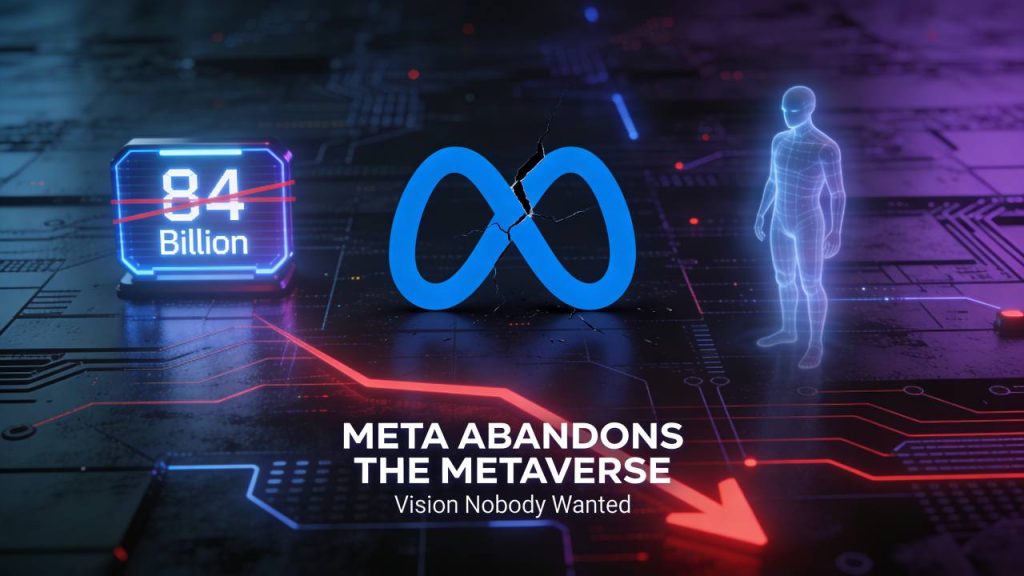
Mark Zuckerberg bet his company’s name, his reputation, and roughly $84 billion of shareholder money on the idea that the future of human connection would happen through cartoon avatars in a virtual world. On Tuesday, Meta officially pulled the plug on that vision.
The company announced that Horizon Worlds will be shut down on VR headsets by June 15, 2026, with the app disappearing from the Quest Store by the end of March. The platform that was supposed to be the metaverse’s beating heart will survive only as a mobile app, which is corporate speak for hospice care.
Let that sink in. In October 2021, Zuckerberg was so confident in the metaverse that he renamed Facebook entirely. He told the world this 3D digital frontier would reach a billion people and host hundreds of billions of dollars in commerce by 2030. Four and a half years later, Horizon Worlds never managed to attract more than a few hundred thousand monthly active users. Not a billion. Not a million. A few hundred thousand, on a platform built by a company with 3.3 billion monthly users across its family of apps.
The $84 Billion Receipt
Reality Labs, the Meta division responsible for VR, AR, and metaverse development, has now accumulated approximately $83.55 billion in operating losses since 2020. The trajectory tells the story of a bet that got more expensive every single year without delivering proportional results: $6.6 billion in 2020, $10.2 billion in 2021, $13.7 billion in 2022, $16.1 billion in 2023, $17.7 billion in 2024, and $19.2 billion in 2025.
For context, $84 billion is roughly the entire market capitalization of companies like Uber or Salesforce. Meta spent that building a product that couldn’t compete with Roblox for teenage attention.
The Q4 2025 earnings painted the final, damning picture. Reality Labs posted a $6.02 billion operating loss on just $955 million in revenue. That means the division’s revenue couldn’t even cover 16% of its operating costs. Analysts had expected a $5.67 billion loss. Reality Labs beat expectations by losing even more money than Wall Street thought possible.
What Actually Killed the Metaverse
The convenient narrative is that VR technology simply wasn’t ready. That’s partly true. But the bigger problem was strategic: Meta built a solution looking for a problem, then spent billions trying to convince people the problem existed.
Vasuman Moza, a former Reality Labs employee, offered a blistering insider account on social media this week. He described building a tool that game developers genuinely needed, only to watch it get shipped to another team and left to die while he was reassigned to a “higher-priority project that zero developers asked for.” His conclusion was devastating: multiply that dysfunction across every team and you understand how Meta spent $84 billion with almost nothing to show for it.
The management failures went deeper than one frustrated engineer. Meta’s CTO Andrew Bosworth recently admitted that VR adoption hadn’t grown as quickly as the company hoped. But “hadn’t grown as quickly” undersells the problem considerably. The general public looked at bulky headsets, legless avatars, and empty virtual conference rooms and collectively shrugged. Apple launched its Vision Pro to lukewarm reception. The entire VR market stalled.
Meanwhile, a leaked 2015 Zuckerberg email revealed what many suspected all along. The metaverse push was never really about creating a revolutionary platform for users. It was about escaping Apple and Google’s stranglehold on mobile. The metaverse was a defensive play dressed up as a visionary one.
The Pivot Nobody Will Call a Pivot
Meta is now doing what any rational company would do after lighting $84 billion on fire: pretending the fire was always part of the plan.
The company has pivoted aggressively toward artificial intelligence and wearable tech. Ray-Ban Meta smart glasses tripled their sales year over year, and Zuckerberg has been telling anyone who will listen that AI glasses are the future of computing. During Meta’s most recent earnings call, he said it was “hard to imagine a world in several years where most glasses that people wear aren’t AI glasses.”
That’s a far cry from the metaverse-or-bust rhetoric of 2021, but credit where it’s due: the smart glasses are actually selling. Millions of units worldwide, which is infinitely more traction than Horizon Worlds ever achieved.
The organizational signals are unmistakable. Vishal Shah, who led metaverse initiatives, was transferred to VP of AI products in Meta’s Superintelligence Labs. More than 1,000 Reality Labs employees were laid off in January 2026. VR game studios including Ouro Interactive were shuttered. The VR fitness app Supernatural, acquired in 2023, was put into “maintenance mode.” And reports from Reuters indicate Meta is planning workforce cuts that could affect 20% or more of its nearly 79,000 employees, driven by the need to fund a staggering $600 billion data center investment through 2028.
This isn’t a pivot. It’s an evacuation.
Wall Street Doesn’t Care About the Metaverse Anymore
Here’s the uncomfortable truth that makes this story so distinctly Silicon Valley: none of this matters to Meta’s stock price in any meaningful way. The company’s core advertising business continues to print money. Ad impressions grew 18% year over year in Q4. AI-driven improvements pushed ad pricing higher. WhatsApp’s paid messaging business crossed a $2 billion annual run rate.
Meta shares trade around $614 as of mid-March 2026, well below the all-time high near $796 from August 2025, but analysts maintain a consensus Buy rating with an average price target around $838. Investors have essentially priced in Reality Labs as a sunk cost and moved on to evaluating Meta’s AI capabilities.
Zuckerberg himself acknowledged during the Q4 earnings call that Reality Labs losses would likely peak in 2025 and begin declining. He framed it as disciplined capital allocation. Others might call it acknowledging a $84 billion mistake while your advertising machine generates enough cash to make the mistake survivable.
The Lesson Silicon Valley Won’t Learn
The metaverse failure is instructive, but probably not in the way the tech industry will internalize it. The lesson isn’t that VR is dead forever or that immersive computing has no future. The lesson is that no amount of capital can substitute for genuine consumer demand. Meta didn’t fail because it couldn’t build the technology. It failed because it built technology that solved a problem its customers didn’t have.
Zuckerberg spent $84 billion trying to will a market into existence. He laid off thousands, shuttered studios, burned through engineering talent, and still couldn’t convince more than a fraction of a percent of his own user base to strap on a headset and attend virtual meetings as a cartoon character.
The metaverse wasn’t killed by technical limitations. It was killed by a fundamental misread of what people actually want from their screens. And that $84 billion? Consider it the most expensive product-market fit lesson in the history of technology.
Horizon Worlds will limp along as a mobile app, competing with Roblox and Fortnite on a platform where it has zero competitive advantage. Meanwhile, the company that renamed itself after its grandest vision is now quietly hoping you’ll forget the whole thing and buy some AI glasses instead.
