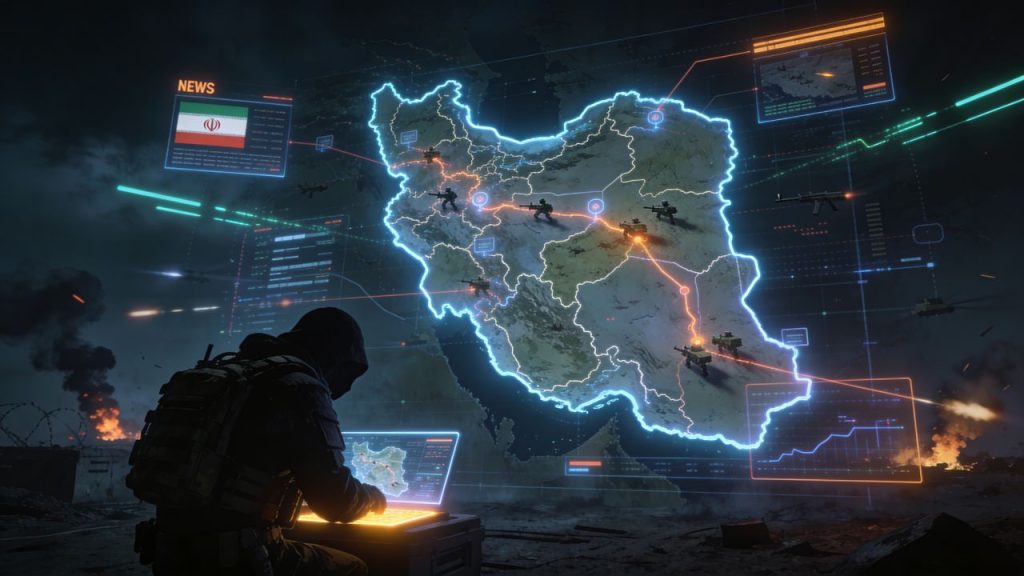
If you want to understand why oil prices have spiked more than 40%, why the Strait of Hormuz has become the most dangerous waterway on earth, and why global markets are in a state of sustained anxiety, the answer is not complicated. Nobody running this war can explain what it is supposed to accomplish.
Operation Epic Fury, the joint U.S.-Israeli military campaign against Iran now entering its third week, was launched without a formal authorization from Congress, without a televised address to the American people, and, most consequentially, without a coherent strategy. President Trump and his senior officials have offered at least six distinct justifications for the conflict since the first bombs fell on February 28, each one replacing or contradicting the last. The result is a war that feels less like a planned operation and more like improvisation at 30,000 feet.
A Menu Of Contradictions
The administration’s stated objectives have shifted with remarkable speed. On the night of the initial strikes that killed Supreme Leader Ayatollah Ali Khamenei, Trump described the operation as a defense against “imminent threats from the Iranian regime.” Within 48 hours, Defense Secretary Pete Hegseth was articulating three military goals: destroy the missile threat, destroy the navy, prevent nuclear weapons. Vice President JD Vance insisted on Fox News that the goal was ensuring Iran never pursues a nuclear weapon and promised it would not become a multi-year commitment. Secretary of State Marco Rubio introduced yet another justification, arguing the U.S. struck preemptively because Iran would have retaliated against American forces once Israel attacked independently.
The problem is that these rationales do not just differ in emphasis. They directly contradict each other. Pentagon briefers told congressional staff that Iran was not planning to strike U.S. forces unless Israel hit first, undermining the “imminent threat” claim. Trump then contradicted Rubio the following day, telling reporters he may have forced Israel’s hand. And despite Hegseth’s insistence that this is “not a regime-change war,” Trump has publicly discussed personally selecting Iran’s next leader and urged the Iranian people to “take over” their government.
NBC News compiled a detailed timeline of the administration’s evolving messaging and found the talking points are, in the outlet’s words, “a moving target.” Senator Mark Warner noted the goals have changed at least four or five times. The White House press secretary dismissed the confusion as a “fake narrative,” but a Reuters/Ipsos poll found that only 33% of Americans believe Trump has clearly explained the mission’s purpose.
The Intelligence Does Not Support The Urgency
The credibility gap between the White House’s public statements and the actual intelligence picture is perhaps the most troubling dimension of this conflict. Trump claimed at his State of the Union address that Iran was building missiles that would “soon reach the United States.” But an unclassified Defense Intelligence Agency assessment from 2025 estimated that Iran could develop a viable intercontinental ballistic missile by 2035 at the earliest, and only if it actively chose to pursue that path.
The nuclear threat was similarly overstated. The Pentagon’s own assessment indicated that strikes conducted last June had already set Iran’s nuclear program back by approximately two years. The framing of an existential, imminent danger requiring the largest American military campaign since Iraq in 2003 simply does not align with the intelligence community’s own conclusions.
When CNN asked Trump directly about how long the war would last, he said he did not want it to go on too long and “always thought it would be four weeks.” By this week, he was telling Axios it would end “soon” because there is “practically nothing left to target,” while simultaneously declining to name a date and watching Israeli officials describe an open-ended campaign with “no time limit.” His own envoy, Steve Witkoff, offered the most revealing assessment when CNBC asked how the war would end: he simply said he did not know.
The Constitutional Surrender
The war launched without a congressional Authorization for Use of Military Force. War powers resolutions introduced by Senators Tim Kaine and Rand Paul were defeated along largely party-line votes in both chambers during the first week of March. The Senate voted 47 to 53 against, followed by a 219 to 212 rejection in the House. Congressional Republicans largely deferred to the president, with Speaker Mike Johnson declining to call the conflict a war and Senator Tommy Tuberville describing it as a brief “conflict.”
The irony is considerable. This is an administration that rebranded the Pentagon as the “Department of War,” invoking the era when American military victories were clear and decisive. But when it comes to the constitutional procedures that accompany actual declarations of war, the administration and its congressional allies have avoided the word entirely.
The Public Is Skeptical And Growing More So
The polling data paints a consistent picture of a public that opposes the war and doubts it will make the country safer. A CNN survey found 59% disapproval for the strikes and 60% saying the president lacks a clear plan. Quinnipiac found 55% of voters did not believe Iran posed an imminent threat before the attacks. NPR/PBS/Marist showed 56% opposition with Trump’s Iran approval at 36%, his lowest approval on any foreign policy issue to date. NBC News found 54% disapproval of his handling of the situation.
The most significant finding, however, is not opposition itself but the reason behind it. Across nearly every major survey, Americans said they believe the war is making the United States less safe. Quinnipiac showed voters saying the conflict would weaken U.S. security by 47% to 34%. CNN found 54% expect Iran to become more of a threat because of the military action. Even the Washington Post, whose most recent poll showed the closest split on the war itself, found 53% of respondents saying the conflict “will not contribute to the long-term security of the United States.”
Support levels are notably lower than for any major U.S. military action in recent memory. In the early stages of the Afghanistan campaign in 2001, 87% of Americans supported President Bush’s approach. Even the Iraq War began with majority approval. Operation Epic Fury launched into majority opposition from its first weekend and has not recovered.
What Happens When The Bombing Stops
The question that matters most is the one the administration cannot answer. Senator Chris Murphy asked officials in a classified briefing what happens when the bombing ends and Iran restarts weapons production. The response, Murphy reported, was a vague suggestion of more bombing. That is not an endgame. That is an admission that no endgame exists.
The conditions that produce short, decisive conflicts are not present here. Iran continues to launch missiles and drones. Tehran’s Assembly of Experts has selected a new Supreme Leader. The Strait of Hormuz remains contested, with oil prices up over 40% and nations scrambling to release emergency reserves. Seven U.S. service members are dead and roughly 140 wounded.
Asked what the United States needs to do to end the war, Trump’s answer this week was: “More of the same.” That is not a strategy. It is the clearest possible signal that one does not exist. And for a nation now two weeks into a conflict with no defined objectives, no timeline, and no congressional authorization, that should alarm everyone, regardless of which side of the aisle they sit on.
