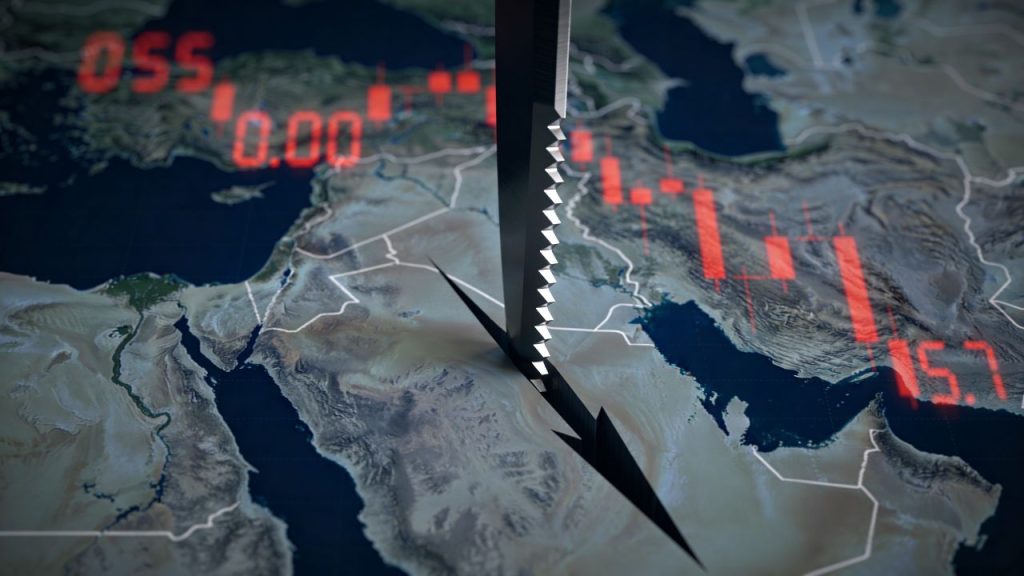
Wall Street is about to have the worst Monday morning in years, and everyone on trading desks already knows it.
The joint U.S.-Israeli military operation against Iran, launched Saturday and still ongoing, has done what months of tariff drama, the Venezuela incursion, and an increasingly chaotic policy environment couldn’t manage: genuinely terrify the financial world. When futures open at 6 p.m. ET tonight, expect a gap down that makes the June 2025 Iran scare look quaint.
Here’s why this time is different, and what every investor needs to understand right now.
The Strait Of Hormuz Is Effectively A War Zone
Forget the headlines about Khamenei’s death or Tehran’s retaliatory strikes. The single most important market story this weekend is three words: Strait of Hormuz.
Iran’s Revolutionary Guard has been broadcasting radio warnings to commercial vessels declaring that no ships are allowed to pass through the strait. While Tehran hasn’t formally confirmed a closure order, the effect is the same: oil companies and major trading firms have paused shipments of crude oil and fuel through the waterway. Ship tracking data shows virtually no tanker traffic near the strait as of Sunday afternoon.
This is the scenario energy markets have priced as “unlikely but catastrophic” for decades. The Strait of Hormuz handles roughly 20% of the world’s daily oil consumption, around 20 million barrels per day. About 31% of all seaborne crude flows transit through that narrow 21-mile channel. China, India, Japan, and South Korea collectively depend on it for 69% of their crude imports.
“A prolonged closure of the Strait of Hormuz is a guaranteed global recession,” said Bob McNally, president of Rapidan Energy Group and a former White House energy advisor. He predicted crude futures could jump $5 to $7 per barrel at the Sunday evening open if there’s no de-escalation, with a spike above $100 entirely plausible if disruption continues.
What The Numbers Are Telling Us Already
Traditional futures markets are closed until tonight, but the data that does exist paints a clear picture. On Hyperliquid, the crypto exchange that allows 24/7 trading, perpetual swap futures tied to oil jumped nearly 5% to $71.70 per barrel. Gold rose roughly 1.2% to around $5,334 per troy ounce. IG Group’s retail trading platform was pricing West Texas Intermediate as high as $75.33, a 12% gain from Friday’s close.
Last week, before a single missile was fired, the Dow dropped 1.3%, the S&P 500 fell 0.4%, and the Nasdaq slid nearly 1% on geopolitical anxiety alone. Brent crude settled at $72.48 on Friday, already up 19% year-to-date.
Bloomberg Intelligence analysts expect Brent to push toward $80 in the near term as a “widening escalation cycle” gets priced in. Alicia Garcia-Herrero, chief economist for Asia-Pacific at Natixis, anticipates a “rough and risk-off” Monday open with global equities potentially down 1% to 2% or more.
The safe-haven trade is already being assembled: U.S. Treasuries, gold (up 22% in 2026 already), the dollar, the Japanese yen, and the Swiss franc. Bitcoin, notably, is no longer part of that playbook. It fell 2% Saturday and has lost more than a quarter of its value in two months, settling around $66,325.
OPEC+ Scrambles, But The Math Doesn’t Work
In what may be the most consequential OPEC+ meeting in years, the group agreed Sunday to resume output increases, adding 206,000 barrels per day starting in April. The decision split the difference between the 137,000 bpd base case and the 411,000 to 548,000 bpd options floated as emergency measures.
Here’s the problem: 206,000 barrels per day is a rounding error compared to what’s at stake. If Hormuz traffic remains disrupted, the world loses access to roughly 15 million barrels per day of crude and 5.5 million barrels per day of refined products. OPEC+ has about 3.5 million bpd in spare capacity, almost all of it concentrated in Saudi Arabia and the UAE, both of which need the strait open to actually export those barrels.
Saudi Arabia had been quietly raising production and exports in recent weeks in preparation for exactly this scenario, Reuters reported. Smart planning. But if the waterway stays blocked, that oil has nowhere to go.
“This could present a scenario three times the severity of the Arab oil embargo and Iranian revolution in the 1970s,” warned Saul Kavonic, head of energy research at MST Marquee, “and drive oil prices into the triple digits.”
The Aviation Shutdown Nobody’s Talking About Enough
While everyone focuses on oil and equities, the aviation industry is experiencing its most severe disruption since the COVID-19 pandemic. More than 6,700 flights have been delayed and 1,900 cancelled globally as of Sunday morning, on top of thousands more from Saturday. At least eight countries have declared partial or full airspace closures.
The three major Gulf hub carriers, Emirates, Qatar Airways, and Etihad, typically handle about 90,000 passengers per day. All three have suspended operations. Dubai International Airport, one of the world’s busiest, was directly hit in Iran’s retaliatory strikes. So was Abu Dhabi’s Zayed International, where one person was killed and seven injured.
Airlines from every continent have pulled Middle East routes. Turkish Airlines suspended flights to ten nations. British Airways, Lufthansa, Air France, Delta, United, American, Air India, Cathay Pacific, Singapore Airlines, and dozens more have cancelled services through the weekend and in many cases into next week.
With Russian airspace still restricted from the Ukraine war, Europe-to-Asia flight corridors were already funneled through Middle Eastern routes. That fallback is now gone. Expect longer flight times, higher fuel costs, surging insurance premiums, and cascading schedule disruptions that will take weeks to untangle.
The Polymarket Signal Wall Street Should Be Watching
While traditional markets sat dark over the weekend, Polymarket became the de facto real-time pricing mechanism for geopolitical risk. Traders wagered over $529 million on strike-timing contracts alone, making it one of the largest markets in the platform’s history. A Khamenei-removal contract pulled $45 million in volume before resolving at 100%.
More concerning: blockchain analytics firm Bubblemaps identified six wallets that collectively netted $1.2 million by betting on a U.S. strike occurring on February 28, the exact day it happened. Most wallets were funded within 24 hours of the attack. That’s either extremely good analysis or something much worse, and it underscores just how much advance signaling this operation generated for those paying attention.
What Happens Next
The critical variable isn’t Tehran’s political future or the body count. It’s duration. David Roche of Quantum Strategy framed it clearly: if the conflict is short and contained, the oil spike and risk-off trade will be brief. If it becomes a three-to-five-week regime change operation, markets will react “rather badly” as investors price in wider conflict and prolonged energy disruption.
Vandana Hari, CEO of Vanda Insights, put it more bluntly: “At this point, it seems we are looking at a full-scale military conflict between the U.S. and Iran, which would be unprecedented and the trajectory impossible to assess.”
The Trump administration could tap the Strategic Petroleum Reserve if prices spike. A small fraction of Gulf crude could be rerouted through Saudi Arabia’s east-to-west pipeline or the UAE’s Fujairah bypass. But these are band-aids on what could become a severed artery for the global economy.
Charu Chanana, chief investment strategist at Saxo Bank, captured the real concern: “The market is not only pricing barrels but also pricing the cost of moving barrels. Even without a full shutdown, higher war-risk premiums, rerouting and insurance repricing can keep crude and freight costs elevated.”
Tonight’s futures open is just the beginning. The real question is whether this becomes a one-week volatility event or the start of something that rewrites the global economic outlook for 2026. Right now, the smart money is preparing for the latter.
