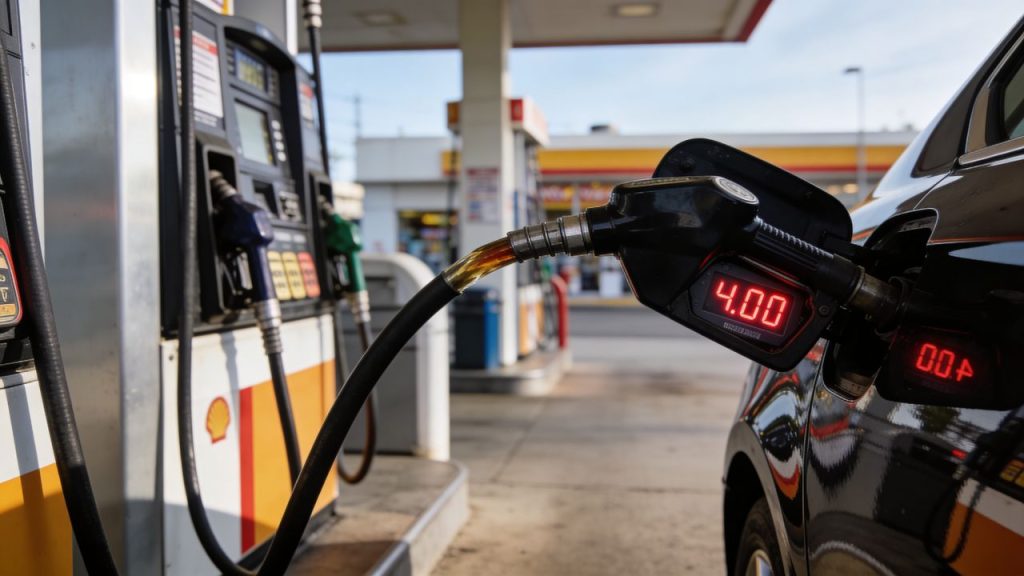
The number on the gas station sign that nobody wanted to see is finally here. The national average for a gallon of regular gasoline crossed $4.02 on Tuesday, according to AAA, the highest level since June 2022 and a grim milestone that arrives just as American household budgets were supposed to be stabilizing.
This is not a seasonal price bump. This is an oil shock, the kind that rewrites consumer behavior, corporate earnings forecasts, and Federal Reserve policy simultaneously. Gas prices have risen more than a dollar per gallon since the Iran war began on February 28, a pace of increase that exceeds even the early weeks of Russia’s 2022 invasion of Ukraine.
Brent Crude Just Posted Its Biggest Monthly Gain in History
The story at the pump starts with the story in the oil markets, and the numbers there are staggering. Brent crude futures surged approximately 55% in March, the largest monthly gain since the contract’s inception in 1988. That is not a typo. In nearly four decades of trading, Brent has never moved this fast in a single month.
The catalyst is the ongoing closure of the Strait of Hormuz, the narrow waterway through which roughly 20% of the world’s traded oil normally flows. The International Energy Agency has called this the largest supply disruption in the history of the global oil market. When a fifth of the planet’s oil supply goes offline, the math at the gas station gets ugly fast.
Brent crude closed near $112.78 per barrel on Monday. West Texas Intermediate, the U.S. benchmark, settled above $100 for the first time since July 2022. Oil futures ticked higher again on Tuesday morning as traders digested a Wall Street Journal report suggesting Trump was willing to end the military campaign, though skepticism about a near-term resolution kept a floor under prices.
The $4 Threshold Is Where Consumer Behavior Shifts
Energy analysts have long identified the $4 mark as the psychological tipping point where American drivers start making different decisions. Below $4, most people grumble but keep driving. Above $4, they start canceling road trips, consolidating errands, showing up at dealerships asking about fuel efficiency, and cutting spending elsewhere to absorb the hit.
That behavioral shift is already underway. Gas prices are now higher than at any point during either of President Trump’s two terms in office, a politically uncomfortable milestone that arrives as midterm campaign season heats up. For a typical American household driving two cars, the increase translates to roughly $120 to $160 more per month at the pump compared to February. That is real money that comes directly out of discretionary spending.
But gasoline is only the most visible symptom. Diesel, the fuel that powers the trucks, trains, and ships that move everything Americans buy, is now averaging $5.45 per gallon nationally. That is up from approximately $3.76 before the war began. When diesel costs rise, the price of moving goods rises with it, and those costs get passed to consumers at the grocery store, the pharmacy, and the checkout page of every online retailer.
The Grocery Aisle Is Next
Food prices are particularly sensitive to energy costs because groceries need to be restocked frequently and travel through energy-intensive supply chains. Fresh produce, dairy, and meat all require refrigerated transport. Every mile those trucks travel at $5.45-per-gallon diesel adds cost that eventually shows up on the price tag.
Analysts at Goldman Sachs have estimated that a sustained $10-per-barrel increase in crude oil adds approximately 0.3 to 0.5 percentage points to food price inflation within three to six months. Oil is up roughly $40 per barrel since the conflict began. The arithmetic suggests grocery bills could rise materially by midsummer, compounding the pain consumers are already feeling at the pump.
Airlines are absorbing hits as well. Jet fuel prices are climbing faster than crude, squeezing margins at carriers that had finally returned to profitability after the pandemic years. Expect fare increases or reduced route capacity in the weeks ahead, particularly on fuel-intensive long-haul routes.
The $4 Milestone in Context
For perspective, gas prices remain below the June 2022 peak of roughly $5.01 per gallon, when the combination of post-COVID demand and the Russia-Ukraine war created a similar supply crunch. But the trajectory is different this time. In 2022, prices spiked and then declined as the global economy absorbed the shock and supply chains adjusted. This time, the underlying supply disruption is more severe. The IEA estimates that 4.5 to 5 million barrels per day have been lost due to the Iran conflict, a number that could double by mid-April if the Strait of Hormuz remains closed.
The Strategic Petroleum Reserve, which the government tapped aggressively in 2022, has already been drawn down significantly and offers less cushion this time around. OPEC+ has announced production increases, but those additional barrels are largely stranded without safe passage through the Strait.
What a WSJ Report About a Possible War Exit Means for Prices
Markets got a brief jolt of optimism on Tuesday morning after the Wall Street Journal reported that President Trump had signaled willingness to end the military campaign against Iran. S&P 500 futures advanced 0.8% on the news, and oil prices swung between gains and losses as traders tried to assess the credibility of the report.
But a willingness to negotiate is not a ceasefire, and a ceasefire is not a reopened Strait of Hormuz. Even in a best-case scenario where diplomatic talks produce a framework within the next week, energy analysts have warned that returning global oil supply chains to normal operation could take weeks to months. Tanker insurance needs to be reinstated. Shipping lanes need to be cleared. Refineries that have been shut down need time to restart safely.
In other words, even good news on the diplomatic front does not mean $2.99 gas is coming back anytime soon.
Who Gets Hurt the Most
The economic pain from $4 gas is not distributed evenly. Lower-income households, which spend a higher percentage of their income on transportation and food, absorb a proportionally larger hit. Rural Americans who drive longer distances and have fewer public transit options feel it more acutely than urban commuters. Small businesses, particularly those in logistics, delivery, and food service, face margin compression that large corporations can weather more easily.
The timing is particularly brutal. The Federal Reserve is already grappling with sticky inflation, and oil-driven price increases threaten to push the personal consumption expenditures price index to 3.5% year-over-year by April. That is well above the Fed’s 2% target and makes the path to rate cuts, which consumers and businesses desperately want, increasingly unlikely.
For now, the $4 number on the gas station sign is doing what it always does: forcing Americans to recalculate their budgets, rethink their driving habits, and wonder how long this will last. The honest answer is that nobody knows. It depends on a diplomatic process that has produced more threats than progress, a military conflict entering its fifth week, and an energy market that has never seen disruptions at this scale.
What is certain is that $4 gas is not the ceiling. It might just be the floor.
